

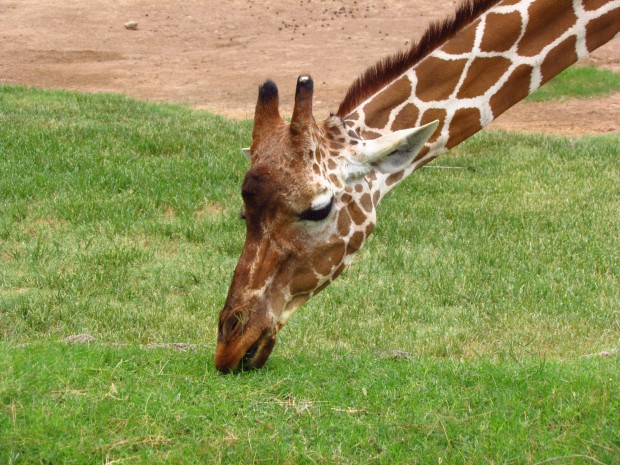
There were really two tragedies in last week's zoo disaster. There was the death of Watoto, and there was the shattering of one young man's dream to become a zookeeper.
One instant. One boneheaded decision. And now that dream is wiped away and out of reach.
"He was good," Vivian VanPeenen, the zoo's education coordinator, told me last week.
We were scooting around the zoo in a golf cart, as VanPeenen showed where the apprentice zookeeper picked up the browse, which is fed to giraffes, and then where he picked up the oleander, which shouldn't be fed to anything. We strained to peer through tinted windows to look at Denver, another giraffe who had eaten oleander, who had been placed under observation. Denver appeared to be standing tall in a stall, although at that time there was plenty of concern for her.
Denver is on the mend now, munching on carrots again. Doing whatever it is giraffes do.
People are also reading…
But I am still concerned about the apprentice, who has been described as passionate and professional as well as distraught and heartbroken. He resigned after Watoto's death. Reid Park Zoo officials have refused to release his name, saying he was employed by a nonprofit connected to the zoo.
No one had asked him to resign, although zoo officials may have following a full review.
"It's just very devastating for everyone," said Nancy Schlegel, the executive director for the Reid Park Zoological Society, which oversees the apprentice program. "He feels horrible."
The apprentice program is highly selective and demands sacrifice. There are only two apprenticeships in a given year, and those two apprentices work for close to minimum wage with the hope of getting enough experience to become a zookeeper somewhere and somehow.
The apprentice who fed the giraffes oleander was set to finish the program in September.
He was "passionate about animals, and professional in his behavior," Schlegel told me.
When I asked Schlegel if there was any way for the apprentice to ever return to the program, she said it was possible, but "that's not anticipated."
One bad decision. One shattered dream.
If there has been anything positive about this tragedy, it's how the zoo has handled it.
Reid Park Zoo officials have been upfront and honest about what has happened (other than not naming the apprentice), mixing concerned criticism with compassion. They have been stern about the decision to feed Watoto and Denver oleander, which all staff are trained to identify. But they have not sought to blame the apprentice.
"We let the giraffe down, and we let the apprentice down. It's been crushing," VanPeenen said. "He made that split-second decision. You pick up branches in the park, and if you are unsure, you don't pick anything up."
And slightly later in our conversation:
"It's not our goal to point fingers at (the apprentice) because clearly the process and all the regulations we had in place failed."
To that end, Reid Park Zoo staffers are reviewing protocols to ensure an accident like this never happens again. There is also talk about removing all of the oleander bushes from the zoo, although that's easier said than done. The area around the zoo's entrance is packed with oleander. Removing it will take considerable planning and resources.
What we know is last Monday afternoon a number of zookeepers picked up browse for the giraffes. The browse was left on a perimeter path, and the apprentice zookeeper was one of the last to pick up the cuttings. There wasn't much left, and when the apprentice was heading back he saw a pile of oleander. He stopped and picked some up, mixing it with the browse. One instant. You just can't get it back.
"We thought the process was foolproof," VanPeenen said.
The quick reaction to our latest tragedy is this apprentice should have known better. It's time for a new career choice. Fair enough, but we all have made terrible mistakes or poor split-second decisions. We all have acted on impulse even though we knew better. We all have made earnest mistakes.
This time, for this zookeeper, it just made the news in a big, sad way.
Forgiveness, compassion and second chances are beautiful things. So are dreams.
If there is a path that can bring this young man back to being a zookeeper, may he travel on it.
Contact columnist Josh Brodesky at 573-4242 or jbrodesky@azstarnet.com


