

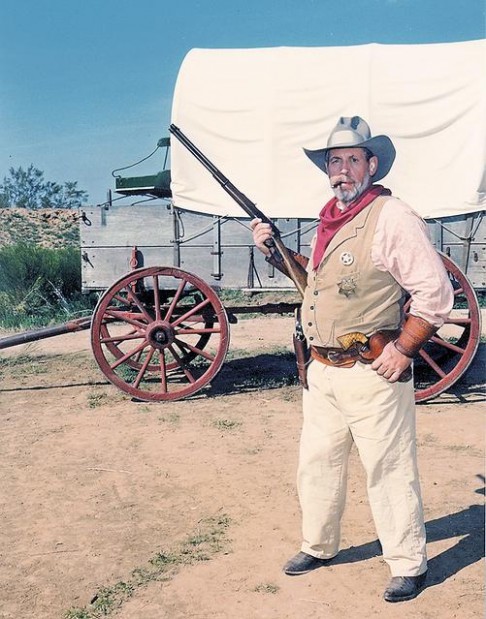
Michael "Ole Dead Eye" Sinclair rode with a wild and woolly gang.
Buckshot Chavez, Crusty Gil, the Wild Irishman, Blackjack Fletcher, Mean Rayleen, Dirty Bob, Bison Bert, Lottie Shots, Turquoise Jake and others.
One or two weekends a month they met up in the dusty rural towns of the West and Southwest to compare firearms and test their marksmanship in timed shooting competitions.
Sometimes a bad guy would pop up behind the saloon. Other times the cowboys — and cowgirls — found themselves belly-down in the dirt, aiming at targets from beneath wooden horses.
The ammo was live, the rule was safety first, and it was all in good fun as part of Los Vaqueros — Arizona Historical Shootists Association, a Tucson-based organization that Sinclair and a handful of others started in 1984.
People are also reading…
On May 9 Ole Dead Eye went "home to ride on God's range," as the Los Vaqueros' Web site puts it, after battling cancer. He was 63.
Sinclair was born into a military family and his father was in the Air Force.
After he graduated from high school in Germany, Sinclair attended the University of Dayton, earning a bachelor's degree in mechanical engineering.
"The degree wasn't important. The (Army) ROTC was," said his wife of 35 years, Gail Sinclair.
Sinclair was intent on joining the military. Immediately after graduation in 1967, he was sent to Fort Campbell in Kentucky for Army Ranger and Airborne School. By August 1968, 1st Lt. Sinclair was in Vietnam as part of the 9th Infantry Division.
He made more than 25 combat jumps, received five Bronze Stars for valor and heroism, a Silver Star for gallantry in action and two Purple Hearts.
Sinclair was injured in early 1969 — he lost an artery in a leg — and spent six months at Walter Reed Medical Center in Washington, D.C. Sinclair, by then a captain, asked to be sent back for a second tour, from which he returned unscathed.
Weeks into his third tour, though, Sinclair was severely wounded. On his 27th birthday, he and his men were attempting to take a hill strewn with land mines. Though an airstrike had been called in earlier to detonate the land mines, it was unsuccessful, Gail Sinclair said.
"Up the mountain, he started losing men left and right because of the land mines," she said. By the time troops reached the top of the hill, Sinclair had lost 30 or so men.
While regrouping, he took off his backpack and set it on the ground. When he picked it up, a pressure release was triggered, and a land mine exploded at his feet. His abdomen was protected by the backpack he was holding, but his limbs were ravaged.
At a field hospital, doctors amputated Sinclair's legs and a thumb. He also lost an eye.
His arms were shredded, and doctors considered amputating them, too, but didn't want to leave the Army Ranger without any mobility. They patched his arms the best they could and shipped him to a hospital.
Sinclair spent two years at Walter Reed. It was at the hospital that he met his wife, an Army physical therapist.
"The one good thing about coming back from Vietnam injured," Gail Sinclair said, "you never thought you were as bad off as the guy in the bed next to you."
Being surrounded by fellow soldiers and military personnel provided wounded soldiers with psychological support as well.
Despite the medical problems, Sinclair was as committed as ever to military service.
"He tried to stay in the Army. He was a captain. At that time they were trying to keep captains who were combat-ready and he wasn't," his wife said.
After he was medically retired, Sinclair accompanied his spouse to her posts overseas and in the United States.
The couple had four children and when Gail retired, Sinclair got a job in California as a financial analyst for IBM. He was transferred to Tucson in 1979.
In the early 1980s, Sinclair learned about a competitive cowboy shooting event in California and he entered.
The authenticity of the sport appealed to him. Participants had to wear the kind of garb donned in the late 1800s and early 1900s. They had to use vintage or antique replicas of rifles, shotguns and pistols, and they had to adopt a shooting alias.
Sinclair chose "Ole Dead Eye" because of his injury and because he was a crack shot, a deadeye on rifle. He also shot trap, skeet and sporting clays.
"He liked any kind of sport where he could shoot," his wife said. Sinclair was extremely athletic and competitive all his life, but his war wounds made it impossible to participate in the more physical sports he liked.
Sinclair and a handful of others started Los Vaqueros in 1984, holding monthly matches in sandy washes, with the permission of the Forest Service.
Odis "T.A. Chance" Flowers joined the group in 1993 and became fast friends with Sinclair.
"He had a great sense of humor," said Flowers, who didn't think twice when Sinclair made a special request of the silversmith. Periodically, when changes occurred in his eye socket, Sinclair was fitted with a new prosthetic eye. He asked Flowers to affix one of his old orbs into a sterling concho and make it into a scarf slide he could wear to competitions.
"You gotta know Mike. It didn't bother me a bit. The first thing I said to him was, 'Are you sure you have another one?' " Flowers said.
Sinclair also had prosthetic eyes attached to his pocket watch fob and embedded in the handle of one of his pistols.
Tom "Buckeye Pete" Colaric met Sinclair in the mid-'80s when they worked at IBM.
Colaric joined Los Vaqueros and learned his co-worker was an excellent shot.
"Mike, like many of us … grew up with Roy Rogers, Dale Evans, Hopalong Cassidy, Saturday matinees; and being a cowboy was something many of us dreamed of being," Colaric said. "It was a way of life and ideas that we all strive for — fair, firm, do what's right even though somebody may not be watching. The fairness in him, making sure everybody had an equal shake, that was very much a part of Mike."
When he was diagnosed with cancer — likely caused, said his wife, by a hepatitis-infected blood transfusion he received after his first injury, combined with the Agent Orange sprayed in Vietnam — Sinclair showed true grit, opting against chemotherapy. Chances for recovery were limited, and the treatment was debilitating.
A true cowboy at heart, Ole Dead Eye chose to enjoy life instead of trying to out-ride death.
Shooting club details
For information on the shooting club Michael "Ole Dead Eye" Sinclair helped start and an international club, check out these Web sites:
• Los Vaqueros: Arizona Historical Shootist Association (AHSA): www.losvaqueros.org
• Single Action Shooting Society (SASS): www.sassnet.com
Add your memories of 'Dead Eye'
• Did you know Michael "Ole Dead Eye" Sinclair? Add your remembrance to this article online at azstarnet.com/lifestories
• Find a photo gallery of this Life Story at azstarnet.com/slideshows
Life Stories
This feature chronicles the lives of recently deceased Tucsonans. Some were well-known across the community. Others had an impact on a smaller sphere of friends, family and acquaintances. Many of these people led interesting — and sometimes extraordinary — lives with little or no fanfare. Now you'll hear their stories. Past "Life Stories" are online at go.azstarnet.com/lifestories


 Hotel on the rise at Tucson’s Uptown project


