A federal judge refused a bid by the Tohono O'odham Nation to immediately block construction of 62 miles of new border wall along the reservation's southern boundary with Mexico.
In the new ruling made public Friday, Judge Richard Leon in Washington, D.C., rejected arguments that:
A new border wall and the construction around it would amount to illegal trespassing on tribal lands;
It would effectively shrink the reservation without congressional approval;
All of the land right down to the border belongs to the tribe despite a 1907 proclamation that reserves the first 60 feet for federal use.
And Leon, in an 18-page opinion, said there's another reason he finds the tribe doesn't have a legal right to stop the double-layered 30-foot-steel-and-concrete barrier now being planned. He said the needs of the United States to secure the border trump the tribe's concerns.
People are also reading…
"Given the national security and foreign policy considerations related to the border wall, deference to the government is warranted,'' he wrote.
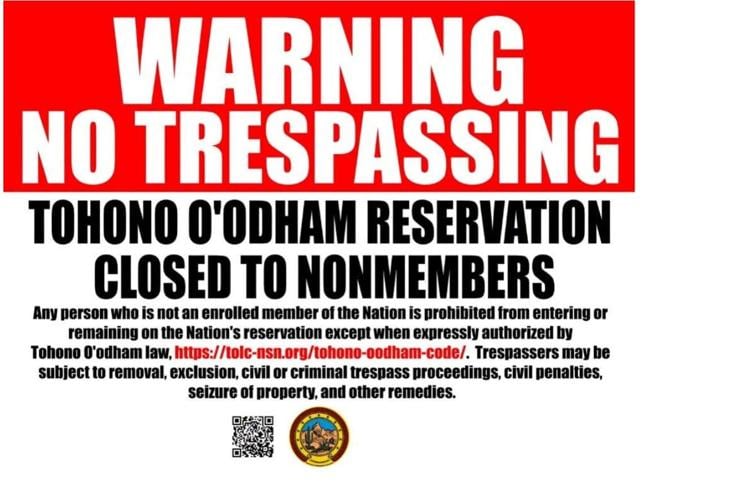
The ruling comes just weeks after the tribe erected "no trespassing'' signs through much of the 2.8 million-acre reservation. But tribal Chairman Verlon Jose said the signs are not related to the contractors being sent to the reservation by the U.S. Department of Homeland Security to start scoping out the project.
The plan to put up the signs "has been in the works for some time,'' he told Capitol Media Services on Friday. "We have a lot of people who come on the nation who are technically trespassing, not only contractors. We have a lot of people come on that do illegal hunting, that want to go driving all over the nation to areas that are not public spaces.''

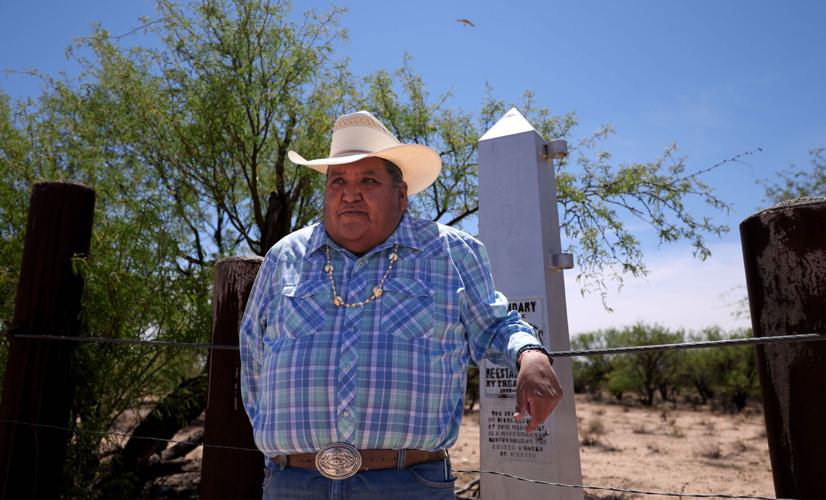
Tohono O'odham Nation Chairman Verlon Jose, seen here earlier this year along tribal land at the U.S.-Mexico border, has been vocal about his opposition to construction of a second border wall.
He acknowledged, though, that there is a specific concern about contractors, not just for Homeland Security but also for Border Patrol. But Jose said it's because they "aren't fully licensed, permitted, paid the necessary taxes,'' not specifically because of the work they are doing related to the border wall.
Yet the tribe, in a Facebook post on Aug. 8, made it clear exactly who it is targeting.
"ANY construction related activities to the illegal and destructive border wall be warned, informed of trespass and escorted of the Nation's land by law enforcement,'' it says.
Judge: Actual site of wall isn't tribal land
In the new ruling, Leon said the tribe has no case to stop planning and construction activities because the wall isn't going up on reservation land.
The key is a 1907 proclamation by President Theodore Roosevelt that claimed all public lands within 60 feet of the international boundary to be within the exclusive control of the federal government. That was done, according to the proclamation, "as a protection against the smuggling of goods between the United States and the Republic (of Mexico).''
It is within that strip that Homeland Security officials intend to build the new fence.
Attorneys for the tribe argued the Roosevelt proclamation does not include the land within the reservation.
Leon, however, said that claim holds no water: Congress did not actually establish a reservation for the tribe until 1917.
The tribe, in an alternate argument, said it had "aboriginal title'' to the land before the creation of the "Roosevelt Reservation.'' Its lawyers also said the 60-foot strip was never "public lands'' and therefore the Roosevelt Reservation never existed on the Tohono O'odham reservation.
The judge acknowledged that what the tribe calls its "broader aboriginal territory'' exists on both sides of the border.
"There are currently 17 O'odham communities with approximately 2,000 members in Mexico,'' he wrote. "And members of the nation continue to cross the border for sacred pilgrimages and ceremonies and important religious and cultural sites.''
But the judge said that doesn't mean the tribe has some title to the 60-foot buffer zone.
"Historical evidence casts doubt on plaintiff's theory,'' Leon wrote.
He also suggested that the tribe itself has effectively conceded the right of the federal government to act within that 60-foot strip, noting that tribal officials in 2004 approved construction of a barrier in that zone, albeit one that stops vehicles but allows pedestrians to pass.
Chairman: Tribe is prepared to challenge ruling
Jose said the tribe is prepared to fight the judge's ruling.
"There are too many critical issues that were not adequately addressed,'' the tribal chairman said.
"The judge's opinion is the judge's opinion,'' he continued. "And I think, at the end of the day, the law will rule.''
Strictly speaking, the new ruling only denies the tribe's request for an injunction. The Tohono O'odham still have the option to seek a full-blown trial to pursue its claims.
But Leon made it clear he believes it will be an uphill battle for the tribe to overturn his ruling. The key, he said, is border security and the clear intent of federal lawmakers to do something about that.
"Congress has directed the Secretary of Homeland Security to 'achieve and maintain operational control' over the border, including 'physical infrastructure enhancements,' '' he wrote.
That includes repeated legislation authorizing construction of physical barriers. And there was a provision in HR 1 — the 2025 so-called ''Big Beautiful Bill'' — appropriating $46 billion to Customs and Border Protection to install and improve barriers.

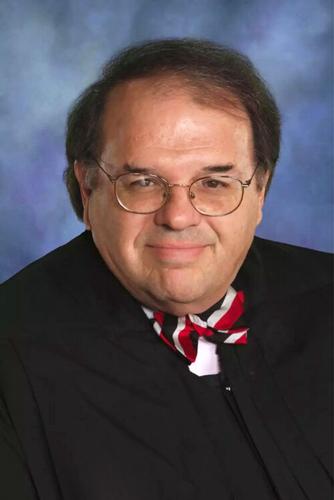
U.S. District Court Judge Richard Leon
Leon also noted that as far back as 1996, Congress approved the Illegal Immigration Reform and Immigrant Responsibility Act, which allows the Homeland Security secretary to "waive all legal requirements'' to ensure construction of new barriers and roads. And in 2008, Michael Chertoff, then the secretary, issued a broad waiver of numerous environmental and procedural laws for projects along the southern border.
Tribal attorneys did not challenge that law.
Instead, they argued that, in constructing the wall, the federal government was shrinking the size of the reservation. That cannot be done absent an act of Congress, they said.
Leon said that, even assuming the federal government did not own the 60-foot strip — a point he specifically disputes — the tribe still would not succeed with that claim.
"I am not aware of any case holding that construction of a border wall adjacent to a reservation — with the possibility of activities that may interfere with the nation's use and occupancy rights — necessarily diminishes the reservation's boundaries,'' the judge wrote.
Trespassing issue
He also said a separate claim that the federal government was trespassing on the reservation holds no water for one simple reason: the federal government is immune from such suits unless Congress waives that immunity.
"Plaintiff does not argue that any statute waives sovereign immunity here,'' the judge wrote, adding, "It couldn't!''
Jose said he doesn't read the ruling to have any effect on the ability of tribal police to cite individuals for trespassing, even those who may be under contract for government agencies. He said it comes back to his argument that the tribe can decide that those doing business without getting the required licenses and permits — and paying the necessary taxes — are trespassing and violating tribal codes.

The Tohono O'odham Nation has posted “No Trespassing” signs on tribal lands, concerned in part that federal contractors might enter the reservation without authorization to construct a border wall.
The signs posted by the tribe say those who are not tribal members or "expressly authorized'' to be there by tribal law are subject to being escorted off the land, civil and criminal trespass charges, civil penalties as well as the possibility of having their property seized.
The Facebook post does say that doesn't apply to any vendor "authorized to do work'' on tribal land or who is invited. And a tribal spokesman pointed out there are other contractors on the reservation from Customs and Border Protection who have permission to tend to the towers used to spot smugglers.
Also exempt are non-tribal members who are driving through the reservation on public roadways.
'Will desecrate countless sacred areas'
The tribe's objections to the wall go beyond the legal issues of whose land it is.
In a written statement late Friday, Jose said he fears construction "will desecrate countless sacred areas, burial sites, and other important locations.''

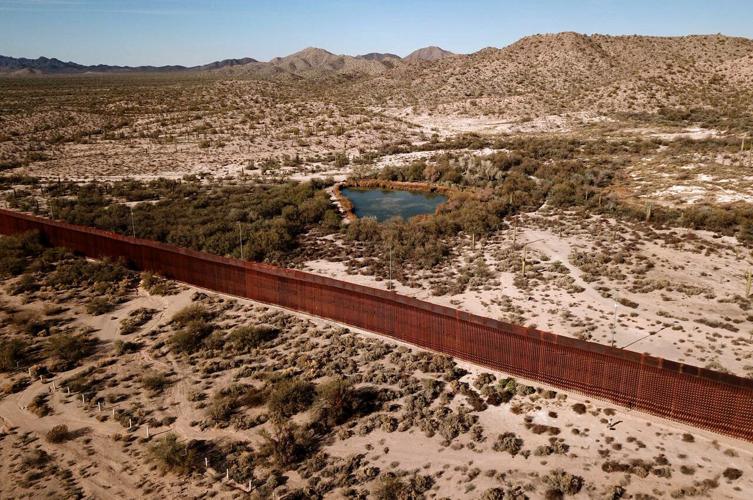
The border wall runs next to Quitobaquito Springs at Organ Pipe Cactus National Monument in an aerial photo taken from Mexico. The Trump administration is planning to build a second wall parallel to the first one, raising concerns for the Tohono O'odham Nation and others about what the project could do to the historic oasis and other sensitive sites.
As evidence, he cited "countless examples" elsewhere in Arizona — not on reservation property — of border wall construction causing damage, such as at the Las Playas intaglio. There, construction crews working earlier this year in Cabeza Prieta National Wildlife Refuge damaged the 1,000-year-old, 200-foot-long fish-shaped geoglyph, essentially a design drawn directly on open ground, by blading directly through the site.
Jose also cited "ongoing damage'' to Quitobaquito Springs in Organ Pipe National Monument.
"The proposed double wall on the nation will have impacts much broader than the 60-foot limit cited in the ruling,'' the chairman said.
Drone video by the Center for Biological Diversity shows an ancient geoglyph in Arizona damaged by border-wall construction.
Howard Fischer is a veteran journalist who has been reporting since 1970 and covering state politics and the Legislature since 1982. Follow him on X, Bluesky and Threads at @azcapmedia or email azcapmedia@gmail.com.