

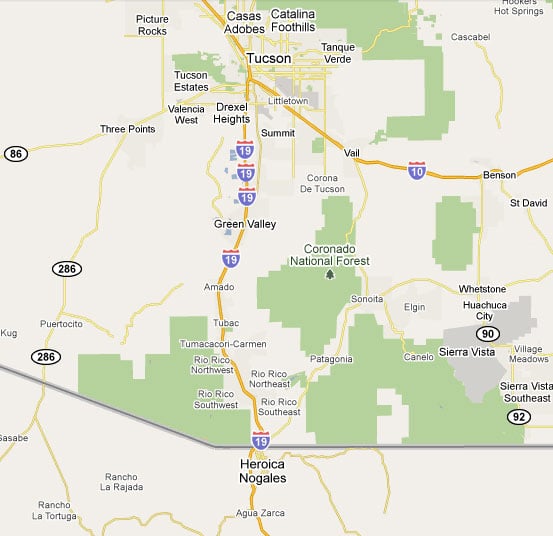
The number of killings in Mexico's drug wars has spiked to unheard-of levels in Nogales, Sonora, during the past two months as a powerful cartel tries to seize control of the valuable corridor.
The 98 people killed in the Mexican border city since Dec. 1 are more than the total number of homicides for 2006 and 2007 combined, according to a tally maintained by El Imparcial newspaper.
There's no evidence that drug traffickers are targeting visiting U.S. citizens or Mexicans not involved in the trade, but officials worry that the risk of being in the wrong place at the wrong time has increased.
The killings don't seem to follow any patterns - they occurred in 16 different neighborhoods last year and almost equally in morning, daytime, evening and overnight, Sonoran statistics about the killings show.
The increased bloodshed was triggered by the Dec. 17 killing of drug kingpin Arturo Beltran Leyva, the leader of the Beltran Leyva cartel, by Mexican naval special forces in a city south of Mexico City, said Anthony Coulson, Drug Enforcement Administration assistant special agent in charge of the Tucson District Office.
People are also reading…
The rival Chapo Guzman cartel of Sinaloa is trying to capitalize on the weakened state of the Beltran Leyva cartel and take firm control of a plaza the two sides have been battling for since the middle of 2007, Coulson said.
The spike in killings can be traced to the Chapo Guzman cartel's efforts to purge Nogales of the remaining loyal members of the Beltran Leyva cartel while at the same time trying to intimidate Mexican law-enforcement officers, he said.
Some of the remaining Beltran Leyva loyalists are fighting back, and some are just being assassinated. Mexican police are fighting back because they're part of President Felipe Calderón's three-year campaign to weaken the cartels. Several police officers have been shot to death in the last few weeks by the Sinaloa cartel, Coulson said.
"It's pure intimidation," Coulson said. "He's laying down the order: 'I'm in control now, and I can take you out because I can.' "
Since Dec. 1, the once-calm border city is averaging more than one killing a day and nearly nine per week. This is in a city that reported a total of 35 killings for the entire year of 2007.
"It's scary. I'm not going to lie," Raul Carbajal, director of Nogales Tuyo, said in Spanish, "But you have to keep living."
The Nogales Tuyo program, a play on words that translates to "Nogales Is Yours," represents city business groups in an attempt to bring back pride and faith in the city so it can improve its image with visitors.
Even though the Arizona-Sonora stretch of the border has been the busiest for drug and human smuggling for nearly a decade, Nogales enjoyed relative calm before 2007-08. But deadly gunfights in May 2007 in Cananea, Sonora, signaled the first sign of trouble. By May 2008, the rival cartels were engaged in open warfare for Nogales.
The U.S. State Department has listed Nogales in its Mexico travel alert since October 2008, alongside notoriously dangerous cities such as Ciudad Juárez, Nuevo Laredo and Tijuana. It says these are cities that "recently experienced public shootouts during daylight hours in shopping centers and other public venues."
The alert doesn't tell U.S. citizens to avoid traveling in Mexico but urges them to be aware of the increase in violence related to drug cartels. The travel alert, last updated on Aug. 20, 2009, is set to expire on Saturday, at which time officials must decide whether to reissue it and whether to revise any of the warnings.
Most Nogales residents have altered their lifestyles to avoid getting caught in the crossfire, Carbajal said.
"It's a challenge, but we are not going to stop battling," Carbajal said in Spanish. "What you do is live differently. You try to avoid going where it happens most often."
Tourism-related business in Nogales has suffered over the past three years as a result of fear caused by the violence, despite assurances from Mexican officials that tourists are safe.
In an effort to reassure potential visitors, Nogales city officials have created a special tourism police force; placed surveillance cameras at neighborhood parks, streets and schools; and is in the midst of a $15.4 million makeover of the downtown tourism area.
Visits to dentists and doctors in the downtown area have not slowed with the recent increase in violence, said Gary Logan, a representative of the Nogales Doctors and Dentists Directory. Dentists offer escorts to and from the port for worried patients but insist the killings occur in other places and are among criminals and police.
"The tourist areas are still a very friendly, safe and secure place to visit," Logan said.
Contact reporter Brady McCombs at 573-4213 or bmccombs@azstarnet.com


