

If the government does chop 8 percent from defense spending on Friday, the impact on the St. Louis aerospace industry should occur in slow motion and without mass layoffs, analysts say.
In fact, it might not occur at all.
The reason lies in the way defense contracting works. Most of the defense work Boeing is doing today — and the money it is receiving — was appropriated years ago. That work shouldn’t be affected by the programmed defense cuts, called sequester, said Loren Thompson, defense expert at the Lexington Institute, a research group in Alexandria, Va.
So, cuts made this week would play out slowly over time as work authorized in the past is finished and new orders slow down.
People are also reading…
“It doesn’t matter if there is a sequester on Friday. It will take years before the full impact of the cut is felt by Boeing,” Thomson said.
That should be limited relief for the 15,000 Boeing workers in St. Louis, as well as employees at Boeing subcontractors here. It means less chance of mass layoffs due directly to the cuts.
“In the first year, the effect on employment will be modest,” Thompson said.
A Boeing spokesman said Monday the company doesn’t know how the sequester will affect its Hazelwood-based defense unit — called Boeing Defense, Space and Security — and is waiting to hear from the Pentagon.
Local workers are still at risk from expectations that Pentagon budgets will get leaner through the decade as Congress tries to trim the federal deficit.
Boeing already has been taking steps to deal with a lean defense spending in the long term. The day after President Barack Obama’s re-election, Boeing announced it planned to slash management ranks by an additional 10 percent and impose $1.6 billion in new cost-cutting measures starting this year.
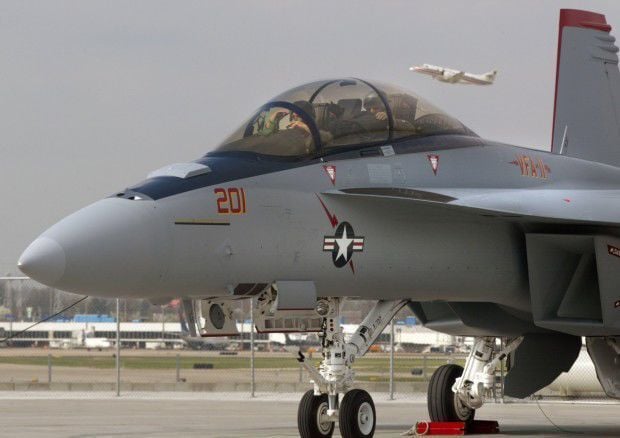
In St. Louis, Boeing makes F/A-18 fighters, Harpoon and SLAM missiles and smart bomb kits for the Pentagon, as well as F-15 fighters for Saudi Arabia. The government F-15 contract is worth $7.1 billion, and the Saudi deal is worth $29.4 billion.
“I don’t think Boeing will get hit all that badly in St. Louis,” said Richard Aboulafia, defense analyst with the Teal Group in Fairfax, Va.
Unless Congress acts, which appears unlikely, $85 billion in automatic federal spending cuts will begin to take effect on Friday, with half of the amount from defense.
In theory, the sequester cuts are supposed to affect all defense programs. But it is hard for the government to get out of multi-year procurement contracts signed with Boeing and other big defense contractors. Penalties are “huge,” Aboulafia said. In some cases it may cost the government more to get out than to stay in.
“The effect is going to be utterly ridiculous,” he said.
Boeing says its F/A-18 contract contains no provision for a reduction in orders. Boeing is now delivering 48 fighters a year.
Instead, the government may try to renegotiate the contracts to meet the sequester, but that might also put the government at a disadvantage.
For instance, the Air Force got a good deal on a contract with Boeing to build new refueling tankers, Aboulafia said. In a renegotiation aimed at building fewer tankers, Boeing would have the upper hand.
While big defense contractors may skate by for a while, the sequester will have consequences quickly on military operations and training, Thomson said. In those programs, money appropriated this year is spent this year.
The Pentagon has already delayed the deployment of a carrier group to the Persian Gulf, and announced its intention to limit training.
The sequester adds to the recent bad news for Boeing. Its new 787 long-haul passenger jet is grounded while engineers try to determine why its batteries catch fire.
Defense and space provide 40 percent of Boeing’s revenue. Defense revenue has been fairly steady for the past three years, as Boeing’s commercial aircraft sales have been growing. The company earned $3.9 billion last year, compared to $4.02 billion in 2011.
That balance between commercial and military has helped the company weather economic shocks in the past. “The best thing about Boeing is that it has a large nongovernment exposure,” said defense analyst Michael Blades of Frost & Sullivan in San Antonio.
Blades said big contractors such as Boeing, Lockheed and Northrop are rich in cash and should weather defense cutbacks over the next few years without a crisis.
“They have a lot of money sitting around, and that’s on purpose,” he said.
The hit will be greater at smaller small and mid-sized firms. “If they lose a single contract, it has much more impact on them,” Blades said.
Boeing said it paid $785 million to 764 suppliers in Missouri in 2011, and $960 million to 683 suppliers in Illinois.
Analysts think the sequester will be short-lived, especially as it applies to defense contractors. “If your local congressional delegation gets its act together, sequestration will cease to be law before the full impact is felt by Boeing,” Thompson said.
Recent news for Boeing hasn’t been all bad, noted Blades.
Boeing may benefit from problems plaguing the new F-35 Joint Strike Fighter, made by Lockheed Martin.
The program has seen massive cost overruns. The Pentagon grounded the planes last week after finding a crack in an engine blade.
“Every time something happens, it’s good news for Boeing,” Blades said. “The only plane that can do what (the F-35) can do is the F-18, and they’re so much cheaper.”
Jim Gallagher is a reporter at the Post-Dispatch


