

The Achtyl file has been found.
Three weeks ago, an attorney for Erie County Sheriff Timothy B. Howard said the Howard team could not locate its internal affairs report on Deputy Kenneth P. Achtyl’s bloody arrest of a Buffalo Bills fan in 2017.
Late last week, the Howard team found the file and turned it over to the lawyer suing Erie County, the sheriff and Achtyl over the wrongful arrest and assault of Nicholas Belsito, who at the time was a 25-year-old University at Buffalo student tailgating outside New Era Field.
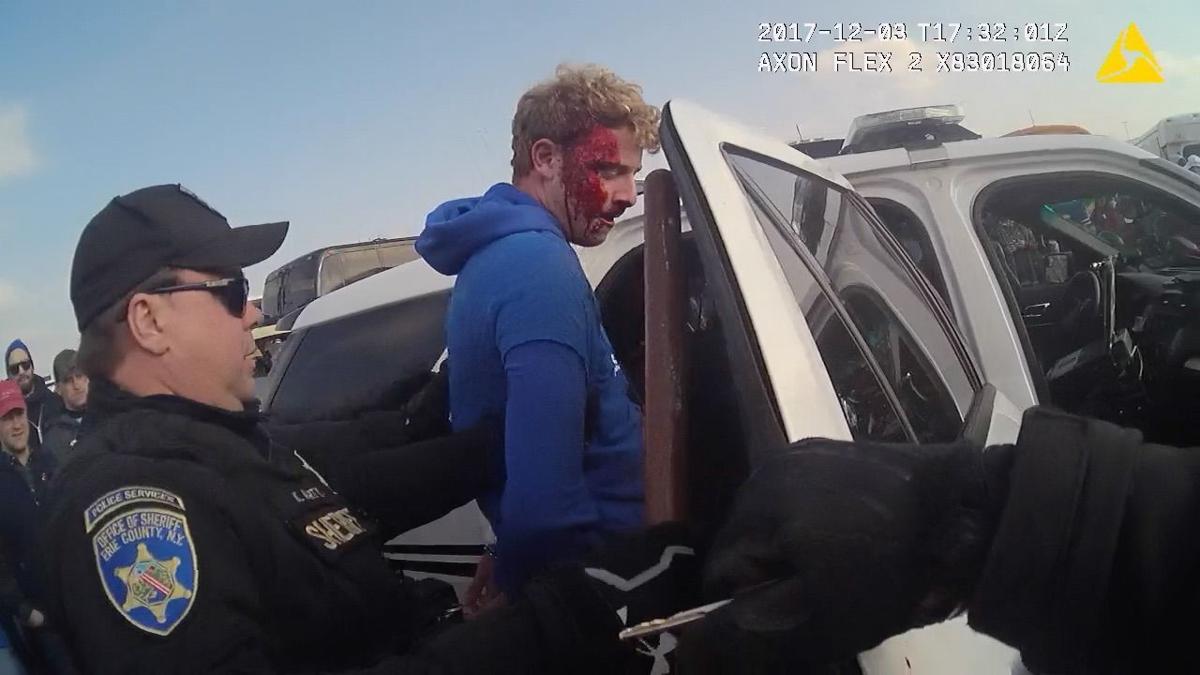
Documents in the file, later obtained by The Buffalo News through a Freedom of Information request, describe a narrow internal inquiry. There is no mention of any effort to ask Achtyl or his partner, James W. Flowers, what happened during the arrest, nor to watch a lengthy video captured on one of the deputy’s body cameras.
People are also reading…
The internal file consists of two documents that total three pages. The earliest document is a one-page letter dated Feb. 6, 2019 – after news surfaced that the District Attorney’s Office and federal prosecutors were investigating the bogus arrest to possibly charge Achtyl with a crime. By then, the false arrest had been widely publicized by The News and other news outlets.
In the February 2019 letter, Sgt. Warren J. Luick Jr. told then-Undersheriff Mark N. Wipperman of the investigative steps the Professional Standards Division took roughly one year earlier, when it received a two-second video of the arrest, well before the media reports were printed and aired. Luick said the division watched the two-second video as well as some photos of the arrest and a longer video taken post arrest.
The two-second video that Luick refers to might be the rapid burst of still images taken by an onlooker and obtained by a lawyer who defended Belsito on the criminal charges, Thomas Eoannou. Erie County prosecutors later used the clip, the photos and the fuller body camera video to convict Achtyl of three misdemeanors.
Luick said the internal investigators found that the two-second video never showed Achtyl actually hitting Belsito with his baton. It does, however, show the deputy about to strike the UB student, who was left with a concussion, a broken nose and blood caked on his face. Wrote Luick: “While there clearly was a struggle, and Deputy Achtyl had his baton out, at no time in the video is Deputy Achtyl shown striking Belsito,” Luick wrote.
He went on to tell Wipperman that, as part of the internal investigation, the sheriff's office asked two FBI agents who specialize in civil rights matters to watch the brief video and review court documents “as a precaution.” The agents saw no civil rights violations “given the evidence we had,” Luick wrote.
The letter mentions nothing about internal investigators watching – or showing the FBI agents – the full body camera video of the moments leading up to Belsito’s arrest and Achtyl’s efforts to handcuff him.
The body camera video provoked public criticism of Achtyl, who on Dec. 3, 2017, lashed out at Belsito when the student asked where he was taking his recently arrested friend, so he might go retrieve him once freed. Achtyl repeatedly told Belsito to “beat it,” and the visibly frustrated Belsito turned to swear at the deputy while walking off. Though swearing at an officer in New York is not, on its own, a crime, Belsito was chased down, hit with the baton and arrested.
Erie County prosecutors, after watching that video in the summer of 2018, realized the scenes did not support the charges Achtyl lodged against Belsito, and each count was dismissed: resisting arrest, obstructing governmental administration, and the charge of criminal mischief, placed because Belsito dented the fender of a police vehicle when Achtyl pushed him into it.
Luick’s letter to the undersheriff in February 2019 also showed the internal investigators did not look into whether Achtyl lied in the court documents he signed to charge Belsito. The deputy had alleged Belsito “did fight with the arresting deputies by swinging his arms and attempting to pull away” and engaged in "violent, tumultuous and threatening behavior." Neither the body camera video or onlookers’ videos showed this.
With the body camera video and video taken by onlookers, the Orchard Park jury convicted Achtyl of assault, official misconduct and falsifying business records. The deputy resigned soon after and was sentenced to community service.
The second document in the Achtyl file is a two-page memo that Luick, of the Professional Standards Division, wrote to Wipperman on Oct. 7, 2019, closing the internal inquiry. The memo restates the letter written in February of that year and features a chronology of the further developments: federal and state prosecutors opened inquiries after the body camera footage surfaced; county prosecutors charged Achtyl; he was placed on leave without pay; he was convicted of three charges in September 2019; and he resigned.
Belsito, Luick noted, never filed a formal complaint with the Sheriff’s Office.
“The case is considered closed,” Luick wrote.
The undersheriff today, John W. Greenan, who had no involvement with the Achtyl inquiry, had no comment in recent days when asked why the internal probe did not address the full body camera video. A Howard spokesman, Scott Zylka, implied in a written statement that the investigators might have viewed the footage, but Zylka did not respond when asked for details to support his suggestion.
As to how the missing file was recovered, Greenan said it was found by locating the computer used to write the report. The documents were on the hard drive, he said.
The lawyer pressing the lawsuit against Erie County over the arrest, Aaron F. Glazer, said he wanted the internal file to see if the Professional Standards Division found no fault with a deputy who, as a jury decided, violated the law.
“They based their entire investigation on a two-second video?” Glazer said after reviewing the file. “I think it’s amazing they didn’t take any statements.”
Similarly, he found it amazing the internal investigators did not address the Sheriff’s Office’s own body camera video of the arrest.
Said Glazer: “If you asked 100 people, what’s the most important piece of evidence here, every one of them would say the bodycam video, and apparently they didn’t even consider it during the course of this investigation.”


