

Fosdick Field is back on track.
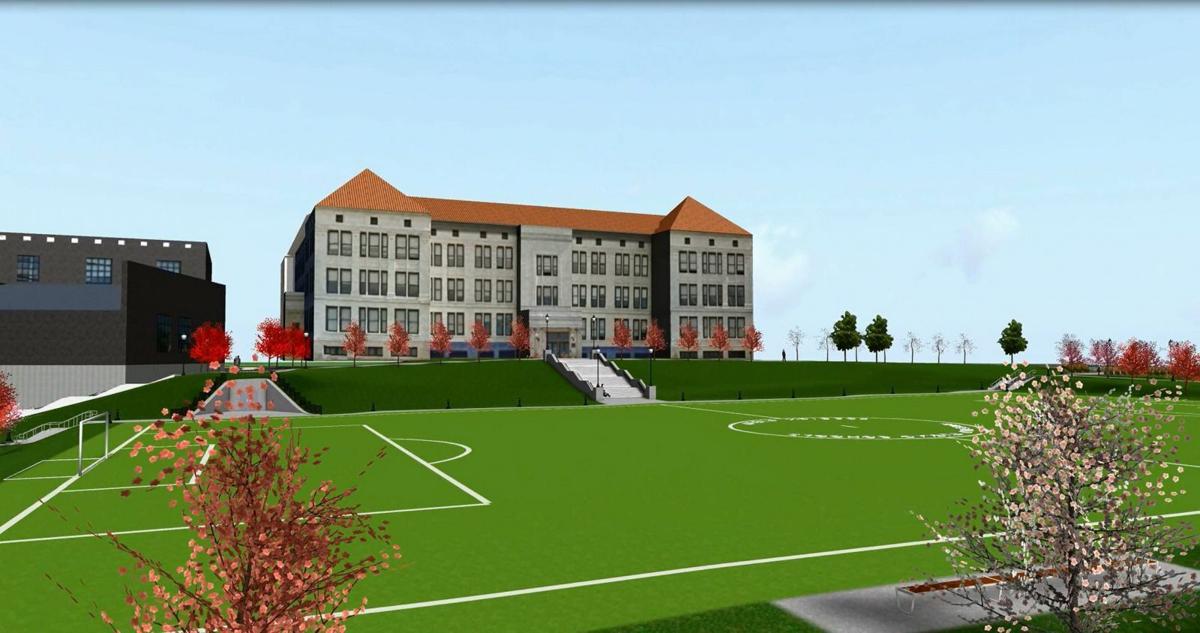
The Buffalo Board of Education has agreed to have the school district take ownership of the 4 acres of grassy land adjacent to the Buffalo Niagara Medical Campus and pay off the debt on the property so it can be turned into a multimillion dollar athletic field.
“We are committed to seeing this through, absent any major, unknown issue that may arise,” said Nathaniel Kuzma, the district’s general counsel.
The School District has been doing its due diligence since October, when it first offered to pay the City Honors/Fosdick-Masten Park Foundation $1 for the parcel in front of City Honors School, on East North Street.
The School Board formally signed off on the deal Dec. 18. The district hopes to close on the property in 60 to 90 days, Kuzma said.
People are also reading…
The City Honors foundation acquired the land from the Buffalo Municipal Housing Authority in 2016 for $2.05 million with the intent of constructing a $3.5 million athletic facility that would include an all-weather field, scoreboard, landscaping and walking path around the property.
But the nonprofit couldn’t afford the payment that came due this summer and the housing agency was preparing to rescind the title.
The foundation asked the School District to step in and Superintendent Kriner Cash offered to take ownership of the land for $1, as the first step toward paying off the debt and completing the vision for Fosdick Field.
The foundation’s board already has agreed to terms of the district’s offer.
Obtaining title to the property allows the district to negotiate with the BMHA, which is still owed the $2.05 million for the property.
“This is a win-win-win situation for the School Board and the foundation and the Housing Authority,” said Gillian Brown, executive director of the BMHA. “We’re finally going to get the money we were counting on.”
The School District plans to use a half-million dollars that the foundation was promised by the Margaret L. Wendt Foundation toward the cost of the acquisition.
The district then hopes to work out with the Housing Authority a payment schedule to pay off the balance over the next year, Kuzma said.
The district also plans to ask the BMHA to waive the interest that has accrued and include two corner parcels that are not currently on the deed.
In addition, the district will have to talk with the city about relinquishing Fosdick Avenue, which dissects the parcel and the school, Kuzma said.
“Those are all issues I’m happy to talk to them about,” Brown said. “I suspect there will be a little back and forth, but I can say my board and I are adamant that the $2.05 is not negotiable.”
The foundation’s intent was for Fosdick Field to benefit City Honors students during the school day, but after school be used for games by any of the district’s athletic teams, as well as for recreation for residents in the Fruit Belt neighborhood.
As for bringing that project to fruition, the district anticipates around a three-year timetable, Kuzma said.
The district will continue to seek private funding; but if using its own money, it could seek reimbursement from the state once the project is complete, Kuzma said.
Fosdick Field was designed by Frederick Law Olmsted in 1887 as part of a 10-acre park, with six of the acres later used to build Masten Park High School, which became Fosdick-Masten Park High School and is now City Honors.
The field was used for physical education, district athletic events and by the neighborhood before the BMHA acquired the property in 1977 for construction of the Woodson Gardens housing development.
The housing, which eventually became run-down, was demolished in 2013, paving the way for the foundation to acquire the property.


