Most business inventories don't include bulk orders for Madagascar hissing cockroaches, snails and thousands of plastic tubes — but the Regional Science Resource Center isn't a typical business.
Its business is education and its goal is to use science to promote critical thinking and improve writing and communication skills.
Nestled in the back corner of a nondescript building next to the TUSD bus yards off of South Kino Parkway, the center isn't glamorous. But it is the backbone of science education in Tucson.
A staff of just 10 people is in charge of supplying more than 100 elementary and middle schools in the region with interactive kits that make hands-on science possible for students.
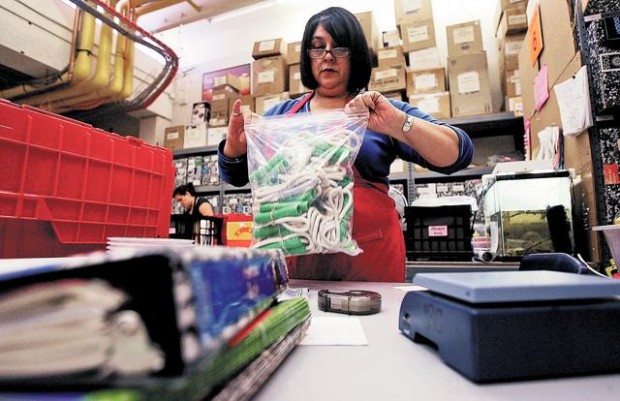
A typical kit contains common items such as straws and rubber bands, as well as the specific tools for an experiment.
People are also reading…
For example, the cockroaches aren't just a gross-out gimmick. They're distributed to second-graders, who are tasked with re-creating the creatures' natural rain-forest habitat in a miniature terrarium and observing their life cycle.
Other kits illustrate electronics by having students construct a circuit to power a lightbulb or introduce basic physics using balls and ramps.
Although the center has been serving the Tucson Unified School District since its inception in 1993, it went regional this year, adding the Sunnyside Unified School District and several charter schools to its list.
Without the center, each school's science teachers would be on their own for collecting the materials and curriculum for science experiments.
Research coordinator Marleen Kotelman said the center operates on a tightly regimented schedule and budget.
"There are over 1,600 consumable items that make up the kits," she said. "With our system, we will refurbish a kit in 15 minutes."
For the 2007-08 school year, the center is on track to refurbish almost 19,000 kits.
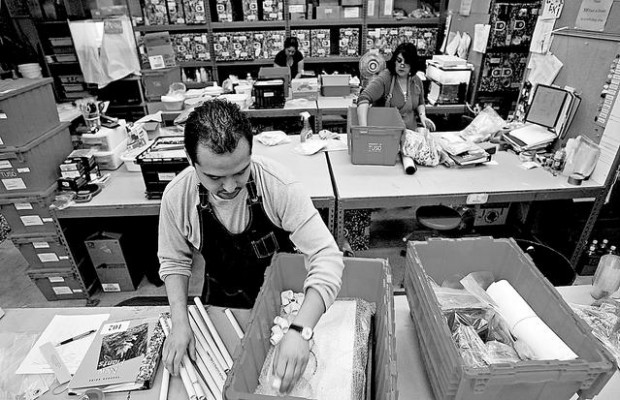
Employees are in charge of picking up used kits at schools, taking them back to the shop for an overhaul and then delivering them back to classrooms.
Students keep the kits for nine to 11 weeks, using the materials to work in groups and keeping journals about what they learn.
"Students need to be doing more science as opposed to reading about science," Kotelman said. "The concept of collaborating as a team is paramount."
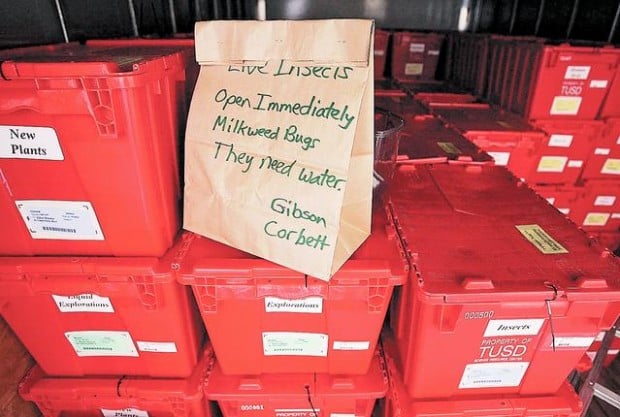
There are 27 kits for kindergarten through eighth grade, and they are all packed neatly into plastic tubs for shipment.
Boxes and plastic crates with color-coded labels are stacked floor-to-ceiling, giving the center a warehouse atmosphere.
Employees bundle everything together in plastic bags at the six preparation stations, marked overhead by fluorescent orange signs.
In one corner, the maze of boxes breaks to make room for two refrigerators and rows of glass tanks that hold Madagascar hissing cockroaches, fish, milkweed bugs and snails.
All of the kits are packaged with curriculum approved by the National Science Foundation, which supplies grants for the center's curriculum development.
The University of Arizona also collaborates with the center, sending graduate students to act as "content specialists" at teacher workshops, where both the teacher and the grad student go through the kits and discuss the accuracy of their contents.
They "make connections, learning about what the teachers are teaching these days. It helps educate the university about what's being taught," said Katrina Mangin, director of the science and math education center at the UA.
The education community has embraced science resource centers since they were established in the 1980s because they save school districts time and money, Kotelman said.
The kits themselves are paid for through curriculum funds.
Teachers say they love the concept because it gives them more time to focus on teaching.
"Having all the materials there is just a huge, huge time saver," said Chris Ducsai, a fifth-grade teacher at Robins Elementary in TUSD. "No running around to different stores to find all the stuff."
Ducsai, who has taught for 32 years, expects that this method of teaching also will translate to good scores on the science portion of the AIMS test, which will be administered in April. That's because students care more about the lessons when they're taught like this, she said.
"And when they care, they learn," she said. "That kind of excitement triggers something neurologically and helps it stick in their minds."
The hands-on learning also crosses language barriers, she said. In addition to seeing how science works, English learners can learn to recognize terms associated with the experiments.
The center hopes to add more schools to its list and increase funding by soliciting local or national businesses.
Want to help?
The Regional Science Resource Center is always looking for volunteers to help prepare science kits. For more information, call 225-4933 or go to instech.tusd.k12.az.us/ science/src.html