

More than a year after Union Pacific announced plans to build a rail yard near the foot of Picacho Peak, the project continues to face resistance.
But foes have found that with railroads regulated by the federal government, there's little that can be done in Arizona to alter or halt the project.
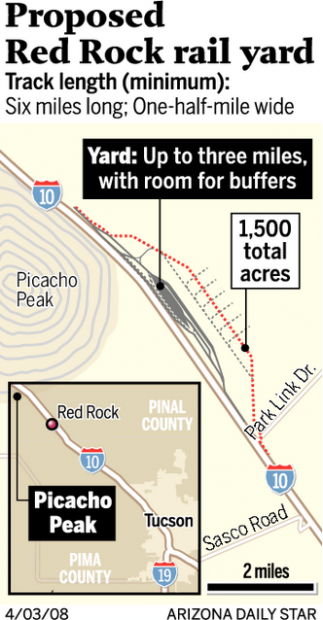
The site stretches six miles along Interstate 10, just east of the peak. Concerns about the site are multiple — and passions on either side are high.
The entire area the railroad is seeking to acquire, 1,500 acres, is three times the size of a rail yard in Tucson.
How big is that? If you lay the plot of land over Tucson it would stretch from the UA's Arizona Stadium to near Pantano Road. And the rail yard itself would not only exceed the size of Tucson International Airport — it would even be larger than Phoenix's Sky Harbor International Airport.
People are also reading…
The rail yard's initial size is expected to be about 550 acres.
Such a facility is needed, Union Pacific says, because the number of trains that cross through the area daily is expected to nearly double during the next 10 years. Between 1999 and 2006, Union Pacific's Arizona business increased by 46 percent, the company reports.
Nevertheless, concerns remain about the environmental impacts, particularly the proposed yard's proximity to a Central Arizona Project canal that delivers water to Southern Arizona. Farm and business owners worry it could harm them, since Union Pacific is seeking to purchase state land leased by Herb Kai, a cotton and pecan farmer. And preservationists say the spot — the site of an important Civil War battle — is filled with nostalgia.
"It's not the kind of thing you want next to a signature state park," said Sandy Bahr, lobbyist for the Sierra Club.
But those in favor of the development say the project could inject jobs into the economy of Pinal County, the fastest-growing county in the country. They also say noise and population would be minimized, in part by buffer space around the facility.
Still, since the issue poked its head up more than a year ago, it's been engulfed in politics.
State Rep. Jonathan Paton, R-Tucson, introduced a bill last year that attracted bipartisan support but also got wrapped up in a debate over federal pre-emption. Ultimately, it earned a veto from Gov. Janet Napolitano.
This year, as Union Pacific continues to seek the land at auction through the Land Department, rail-yard foes started over. But the legislation takes less drastic measures that some say could make the development all but certain.
Law narrowed
While lawmakers initially sought to give the Arizona Corporation Commission the power over deciding whether a railroad can use state land and whether the railroad can exercise its condemnation power, the new version is much more limited in scope.
Now it directs the Arizona Department of Transportation to conduct environmental impact studies and call a public hearing on major rail projects. And to pacify advocates of a long-desired Tucson-Phoenix commuter rail, the bill would exempt those kinds of state projects.
But the potential effects of the railroad remain vague.
"Obviously, there's going to be an impact," says Janick Artiola, a research scientist and associate professor in the UA's Department of Soil, Water and Environmental Science. But Artiola said it's hard to predict.
"When you exhaust chemicals into the air, you don't know where it's going to end up — it could be minimal, or it could end up a mile away," he said. And on the concern about the proximity of the potential yard to the CAP canal about a half-mile away, he said, "The closer you bring in traffic to an open source of water, the more likely there will be an impact."
Luis Heredia, public affairs director for Union Pacific, says those issues will be vetted since the railroad must already meet state and federal environmental standards.
"We feel the process is redundant," he said of the legislation.
State Rep. Steve Farley, D-Tucson, says expanding the railroad could be good for the environment since it might reduce the need for commercial trucks on I-10. "We shouldn't be making it harder; we should be making it easier for the railroad," he said.
The Land Department has yet to determine whether to put the land up for auction, as Union Pacific has requested, said Jamie Hogue, deputy commissioner.
The department is not required to do environmental impact studies. It would only be after Union Pacific obtains the property that the railroad would need to face the state and federal regulations.
Union Pacific remains opposed to the legislation, and during a hearing before the Senate Transportation Committee Tuesday at the state Capitol, a railroad attorney predicted a legal challenge if the legislation is passed. The bill, which has already passed the House, cleared that committee and needs to go to the full Senate.
Rooftops or train tracks?
Legislators and community activists say the railroad failed in the beginning to listen to communities when in 2006 it sought to develop projects in Red Rock and Yuma.
In an effort to better deal with anxiety, Union Pacific recruited Heredia, a former staffer for U.S. Rep. Raúl Grijalva, D-Ariz. Heredia, who grew up in Yuma, says despite the complaints, "local communities are in the front seat of the process."
"That whole stretch will either transform into rooftops, or it can transform into some economic opportunity for Pinal County," he said.
A proponent of the rail yard, state Rep. Tom Prezelski, D-Tucson, says he's not fond of the "urbanization going on in the area, and I'm not sure if it's sustainable, but I think this project is good for the state," he said.
Prezelski was an opponent of Paton's legislation last year, but this year he helped lead discussions with Union Pacific to bring the bill to its current form. But Prezelski says he still thinks it conflicts with federal law.
Historic ground
Since the 1970s, Tucsonan Richard Collins has been one of about 300 Arizonans who re-enact a Civil War battle near the base of the peak. Collins says the actual 1862 battle, which resulted in the withdrawal of Confederate forces from Arizona, was likely in the area were the rail yard would be.
"I think it would destroy a lot of historic ground," Collins said. "Important historical areas of Arizona are disappearing very quickly, and this seems a shortsighted solution to the railroad problem."
Paton, the sponsor of this year's legislation, says the railroad is still being treated the way it was in the 1800s.
"It's a different day in Arizona," he said. "We're not in the Old West anymore. We're in the New West that has whole different demographic pressures."
Workers undecided
The Union Pacific workers union — the Brotherhood of Locomotive Engineers and Trainmen — is unsure how the project would affect them, said Vince Verna, legislative liaison for the Tucson chapter.
"There's potential reasons we could have some heartburn over it," said Verna. Chief among their concerns is the potential commute for Tucson engineers.
"I don't see very many people picking up stakes and moving to Red Rock," Verna said. Since shifts can last up to 16 hours, Verna said driving 60 miles home from work could be dangerous, and the union is waiting for more information — like whether Union Pacific will provide transportation.
Heredia said no determinations on transportation for employees will be made until the project is further along, and he stressed that the site will provide new jobs for residents in Pinal County.
Meanwhile, the impact of the latest legislative attempt to deal with the railroad remains to be seen.
While Union Pacific argues it could harm its business in the state, others say the legislation does little more than let people air their concerns.
And on that point, Heredia says, Pinal County has already had its own hearings.
But for the sponsor of the bill, that's not enough. "Giving the citizens the power to speak their mind is a powerful thing," Paton said.


 Hotel on the rise at Tucson’s Uptown project


