

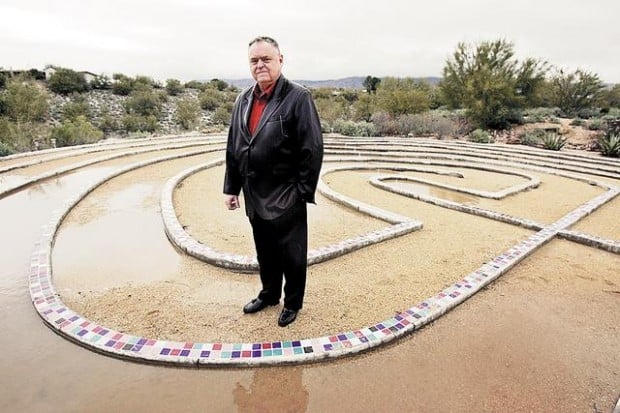
An unassuming white sign with blue letters marks the entrance to an unusual desert trail:
"Welcome to Unity of Tucson's Labyrinth. Please enjoy your experience of quiet and solitude."
Sunlight reflects off the ankle-high, tiled concrete curb that delineates the meandering footpath from the edge to the center of a 50-foot circular clearing perched above a sun-bleached, bursage-dotted wash.
Some mistake the labyrinth for a maze, said Larry Swartz, co-minister at Unity of Tucson, 3617 N. Camino Blanco. "A maze you can get lost in; a labyrinth is directed."
The church is south of East River Road, between North Craycroft and North Swan roads.
The labyrinth's raised curb, Swartz said, enables the visually impaired to navigate the path, which is also wide enough to accommodate a wheelchair.
People are also reading…
Silver garden lamps illuminate the perimeter at night.
Always open to the public, it's a place to quiet the mind, watch shadows skate over the Santa Catalina Mountains, take in the sunset and stroll amid barrel cacti, ocotillo, staghorn cholla, agave and saguaros.
A light breeze jingles bells hanging from the church roof. The only other sounds a labyrinth visitor is likely to hear are the rush of wind through palo verde and mesquite trees, the chaotic chorus of many birds and the crunch of gravel underfoot.
There are no religious symbols in the area around the labyrinth, except for a small ceramic cherub lazing on a bench.
"For many people (the labyrinth) provides a tool for a little exploration of their connectivity with their creator — with God," Swartz said. "For some people it represents something in life that they're questioning. They take that with them as they enter."
Ideally, Swartz added, visitors come away with answers to their questions.
"It becomes like a point of focus where you walk in knowing exactly where you're going to go and where you're going to end up," said Sammie Alijagic, who manages the Unity of Tucson bookstore. "With that knowledge, my troubles can begin to drift away and I can remain present and spiritually focused,"
A casual saunter to the center of the labyrinth and back takes about 15 minutes.
The classical seven-circuit, left-handed labyrinth borrows its shape from an ancient design, according to the Connecticut-based Labyrinth Society's Web site, www.labyrinthsociety.org. The Labyrinth Society was founded in 1998 "to support all those who create, maintain and use labyrinths."
The Unity of Tucson labyrinth was built in September 2001 to share with the congregation and the community the insights and serenity that can result from a walking meditation, according to a pamphlet available at the entrance.
Unity of Tucson was incorporated in 1956, Swartz said. He began as its minister in 1964, and since his wife, Mary Ellen Swartz, was ordained in 1972, they have co-ministered the congregation. They teach what Larry Swartz calls "metaphysical Christianity."
Mary Kosies, Unity of Tucson's office coordinator, walks the labyrinth frequently and believes strongly in its restorative power — not just for church members but for anyone willing to give it a try.
"If anything's bothering you at the center, you can just walk out and leave that behind," she said.
If you go
What: Unity of Tucson's labyrinth.
Where: Unity of Tucson, 3617 N. Camino Blanco.
Hours: Always open.
Cost: Free.
For more information: Call Unity of Tucson, 577-3300.


