

The Reid Park Zoo is now home to two new elephants, even as it prepares to bid goodbye to its longtime resident elephants, Connie and Shaba.
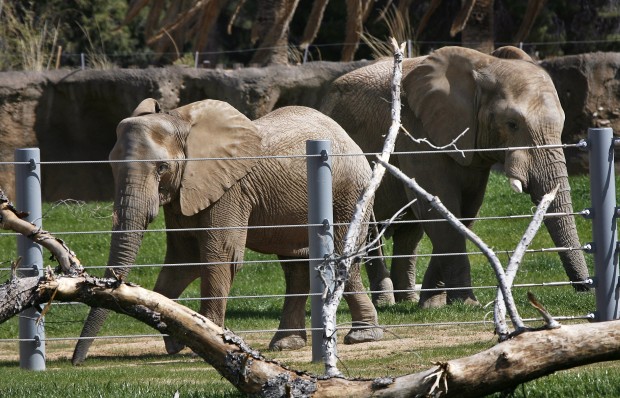
Mabu, a male African elephant, and Lungile, a female, took their first steps in the brand-new, $9.7 million elephant exhibit that is expected to be unveiled to the public in late March.
The two are part of a breeding group coming to Reid Park Zoo from San Diego Zoo Safari Park in Escondido, Calif. A female and her two male offspring, a 1-year-old and a 5-year-old, are expected to arrive in mid-March.
Mabu, who is estimated at 22 years old, has fathered nine calves since he's been in captivity.
Lungile (pronounced Loon-GEEL-ee), estimated at 21 years old, had one calf in 2007, which died a year later.
Zoo officials say they believe it is possible she can still conceive.
People are also reading…
Connie and Shaba, meanwhile, are headed to San Diego Zoo after the mayor last month brokered a deal intended to end controversy over an earlier plan to send Connie, the Asian elephant, to San Diego and keep Shaba, the African, here in Tucson to mingle with the new herd. The zoo said it was responding to accreditation requirements to refrain from mingling separate species, although that also meant severing a tie of nearly 30 years between the two elephants.
Instead, the two will remain together but will go to San Diego, which officials say is better equipped to deal with geriatric elephants.
Zoo officials don't have a date for their exodus yet, but it will likely be soon.
Zoo spokeswoman Vivian VanPeenen said the move hinges on how the two progress with training designed to boost their comfort levels with the crates that will take them on their 10-hour journey to San Diego Zoo. They've been in public training sessions for weeks.
The two new elephants look decidedly different from the current residents.
Connie and Shaba are each about 8,000 pounds. Mabu weighs 10,500 pounds. Lungile is a rather petite 4,800.
Both were wild-caught and saved from a cull in Swaziland to deal with overpopulation. They were transported to San Diego in 2003.
Their San Diego trainers are in Tucson, making sure the transition goes smoothly.
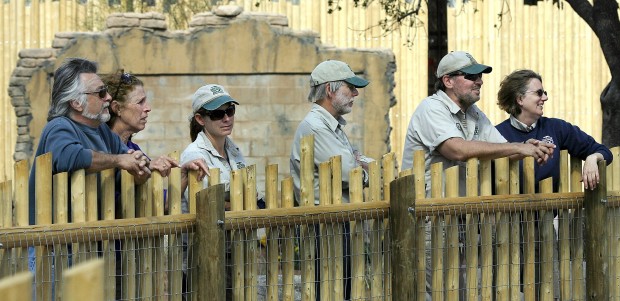
"It's taken a tremendous amount of time, and it's been extremely exciting to see it become reality," VanPeenen said as she watched the two venture into the new enclosure, which took one year to build and was a decade in planning. The new enclosure is three acres, while Connie and Shaba's existing space is one-third of an acre.
The two seemed curious, beginning to graze in the new grass. The ears-out, trunk-up stance of excitement or distress only happened briefly when a jet flew overhead.
The new elephants will not meet Connie and Shaba.
VanPeenen said Connie and Shaba will get more space and will have the opportunity to mingle with new elephants at their new home.
Tracy Toland, one of the primary critics of the original plan to split up Connie and Shaba, called the news of the new arrivals "bittersweet."
On the one hand, she said, she's glad that at least there's a chance the Tucson elephants will remain together, and said she hopes San Diego will honor Tucson's intent.
On the other, she said, she feels bad for the new elephants, since the zoo will breed them and their families will likely be split at some point in the future. "I think the community needs to look at the bigger issue and that is: Do elephants belong in captivity and should we be trying to breed them here if it means keeping splitting them up? It's a vicious cycle."
VanPeenen said Tucson is the first zoo to receive an established breeding group from another zoo.
Contact reporter Rhonda Bodfield at rbodfield@azstarnet.com or 573-4243.


