

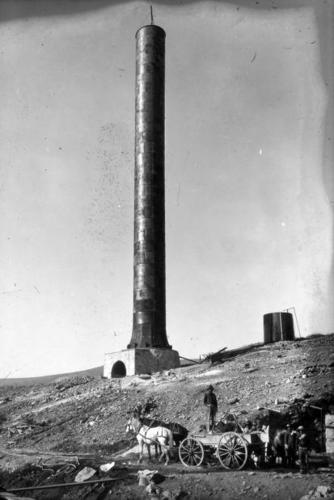
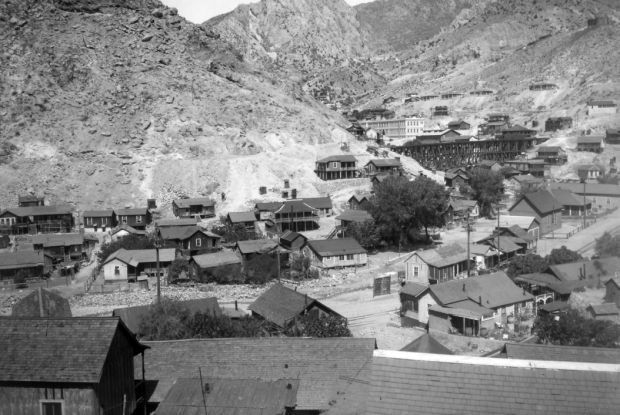
This is the first part in a two-part series on the Clifton-Morenci District.
The Clifton-Morenci District, also called the Copper Mountain District after a prominent green-stained peak, was Arizona’s first major copper-producing region, dating to the 1850s with prospectors and trappers finding copper and gold.
Henry Clifton, the town of Clifton’s namesake, and associates mined gold placers along the San Francisco River in 1864. Apache raids hindered development in the region until 1886.
Organized in 1872, the Clifton-Morenci District included the prominent towns of Clifton, Metcalf and Morenci near the junction of the San Francisco River and Chase Creek.
Robert Metcalfe — a Confederate veteran and former member of Terry’s Texas Rangers, as well as the namesake of Metcalf, seven miles north of Clifton — was credited with discovering the rich Longfellow claim while his nephew, Charles Shannon, located the Shannon Mines atop Metcalf Mountain.
People are also reading…
The mines quickly assumed prominence with the investment of wealthy New Mexico merchants, including Henry and Charles Lesinsky and their uncle, Julius Freudenthal, in the Longfellow Copper Mining Co. and the Longfellow Mine, whose ore in the late 1870s averaged 20 percent copper.
Lesinsky later sold the property to the Arizona Copper Co., a Scottish firm located in Edinburgh.
Before Henry Lesinsky built the Coronado Railroad in 1879, the ore was transported by wagon to Silver City then to Colorado and the copper markets of Kansas City and San Francisco.
Morenci was originally called Joy’s Camp for Capt. Miles Joy, an affiliate of Capt. Eber Ward, principal stockholder of the Detroit Copper Co. in 1872, acquired by William Church in 1875.
Seeking funding for his new smelter in 1880, Church traveled to the offices of Phelps Dodge & Co. in New York City to meet with William E. Dodge Jr. and metallurgist James Douglas.
Douglas was sent to Arizona to examine Church’s holdings, and with Douglas’ positive feedback Phelps Dodge advanced Church a loan of $50,000 for a smelter built in 1882 two miles south downstream from Clifton on the San Francisco River to accommodate the ores mined by the Detroit Copper Co.
Becoming a partner in the Detroit company marked the import-export firm of Phelps Dodge & Co.’s first entry into the mining business.
Three primary copper companies shaped the early years of the Clifton-Morenci District: the Detroit Copper Co., 1875-97; the Arizona Copper Co., 1882-1921, noted as the greatest copper producer during the underground mining days; and the Shannon Copper Co., 1900-19. The latter’s mines above the town of Metcalf were serviced in 1910 by the narrow-gauge Shannon-Arizona Railway to the Shannon smelter.
Serving as a company town for the Arizona Copper Co. in 1882, Metcalf included a population of 3,000 and several banks, a hospital and the ephemeral Metcalf High School, built in 1917 and closed in 1920 due to declining copper prices.
By the mid-1880s, the district’s average copper ore grade of 6 percent was considered too low to produce a high-grade product through smelting.
Credited with innovative smelting applications along with devising a leaching process leading to copper production from low-grade porphyry ores in 1893, James Colquhoun, president of the Arizona Copper Co., established a Bessemer plant in 1897 providing low-cost smelting.
In 1912, the district was annually producing 80 million pounds of copper. The Detroit Copper Co., acquired by Phelps Dodge & Co. in 1897 for $1.8 million, retained its name until 1917, when it became the Phelps Dodge Corp., Morenci Branch.
After World War I, depressed copper prices led the Arizona Copper Co. to buy the Shannon Copper Co. in 1919. Phelps Dodge acquired the Arizona Copper Co. in 1921, making it the sole producer in the district.
William Ascarza is an archivist, historian and author. Email him at mining@tucson.com
Sources: Theodore L. Cogut and William C. Conger (1999), “History of Arizona’s Clifton-Morenci Mining District, Vol. II”; William C. Conger (1987), “History of the Clifton-Morenci District”; James H. McClintock (1916), “Arizona, Prehistoric, Aboriginal, Pioneer, Modern: Vol. 2”; David F. Myrick (1984) “Railroads of Arizona, Vol. III”; Carlos A. Schwantes (2000), “Vision & Enterprise: Exploring the History of the Phelps Dodge Corporation.”


