

This is the second in a two-part series on the railroad’s impact on mining in Arizona. Read the first part at http://tinyurl.com/arizonarailroads online.
Created in 1910, the Tucson-Nogales Railroad supplemented a line established 20 years prior between Nogales and Guaymas.
At an elevation of 4,613 feet, Dragoon Railroad station — the highest point on the Southern Pacific line between Los Angeles and El Paso — also served as the junction of the Johnson, Dragoon and Northern Railroad.
The railroad supplanted the freight wagon and stagecoach as did its method of power generation. Steam, electric and diesel locomotives were employed in Arizona history for mining, passenger transport and irrigation projects for agriculture.
Standard, narrow and baby railroad gauges used at the mines in Arizona were based upon the width of the track: standard gauge (56ƒ inches), narrow gauge (less than 56ƒ inches) and baby gauge (20 inches).
People are also reading…
Standard-gauge railroads in Arizona became dominant in the early 20th century, though many narrow gauge railroads continued to service the mines.
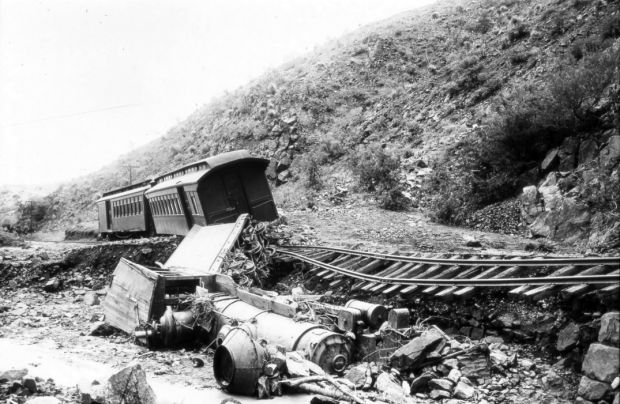
Challenges facing railroads included rockslides, floods, Indian raids and steep gradients. In 1910, the Arizona Eastern Railroad connected the eight miles between Winkelman and Christmas. It proved challenging, requiring drilling a 979-foot tunnel through solid granite, with costs averaging $100,000 per mile.
A plethora of railroad operations existed at Clifton and Morenci in the late 19th and 20th centuries.
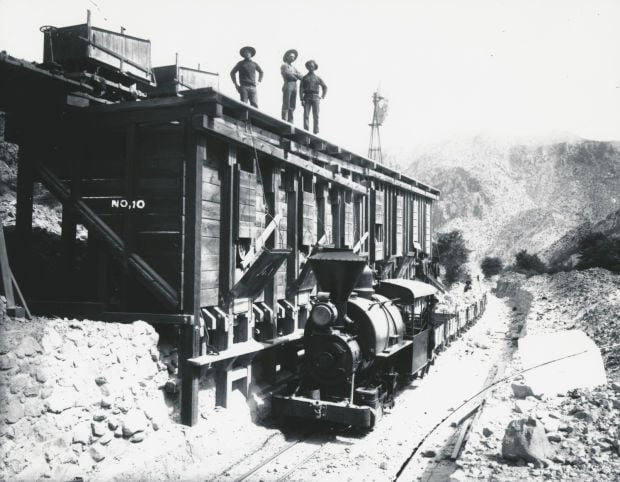
Arizona’s first narrow gauge railroad operated along Chase Creek above Clifton. The Coronado Railroad, built in 1880 and converted from 20- to 36-inch guage by 1902, connected the Metcalf mines, including the Longfellow Mine incline to the Clifton smelter until it was decommissioned in 1922.
About 71 miles away, the Arizona and New Mexico Railway in 1883 added a Southern Pacific junction at Lordsburg, opening the Copper Mountain mining district by rail to the outside world. The railroad imported coal and coke for the Clifton smelter while exporting copper bars from the Arizona Copper Co. and Detroit Copper Mining Co.
The Detroit Copper Mining Co., by then a subsidiary of Phelps Dodge Corp., built a line, the Morenci Southern Railway, in 1901. It was known as “The Corkscrew Route of America” because its five loops negotiated Morenci Gulch and a rise of 1,400 feet difference in elevation between Morenci and the San Francisco River.
The 17.87-mile route between Morenci and Guthrie transported freight and passengers until its abandonment in 1922. Replete with bridges and trestles ranging between 80 and 385 feet in length, it spanned the Gila and San Francisco Rivers at a maximum grade exceeding 2 percent.
Because of the rising servicing costs of steam locomotives, including operational efficiency and fuel, diesel locomotives and electric locomotives became the preferred power source for railroads by 1940.
The development of the Clay ore body at Morenci in the late 1930s necessitated waste rock hauled by diesel locomotives to dumps north of the mine. Electric locomotives hauled ore from the mine to the concentrator.
The 30-mile Magma Arizona Railroad hauled copper concentrate from Superior to Magma Junction and retained use of steam locomotives until they were replaced by Baldwin-Lima-Hamilton diesels in 1968.
In 1973, the world’s first three 50,000-volt alternating-current electric locomotives traversed Northeastern Arizona, servicing Peabody’s Black Mesa Coal operation. Operating under 50-kilovolt overhead wires that supplied electricity, the 6,000-horsepower General Electric E60 units included 70 hopper cars, each loaded with 100 tons of coal destined for the Navajo Generating Station near Page.
For Arizona, railroads accomplished the transition from a territory of scattered mining claims to a state built upon the profits of more than 246 mining districts, where mineral production, concentration and smelting required reliable, cost-efficient transportation.
Sources: Gerald E. Thompson and Thomas J. Cram, “Railroads and Mines in Arizona: The Cram Memoir of 1858,” Arizona and the West, Vol. 10, No. 4 (Winter, 1968); P.R. Griswold (1992), “Arizona’s Railroads: Exploring the State by Rail”; David F. Myrick (1975), “Railroads of Arizona Vol. I-III”; John W. Sayre (1985), Ghost Railroads of Central Arizona: A Journey Through Yesteryear.
William Ascarza is an archivist, historian and author of five books. Email him at mining@tucson.com


