


A pending lawsuit against Pima County marked Marana's inauspicious foray into the sewer business a few months ago.
Town officials are hoping its endeavors in becoming a regional aviation player go much more smoothly.
Preliminary talks have begun between Marana, Pinal County and representatives of the two major tenants of Pinal Air Park to discuss what — if any — development in and around the facility might benefit the area.
"The air park is a strategic asset to both the county and Marana," said Heather Murphy, communications director for Pinal County. "There are plenty of potential benefits to expanding its use."
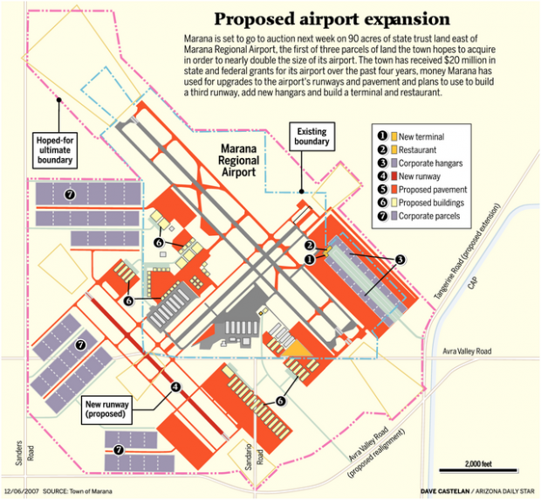
Marana already has one airport under its control. The town purchased what is now known as Marana Regional Airport from Pima County back in 2000. That airport has undergone massive upgrades over the last four years and hopes to almost double in size over the next 20 years, while plans are being formulated for how the area around the airport should be developed.
People are also reading…
Whether such expansion would occur at Pinal is still to be determined, but Marana officials want to get involved in planning for the area now.
"One of the things Marana has the opportunity to do is plan for the future," said the town's airport director, Charlie Mangum, who oversees operations at Marana Regional Airport and has been involved in future planning for Pinal Air Park.
As it stands, Pinal Air Park lies outside Marana's boundaries, though not by much.
And since all indications — including the town's planning maps, which include a huge section of southern Pinal County — point to Marana's moving in that direction soon, town officials want to get involved now in figuring out how that area gets developed.
"We want to do our research ahead of time," Marana Mayor Ed Honea said.
A former military base
The 2,080-acre Pinal Air Park is on the west side of Interstate 10 just north of the Pima-Pinal county line. Much of the former military base — which was also linked to covert CIA operations during the Vietnam War — is owned by Pinal County, though it leases that land to Evergreen Maintenance Center.
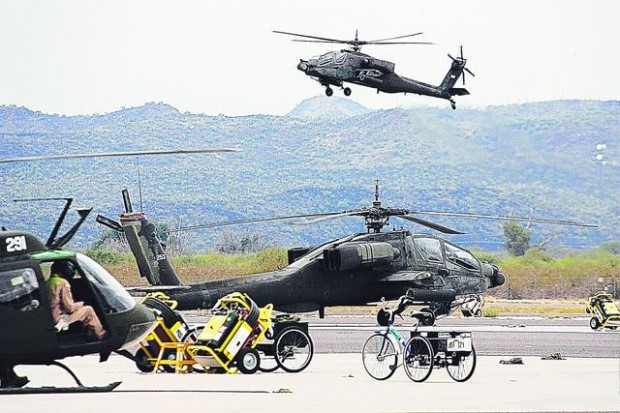
The remainder of Pinal Air Park, known as the Silverbell Army Heliport, is where the Army National Guard does its training at the Western Army National Guard Aviation Training Site, also known as WAATS.
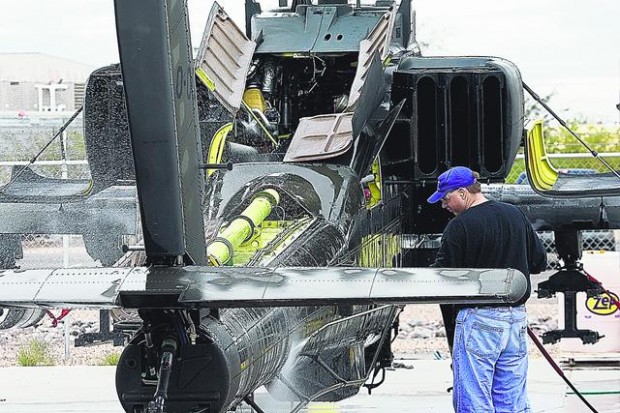
Evergreen — whose parent company Evergreen International Aviation has business interests ranging from defense contracting to hazelnut and wine production — runs what is essentially an airplane repair and storage shop. It has a 40-year lease on its land, through August 2032.
Though the air park is technically a public facility, Evergreen's portion is kept private in the interest of its clients, president of operations John Keating said.
"We just go through security at the gate because Homeland Security requires it," Keating said. "Nowadays there's no such thing as an open airport."
Though he said it doesn't matter to his company what happens in terms of future development in the area, which Marana and Pinal County officials envision could include turning the land around the air park into an industrial center, Keating said he plans to listen to what other interested parties have to say.
"To us, it doesn't make a difference one way or the other, but we're open to options so we're listening," Keating said. "The landlord would like (expansion) to happen."
Military's concerns on growth
Growth and development in a state like Arizona are inevitable, says Col. Robert Jordan Jr., the outgoing WAATS commander, who has also been involved in talks about the air park's future.
Making sure that growth doesn't infringe on the military's needs, Jordan says, is his biggest concern.
"We've been very active with Marana, with Pinal County and with developers, so they're aware of what our restrictions are . . . so they don't end up building a house next to a (training) range," said Jordan, who on Jan. 1 will turn over command of WAATS to Lt. Col. Matt Brown. "This was the first meeting of many meetings we're going to have. Any expansion they're doing we're going to be involved in."
WAATS serves as a training ground for the AH-64A Apache attack helicopter currently in heavy use in the Middle East. Jordan said his pilots fly over a 9,500-square-mile area of Southern Arizona and do their best to avoid housing developments and high-population areas.
"The communities have built up around us," Jordan said. "I can see it (the air park) expanding, as the town expands, but as cohabitants of the same area, we need to all work together."
20-year expansion program
Any growth around Pinal Air Park is likely to be somewhat similar to the plans Marana has for the land around its airport, which is in the southwest corner of town on West Avra Valley Road.
Marana hopes to take the first step of a 20-year expansion program next week when Mangum, the airport director, is set to bid at auction Monday on 90 acres of state trust land on the east side of the airport.
The land, which Mangum says has been appraised for $1.3 million, would help provide access to a new terminal, a restaurant and a corporate hangar planned for the east side of the airport.
Marana is also looking at acquiring 250 acres to the west and 208 acres on the south side of Avra Valley Road — both on state trust land. That would, among other things, allow the airport to add a third runway and provide plenty of space for additional tenants.
Eight companies lease space at Marana Regional Airport, while the planned expansion would enable that number to more than double.
"The town really feels this could be the economic engine for the town," Mangum said. "Right now we're kind of landlocked. This will allow us to bring in additional businesses, additional jobs. The town's goal is not necessarily to be just a bedroom community for Tucson."
Marana has also started the process of getting a control tower at its airport. Only about 500 of the more than 16,000 airports in the United States have control towers, Mangum said.
The town received a $150,000 grant — part of more than $20 million in state and federal grants Mangum has secured in his 4 1/2 years on the job — to work on planning for the control tower, which Mangum says is necessary for his airport's increasing traffic.
Takeoffs and landings have risen from 80,000 per year to about 110,000 on Mangum's watch.
Pinal Air Park would also need a control tower if it expands Mangum said.
"Inland port" envisioned
Though all discussions related to Pinal Air Park are of the long-range-planning variety, Marana and Pinal County officials do have a distinct vision for the area. They see it as being a prime location for a global freight operation, what Marana town manager Mike Reuwsaat calls an "inland port" due to its proximity to the Union Pacific railroad tracks just east of I-10.
To see if that's even viable, though, an airport-noise-influence study would need to be commissioned.
"We believe there is a need for such a study," said Murphy, Pinal County's communication director. "Out of that study would come recommendations for land use in the area based on scenarios."
Pinal County recently completed a master plan for its parks, trails and open space and hopes to do a similar long-term plan for Pinal Air Park as part of its county comprehensive plan.
"The long-range planning that makes for a good community is what we're pursuing at all levels of the county," Murphy said.
Marana is close to updating its general plan, and has identified the Pinal Air Park area as a major focus.
"The bottom line is, we all have a common goal that the opening of the air park would be good for everybody," said Reuwsaat, the town manager.


