

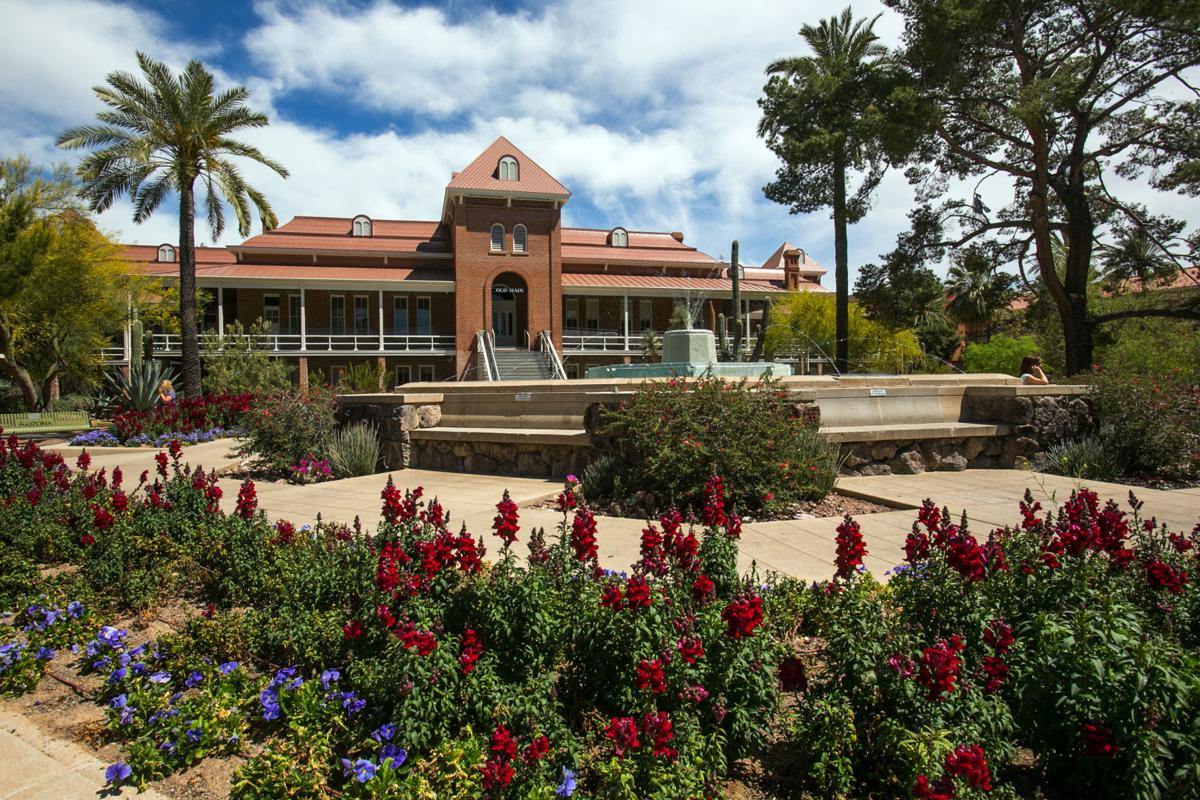
Ninety-two-year-old Laura Mendez has had many neighbors while living in her Seventh Street house since 1967.
The newest is a billionaire — the University of Arizona — which plans to buy up the street to turn into soccer fields.
“It’s a quiet and nice neighborhood, and it’s a bummer seeing neighbors move and the street go quiet,” Mendez said.
Some residents are cashing out, while others are holding out as the UA acquires Seventh and Eighth Streets in Rincon Heights for the newest campus recreation expansion.
The university is in the process of purchasing and developing the entire 10-acre block area between Highland and North Cherry avenues. In the past two years, the university has bought four properties in the neighborhood.
Arizona Ambassador tour guides advertise to prospective students that “campus is comfortably situated inside a 1-square-mile block,” but the campus now bulges noticeably outside that parameter. Parking lots and garages, student housing and faculty offices have spilled into previously residential Tucson to accommodate the university’s expanding footprint.
People are also reading…
The new North Recreation Center and Honors Village situated north of Speedway are the latest examples of growth on a campus that now educates more than 35,000 undergraduates.
“The university has an increasingly diverse and qualified student body,” said campus architect Peter Dourlein, from the university’s office of Planning, Design, and Construction. “Those people need space. Our job at PDC is to shape the future.”
In fiscal year 2019, the office spent $4.35 million buying properties, according to its Report on Acquisitions and Sales of Land and Improvements. In fiscal year 2018, the number was almost $10 million, and in 2017 over $13 million.
The budget is primarily made of funds that are generated by the university through tuition, fees, and donations, said Bruce Vaughan, planning, design and construction real estate director. If a project is for a specific academic department, then that department might also contribute toward payment.
The university has several options when property hunting. Purchases over $500,000 must be approved by the Arizona Board of Regents unless the property is within the university’s planning boundary, as defined in its master plan.
The university planning boundary is reflective of the Board of Regents-approved 20-year development plan for the university.
When houses fall within this planning boundary, the university has the power of eminent domain, which allows it to legally force private owners to sell their property.
Vaughan said the university avoids eminent domain, preferring to buy property as it is put up for sale, to maintain good relations with the community.
Until recently, the university’s planning boundary ran along Sixth Street and formed the southern border of its advertised 1-square-mile footprint. In recent years it has advanced southward, snaking along Seventh Street to include the Main Campus Recreation Center, and most recently the South Stadium Garage.
Dourlein said more fields are needed for the university’s rec center.
“The idea is also that placing fields instead of high rises in that neighborhood will be more respectful of the neighbors,” he said.
Some homeowners embrace the university’s growth, knowing they’ll get a fair price for their property and enjoy cashing in on their real estate investments.
Chris Chadler sold his longtime Seventh Street property to the university in November.
“I never had a problem with it because I’m an investor and that’s what the property was for me. It was all economics,” Chadler said. “The university paid for an appraisal and made me an offer, I countered, and they came up more. It was not a lowball offer at all.”
He retired the day he received the check.
Dave Davis has been a resident on Eighth Street for 19 years and sees parallels between his neighborhood and the adjacent block, which the university has since turned into the South Stadium Garage.
“It is disconcerting no longer having immediate neighbors and knowing that houses will stay vacant until demolition,” he said. “I love UA, I’m an alumnus, but they’re not very good neighbors.”
However, Mendez said she still enjoys the accessibility and parking benefits of living next to the university.
“We’re not sure if we’ll sell yet,” she said. “My sons and I really enjoy living here.”
Conor Villines is a University of Arizona student. This article was originally reported for a UA journalism class.



 101 homes to be built on NW Tucson corner


