WASHINGTON — As Speaker Mike Johnson gathered House Republicans behind closed doors Wednesday to sell the spending deal he reached with Democrats, one thing quickly became clear: many GOP lawmakers weren't buying it.
Rep. Warren Davidson of Ohio left early, saying he had enough.
"I'm not going to sit there and listen to that drivel, because he has no plans to do anything but surrender," Davidson said.
In the afternoon, 13 Republicans refused to support a routine procedural vote setting the stage for considering three GOP-led bills. A similar revolt occurred in June when, for the first time in some 20 years, such a routine vote was defeated, essentially grinding the House to a halt.
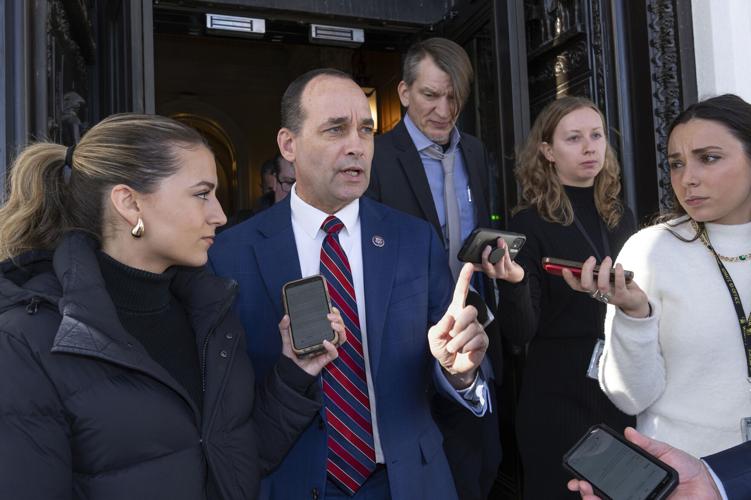
"We needed to send a message that what's going on with this announced agreement is unacceptable," said Rep. Bob Good, R-Va., the chairman of House Freedom Caucus, made up many of the House's most conservative lawmakers.
People are also reading…

Rep. Bob Good, R-Va., is interviewed by reporters Dec. 14 at the Capitol in Washington.
House Republicans are off to a raucous start in their first week back in Washington after an extended holiday break. The open criticism of the speaker and the parliamentary standoff reflects deep divisions within the party that continued despite new leadership, raising questions about his ability to unite the conference.
Most Republicans still support for Johnson, saying he is doing the best he can with such a slim majority and Democrats in control of the Senate and White House. But it took only eight Republicans to oust Rep. Kevin McCarthy as speaker last year — along with 208 Democrats. A similar revolt from just a handful of Republicans would leave Johnson vulnerable as well.
Rep. Chip Roy, R-Texas, told Fox News he's not going to say what would trigger a motion by him to seek Johnson's removal, but "we've got to do better than this."
Rep. Tim Burchett, R-Tenn., said "a lot of people are talking about" a motion to vacate Johnson from the speakership. But the Tennessee Republican who helped oust McCarthy said he's personally not there "yet."
"There is a lot of division with the conference. We've got a brand new leader, but it's kind of the same ol' song and dance," Rep. Steve Womack, R-Ark., told reporters upon exiting Wednesday's closed-door meeting of House Republicans.
Facing reporters afterward, Johnson said he was not concerned about losing his job.
"Look, leadership is tough. You take a lot of criticism, but remember, I am a hard-line conservative. That's what they used to call me," Johnson said. "I come from that camp."

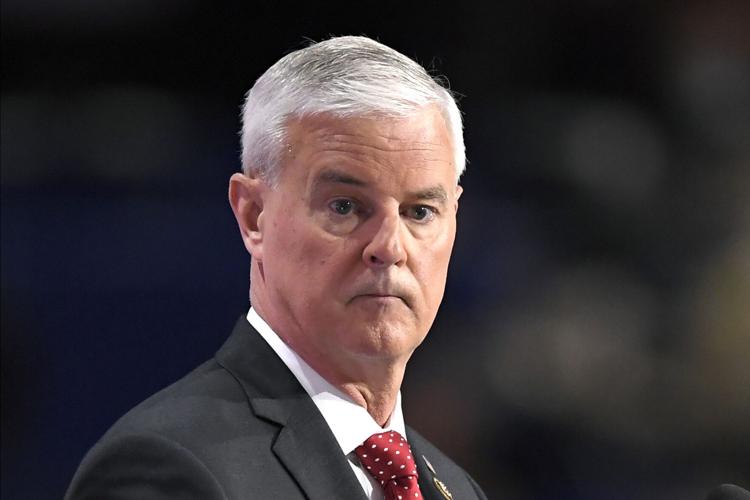
Rep. Steve Womack, R-Ark., during the opening day of the Republican National Convention July 18, 2016, in Cleveland.
Many Republicans doubt colleagues would want to put the House through more of the chaos that erupted when McCarthy was ousted. It took nearly three tense weeks to land on Johnson as a replacement for McCarthy. Johnson has been on the job for less than three months, having just recently filled out his staff.
"The reality is nobody wants to go through another speaker's campaign," said Rep. Tom Cole, R-Okla. "You can take somebody down once and say you're killing a tyrant. When you do it twice, you become an assassin. So I think the speaker is much more secure than people realize."
Government funding expires Jan. 19 for about 20% of the federal government, while the rest of the government is funded only through Feb. 2. The agreement that McCarthy negotiated with the White House called for capping defense spending at $886 billion and non-defense spending at about $704 billion for the current fiscal year, which began in October. A series of side agreements made as part of the debt ceiling deal lifts the non-defense spending to about $772 billion.
In recent months, lawmakers worked to incorporate that agreement into the spending bills that will fund the federal government for the year. House and Senate leaders announced their agreement on overall spending levels Sunday.

Speaker of the House Mike Johnson, R-La., pauses during a news conference Wednesday at the Capitol in Washington.
Johnson said when announcing the overall spending numbers that he was able to speed up the roughly $20 billion in cuts already agreed to for the Internal Revenue Service in the debt ceiling deal and rescind about $6 billion in COVID relief money not yet spent.
However, McCarthy's debt ceiling deal was not popular with many House Republicans and contributed to his ouster. They hoped Johnson would gain more non-defense spending cuts and do more to deter the historic number of people arriving at the U.S.-Mexico border from countries all over the world.
The GOP infighting gives Democrats that chance to highlight the division going into an election year.
"These guys are unable to govern and they're unfit to govern and that's what you saw today," said Rep. Jim McGovern, D-Mass.
The debate over this year's spending bills is separate from the negotiations that are taking place to secure additional funding for Israel and Ukraine.
Many Republicans believe Johnson got what he could given the slim majority and debt ceiling agreement he inherited.
"He's doing the best he can under the circumstances," said Rep. Tom Emmer, R-Minn.
Today in history: Jan. 11
1908: The Grand Canyon

In 1908, President Theodore Roosevelt proclaimed the Grand Canyon National Monument (it became a national park in 1919).
1935: Amelia Earhart

In 1935, aviator Amelia Earhart began an 18-hour trip from Honolulu to Oakland, California, that made her the first person to fly solo across any part of the Pacific Ocean.
1963: The Beatles

In 1963, the Beatles’ single “Please Please Me” (B side “Ask Me Why”) was released in Britain by Parlophone.
1964: Luther Terry

In 1964, U.S. Surgeon General Luther Terry issued “Smoking and Health,” a report that concluded that “cigarette smoking contributes substantially to mortality from certain specific diseases and to the overall death rate.”
1989: Ronald Reagan

In 1989, nine days before leaving the White House, President Ronald Reagan bade the nation farewell in a prime-time address, saying of his eight years in office: “We meant to change a nation and instead we changed a world.”
2010: Mark McGwire

In 2010, Mark McGwire admitted to The Associated Press that he’d used steroids and human growth hormone when he broke baseball’s home run record in 1998.
2020: Coronavirus

In 2020, health authorities in the central Chinese city of Wuhan reported the first death from what had been identified as a new type of coronavirus; the patient was a 61-year-old man who’d been a frequent customer at a food market linked to the majority of cases there.
2021: Pope Francis

One year ago: Pope Francis changed church law to explicitly allow women to do more things during Mass, while reaffirming they cannot be priests.