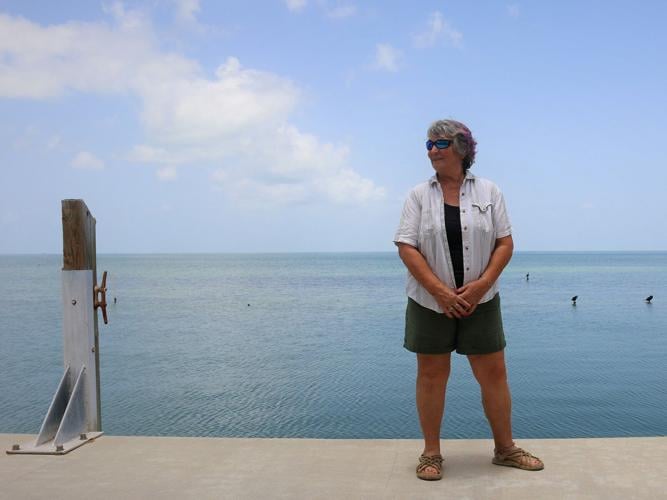
THE FLORIDA KEYS — Cynthia Lewis carefully pulled back the lid covering a 240-gallon tank.
As the bubbles subsided, there they were: her life’s work, the very animals she has studied for more than two decades, dying in front of her eyes.
Corals, hundreds of them, lined the scores of saltwater tanks in the outdoor lab Lewis oversees. All showed signs of serious trouble — paled patches or bleached entirely white — and some were likely already dead.

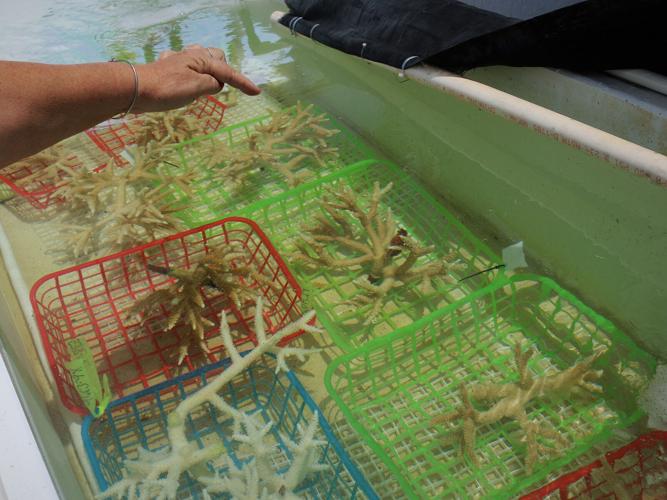
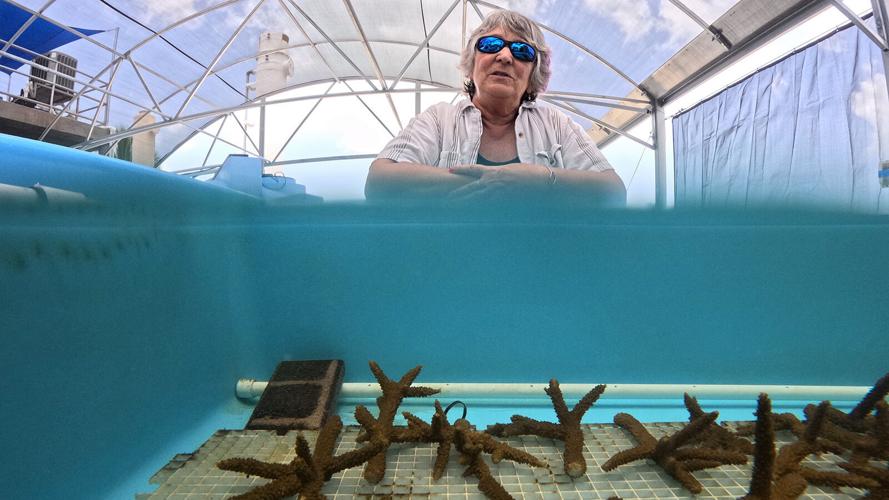
Cynthia Lewis, director of the Keys Marine Laboratory, monitors the health of several staghorn coral species that were rescued from the scorching ocean this week as an unprecedented marine heat wave threatens a massive die-off. Hundreds of coral specimens have been transported to the lab to stay safe in the unlivable heat.
Just days and even hours before, many of these corals were in the open ocean, where temperatures surged this past week into the triple digits for the first time in recorded history. A buoy stationed in the waters around Manatee Bay, to the north of Key Largo, recorded an ocean temperature of 101.1 degrees at 6 p.m. July 24. If verified, that could be the hottest sea surface temperature ever recorded on Earth.
People are also reading…
Now, scientists are scrambling to evacuate corals from their suddenly unlivable waters. More than 1,500 corals and counting have already been harvested from offshore nurseries over the past week and delivered to their new refuge in the temperature-controlled tanks at the Keys Marine Laboratory on Long Key.
The corals will likely shelter here — in what Lewis describes as a “coral halfway house” — for months until the ocean heat subsides. This time of the year, water temperatures should be in the mid-80s, not pushing mid-90s or higher.
“It’s happening so much earlier than we’ve ever seen it,” said Lewis, the lab’s director. She paused in the 95-degree heat to catch her breath.
“It’s an unprecedented event: We’ve never seen it this hot, for this long, this early.”

Cynthia Lewis, director of the Keys Marine Laboratory, points to staghorn corals that were recently bleached in an ongoing, unprecedented marine heat wave.
In a last-ditch effort to curb mass bleaching and death, scientists from across the state who monitor offshore nurseries are using the lab as refuge. The Tampa-based Florida Aquarium, the state’s wildlife commission and the University of South Florida in St. Petersburg are using the coral refuge.
Lewis worries for her staff. Like her, they are losing animals they dearly love. And fast.

For many working to round up corals, there’s no time to grieve, Lewis says. That part will come later, as it inevitably does in this line of work, marred by disease, human-caused water quality problems and the looming threats of climate change.
But for now, she says, there is only time to act. When you’re dealing with super-heated corals in an unprecedented marine heat wave, every minute counts.
“There’s an emotional toll that nobody can understand unless you’ve been in the trenches and done it yourself,” Lewis said. “They’re under a lot of emotional stress. But for now, they’re running on adrenaline. They’ve got to get it done.”
Last week, the federally operated Coral Reef Watch placed the Florida Keys under a bleaching Alert Level 2, the highest alert level on the scale.

That means there’s a likelihood of more than 90% of all the reefs and corals in the Florida Keys bleaching at some point this summer, according to Bill Precht, a Miami-based coral scientist with more than four decades of research experience.
Acting quickly to soften the crisis, the Coral Restoration Consortium, a community of global experts, sent out guidance this week with advice for how scientists in Florida should respond: Immediately cease restoration activities, the consortium urged, and move offshore corals to land facilities. Monitor the health of rescued corals daily. Document the losses. Take pictures. And do your best.
When temperatures rise, corals begin bleaching, or weakening, as they expel the tiny algae species living in their tissues. When a coral bleaches, it becomes more susceptible to diseases like the lesion-causing stony coral tissue loss disease, which is impacting more than 20 coral species across the Caribbean.
The number of weeks when the water temperature is above a coral’s bleaching threshold for a given location is usually eight to 10 weeks during a bad summer, according to Precht.
This year, some areas are already entering week six.

Cynthia Lewis, director of the Keys Marine Laboratory, has overseen operations as a coral evacuation is underway. Hundreds of corals are being relocated to Lewis' lab as ocean temperatures hover in the mid-90s.
“And it’s only July. We likely haven’t seen the warmest part of the year yet,” Precht said. Even if temperatures were to stay the same, and not get any warmer through August and September, there could be at least nine more weeks above the bleaching threshold, he said. That could be 14 weeks, or more, with inhospitable temperatures for corals this year.
“All the clues in front of us are pointing to that this year is going to be catastrophic — unlike any other year,” Precht said. “We could be losing corals in percentages that we’ve never lost before in a year.”
For Keri O’Neil, the ongoing coral rescue operation has been a “crazy, crazy time.”
As the director of the Tampa-based Florida Aquarium’s Coral Conservation Program, O’Neil and a team of researchers spent last week driving up and down the Florida Keys, scooping up elkhorn corals reined in from offshore nurseries.
The team drove those corals to Lewis and the Keys Marine Laboratory, where they “rent” a few of the 60 saltwater tanks, which range anywhere from 40 to 1,000 gallons. The lab, part of the larger St. Petersburg-based Florida Institute of Oceanography, is the favorite landing spot for most coral rescuers, as it’s located roughly in the middle of the 220-mile island chain.

Their work is especially pressing because of what’s on the horizon: The August full moon, one week away, is when corals begin to spawn. It’s a crucially important period when creating future corals begins — and this year, it’s aligning with the marine heat wave.
“It’s really easy to get to this point where you just want to throw your hands up in the air and give up,” O’Neil said. “But our work is more important now than ever. We can’t just give up.”
Photos: Coral evolution tweaked for global warming

A coral reef is shown in Kaneohe Bay on Friday, Oct. 1, 2021 in Kaneohe, Hawaii. Scientists are trying to speed up coral's evolutionary clock to build reefs that can better withstand the impacts of global warming. For the past five years, researchers in Hawaii and Australia have been conducting experiments to prove their Darwinian theories work. They say they do, and now they're getting ready to plant selectively bred and other lab-evolved corals back into the ocean to see if they can survive in Nature. If successful, the scientists say the more heat tolerant corals could help save vital reefs that are dying from climate change. (AP Photo/Caleb Jones)

Kira Hughes, a coral researcher at the University of Hawaii's Institute of Marine Biology, drives a boat in Kaneohe Bay during a survey dive on Friday, Oct. 8, 2021. Scientists are trying to speed up coral's evolutionary clock to build reefs that can better withstand the impacts of global warming. For the past five years, researchers in Hawaii and Australia have been conducting experiments to prove their Darwinian theories work. They say they do, and now they're getting ready to plant selectively bred and other lab-evolved corals back into the ocean to see if they can survive in Nature. If successful, the scientists say the more heat tolerant corals could help save vital reefs that are dying from climate change. (AP Photo/Caleb Jones)

Kira Hughes, a coral researcher at the University of Hawaii's Institute of Marine Biology, looks at coral growing in a tank at a lab in Kaneohe, Hawaii on Friday, Oct. 1, 2021. Scientists are trying to speed up coral's evolutionary clock to build reefs that can better withstand the impacts of global warming. For the past five years, researchers in Hawaii and Australia have been conducting experiments to prove their Darwinian theories work. They say they do, and now they're getting ready to plant selectively bred and other lab-evolved corals back into the ocean to see if they can survive in Nature. If successful, the scientists say the more heat tolerant corals could help save vital reefs that are dying from climate change. (AP Photo/Caleb Jones)

Coral ecologist Crawford Drury sets up test tubes to collect spawning coral eggs in a lab at the University of Hawaii's Institute of Marine Biology in Kaneohe, Hawaii, Saturday, Aug. 7, 2021. Scientists are trying to speed up coral's evolutionary clock to build reefs that can better withstand the impacts of global warming. For the past five years, researchers in Hawaii and Australia have been conducting experiments to prove their Darwinian theories work. They say they do, and now they're getting ready to plant selectively bred and other lab-evolved corals back into the ocean to see if they can survive in Nature. If successful, the scientists say the more heat tolerant corals could help save vital reefs that are dying from climate change. (AP Photo/Caleb Jones)

Test tubes are set up to collect spawning coral eggs in a lab at the University of Hawaii's Institute of Marine Biology in Kaneohe, Hawaii, Saturday, Aug. 7, 2021. Scientists are trying to speed up coral's evolutionary clock to build reefs that can better withstand the impacts of global warming. For the past five years, researchers in Hawaii and Australia have been conducting experiments to prove their Darwinian theories work. They say they do, and now they're getting ready to plant selectively bred and other lab-evolved corals back into the ocean to see if they can survive in Nature. If successful, the scientists say the more heat tolerant corals could help save vital reefs that are dying from climate change. (AP Photo/Caleb Jones)

Kira Hughes, a coral researcher at the University of Hawaii's Institute of Marine Biology, leaves Coconut Island as she navigates her boat into Kaneohe Bay, Hawaii on Saturday, Aug. 7, 2021. Scientists are trying to speed up coral's evolutionary clock to build reefs that can better withstand the impacts of global warming. For the past five years, researchers in Hawaii and Australia have been conducting experiments to prove their Darwinian theories work. They say they do, and now they're getting ready to plant selectively bred and other lab-evolved corals back into the ocean to see if they can survive in Nature. If successful, the scientists say the more heat tolerant corals could help save vital reefs that are dying from climate change. (AP Photo/Caleb Jones)

Kira Hughes, a coral researcher at the University of Hawaii's Institute of Marine Biology, looks at a test tube with eggs and sperm from spawning coral in Kaneohe Bay, Hawaii on Saturday, Aug. 7, 2021. Scientists are trying to speed up coral's evolutionary clock to build reefs that can better withstand the impacts of global warming. For the past five years, researchers in Hawaii and Australia have been conducting experiments to prove their Darwinian theories work. They say they do, and now they're getting ready to plant selectively bred and other lab-evolved corals back into the ocean to see if they can survive in Nature. If successful, the scientists say the more heat tolerant corals could help save vital reefs that are dying from climate change. (AP Photo/Caleb Jones)

Kira Hughes, a coral researcher at the University of Hawaii's Institute of Marine Biology, uses a satellite map on her cellphone as she navigates her boat to a reef in Kaneohe Bay, Hawaii on Saturday, Aug. 7, 2021. Scientists are trying to speed up coral's evolutionary clock to build reefs that can better withstand the impacts of global warming. For the past five years, researchers in Hawaii and Australia have been conducting experiments to prove their Darwinian theories work. They say they do, and now they're getting ready to plant selectively bred and other lab-evolved corals back into the ocean to see if they can survive in Nature. If successful, the scientists say the more heat tolerant corals could help save vital reefs that are dying from climate change. (AP Photo/Caleb Jones)

Kira Hughes, a coral researcher at the University of Hawaii's Institute of Marine Biology, looks at a test tube full of coral eggs and sperm collected from a reef in Kaneohe Bay, Hawaii on Saturday, Aug. 7, 2021. Scientists are trying to speed up coral's evolutionary clock to build reefs that can better withstand the impacts of global warming. For the past five years, researchers in Hawaii and Australia have been conducting experiments to prove their Darwinian theories work. They say they do, and now they're getting ready to plant selectively bred and other lab-evolved corals back into the ocean to see if they can survive in Nature. If successful, the scientists say the more heat tolerant corals could help save vital reefs that are dying from climate change. (AP Photo/Caleb Jones)

Coral researchers shine a flood light into the Kaneohe Bay as lights from Kaneohe, Hawaii, are seen in the distance, Saturday, Aug. 7, 2021. Scientists are trying to speed up coral's evolutionary clock to build reefs that can better withstand the impacts of global warming. For the past five years, researchers in Hawaii and Australia have been conducting experiments to prove their Darwinian theories work. They say they do, and now they're getting ready to plant selectively bred and other lab-evolved corals back into the ocean to see if they can survive in Nature. If successful, the scientists say the more heat tolerant corals could help save vital reefs that are dying from climate change. (AP Photo/Caleb Jones)

Scientists pass a test tube of coral eggs and spawn collected from a reef in Kaneohe Bay, Hawaii on Saturday, Aug. 7, 2021. Scientists are trying to speed up coral's evolutionary clock to build reefs that can better withstand the impacts of global warming. For the past five years, researchers in Hawaii and Australia have been conducting experiments to prove their Darwinian theories work. They say they do, and now they're getting ready to plant selectively bred and other lab-evolved corals back into the ocean to see if they can survive in Nature. If successful, the scientists say the more heat tolerant corals could help save vital reefs that are dying from climate change. (AP Photo/Caleb Jones)

A researcher separates coral eggs in a lab at the University of Hawaii's Institute of Marine Biology in Kaneohe, Hawaii on Saturday, Aug. 7, 2021. Scientists are trying to speed up coral's evolutionary clock to build reefs that can better withstand the impacts of global warming. For the past five years, researchers in Hawaii and Australia have been conducting experiments to prove their Darwinian theories work. They say they do, and now they're getting ready to plant selectively bred and other lab-evolved corals back into the ocean to see if they can survive in Nature. If successful, the scientists say the more heat tolerant corals could help save vital reefs that are dying from climate change. (AP Photos/Caleb Jones)

A researcher separates coral eggs in a lab at the University of Hawaii's Institute of Marine Biology in Kaneohe, Hawaii on Saturday, Aug. 7, 2021. Scientists are trying to speed up coral's evolutionary clock to build reefs that can better withstand the impacts of global warming. For the past five years, researchers in Hawaii and Australia have been conducting experiments to prove their Darwinian theories work. They say they do, and now they're getting ready to plant selectively bred and other lab-evolved corals back into the ocean to see if they can survive in Nature. If successful, the scientists say the more heat tolerant corals could help save vital reefs that are dying from climate change. (AP Photo/Caleb Jones)

Coral grow in a tank at a lab at the University of Hawaii's Institute of Marine Biology in Kaneohe, Hawaii on Friday, Oct. 1, 2021. Scientists are trying to speed up coral's evolutionary clock to build reefs that can better withstand the impacts of global warming. For the past five years, researchers in Hawaii and Australia have been conducting experiments to prove their Darwinian theories work. They say they do, and now they're getting ready to plant selectively bred and other lab-evolved corals back into the ocean to see if they can survive in Nature. If successful, the scientists say the more heat tolerant corals could help save vital reefs that are dying from climate change. (AP Photos/Caleb Jones)

Coral grow in a tank at a lab at the University of Hawaii's Institute of Marine Biology in Kaneohe, Hawaii on Friday, Oct. 1, 2021. Scientists are trying to speed up coral's evolutionary clock to build reefs that can better withstand the impacts of global warming. For the past five years, researchers in Hawaii and Australia have been conducting experiments to prove their Darwinian theories work. They say they do, and now they're getting ready to plant selectively bred and other lab-evolved corals back into the ocean to see if they can survive in Nature. If successful, the scientists say the more heat tolerant corals could help save vital reefs that are dying from climate change. (AP Photo/Caleb Jones)

Kira Hughes, a coral researcher at the University of Hawaii's Institute of Marine Biology, holds a juvenile coral that is growing in a tank at a lab in Kaneohe, Hawaii on Friday, Oct. 1, 2021. Scientists are trying to speed up coral's evolutionary clock to build reefs that can better withstand the impacts of global warming. For the past five years, researchers in Hawaii and Australia have been conducting experiments to prove their Darwinian theories work. They say they do, and now they're getting ready to plant selectively bred and other lab-evolved corals back into the ocean to see if they can survive in Nature. If successful, the scientists say the more heat tolerant corals could help save vital reefs that are dying from climate change. (AP Photo/Caleb Jones)

Fish swim near a head of coral in Kaneohe Bay, Hawaii on Friday, Oct. 1, 2021. Scientists are trying to speed up coral's evolutionary clock to build reefs that can better withstand the impacts of global warming. For the past five years, researchers in Hawaii and Australia have been conducting experiments to prove their Darwinian theories work. They say they do, and now they're getting ready to plant selectively bred and other lab-evolved corals back into the ocean to see if they can survive in Nature. If successful, the scientists say the more heat tolerant corals could help save vital reefs that are dying from climate change. (AP Photo/Caleb Jones)

Fish swim near a head of coral in Kaneohe Bay, Hawaii on Friday, Oct. 1, 2021. Scientists are trying to speed up coral's evolutionary clock to build reefs that can better withstand the impacts of global warming. For the past five years, researchers in Hawaii and Australia have been conducting experiments to prove their Darwinian theories work. They say they do, and now they're getting ready to plant selectively bred and other lab-evolved corals back into the ocean to see if they can survive in Nature. If successful, the scientists say the more heat tolerant corals could help save vital reefs that are dying from climate change. (AP Photo/Caleb Jones)

Kira Hughes, a coral researcher at the University of Hawaii's Institute of Marine Biology, dives on a reef in Kaneohe Bay during a survey on Friday, Oct. 8, 2021. Scientists are trying to speed up coral's evolutionary clock to build reefs that can better withstand the impacts of global warming. For the past five years, researchers in Hawaii and Australia have been conducting experiments to prove their Darwinian theories work. They say they do, and now they're getting ready to plant selectively bred and other lab-evolved corals back into the ocean to see if they can survive in Nature. If successful, the scientists say the more heat tolerant corals could help save vital reefs that are dying from climate change. (AP Photo/Caleb Jones)

A coral reef is shown in Kaneohe Bay on Friday, Oct. 1, 2021 in Kaneohe, Hawaii. Scientists are trying to speed up coral's evolutionary clock to build reefs that can better withstand the impacts of global warming. For the past five years, researchers in Hawaii and Australia have been conducting experiments to prove their Darwinian theories work. They say they do, and now they're getting ready to plant selectively bred and other lab-evolved corals back into the ocean to see if they can survive in Nature. If successful, the scientists say the more heat tolerant corals could help save vital reefs that are dying from climate change. (AP Photo/Caleb Jones)

Fish swim on a coral reef in Kaneohe Bay on Friday, Oct. 1, 2021 in Kaneohe, Hawaii. Scientists are trying to speed up coral's evolutionary clock to build reefs that can better withstand the impacts of global warming. For the past five years, researchers in Hawaii and Australia have been conducting experiments to prove their Darwinian theories work. They say they do, and now they're getting ready to plant selectively bred and other lab-evolved corals back into the ocean to see if they can survive in Nature. If successful, the scientists say the more heat tolerant corals could help save vital reefs that are dying from climate change. (AP Photo/Caleb Jones)

Kira Hughes, a coral researcher at the University of Hawaii's Institute of Marine Biology, dives on a reef in Kaneohe Bay during a survey on Friday, Oct. 8, 2021. Scientists are trying to speed up coral's evolutionary clock to build reefs that can better withstand the impacts of global warming. For the past five years, researchers in Hawaii and Australia have been conducting experiments to prove their Darwinian theories work. They say they do, and now they're getting ready to plant selectively bred and other lab-evolved corals back into the ocean to see if they can survive in Nature. If successful, the scientists say the more heat tolerant corals could help save vital reefs that are dying from climate change. (AP Photo/Caleb Jones)

Fish swim near a head of coral in Kaneohe Bay, Hawaii on Friday, Oct. 1, 2021. Scientists are trying to speed up coral's evolutionary clock to build reefs that can better withstand the impacts of global warming. For the past five years, researchers in Hawaii and Australia have been conducting experiments to prove their Darwinian theories work. They say they do, and now they're getting ready to plant selectively bred and other lab-evolved corals back into the ocean to see if they can survive in Nature. If successful, the scientists say the more heat tolerant corals could help save vital reefs that are dying from climate change. (AP Photo/Caleb Jones)

Test tubes are set up to collect spawning coral eggs in a lab at the University of Hawaii's Institute of Marine Biology in Kaneohe, Hawaii, Saturday, Aug. 7, 2021. Scientists are trying to speed up coral's evolutionary clock to build reefs that can better withstand the impacts of global warming. For the past five years, researchers in Hawaii and Australia have been conducting experiments to prove their Darwinian theories work. They say they do, and now they're getting ready to plant selectively bred and other lab-evolved corals back into the ocean to see if they can survive in Nature. If successful, the scientists say the more heat tolerant corals could help save vital reefs that are dying from climate change. (AP Photo/Caleb Jones)