U.S. job growth topped expectations for a second straight month in April — and by a hefty margin — while the unemployment rate held steady, showing the labor market is resilient in the face of the U.S.-Israeli war on Iran and the inflation pressures it created.
However, looking beyond that headline figure, the job market is far from booming. While employers report record overall employment levels, households report employment is shrinking. Moreover, the U.S. workforce is declining at a rapid rate, the participation rate is the lowest in nearly five years and the breadth of hiring across industries continues to be narrower than average.

Here's a look at some of the other dynamics at play in the April jobs report.
Employment
The Labor Department's monthly employment report is actually two different surveys: one of establishments — employers like businesses and governments — that report how many people were on their payrolls, and one of U.S. households that report whether household members worked at the time the survey was taken. So far this year, the two tell very different stories.
People are also reading…
By the establishment survey measure, which provides the benchmark for the number of new jobs created each month, total employment is at a record high of 158.7 million people who hold payroll jobs and grew by 304,000 so far this year.
By the household survey measure, which provides the benchmark for the national unemployment rate, overall employment declined by 1.37 million this year.

A worker transports sod May 7 at MetLife Stadium in East Rutherford, N.J.
Workforce shrinks
The U.S. labor force — the total number of people who have a job or are unemployed and looking for one — is smaller today than when President Donald Trump returned to the White House for his second term. There were about 700,000 fewer people in the workforce in April than in January 2025, and the number declined in four of the past five months.
Historic decline
In fact, the workforce shrunk at a historic rate since late last year. About 1.55 million people left the labor force since it touched a record high last November, a departure wave exceeded over a comparable time only by the short-lived exodus of workers during the COVID-19 pandemic shutdowns in 2020. With households reporting a sharp drop in employment, the drop in the labor force level of about the same magnitude is the only reason the unemployment rate did not rise.
Participation falls
While the jobless rate held steady, the participation rate — the share of the total estimated U.S. population that is active in the job market either working or seeking work, another key barometer of labor market health — dropped swiftly. It declined for five straight months and is the lowest — outside the COVID-19 pandemic era — since the mid-1970s.

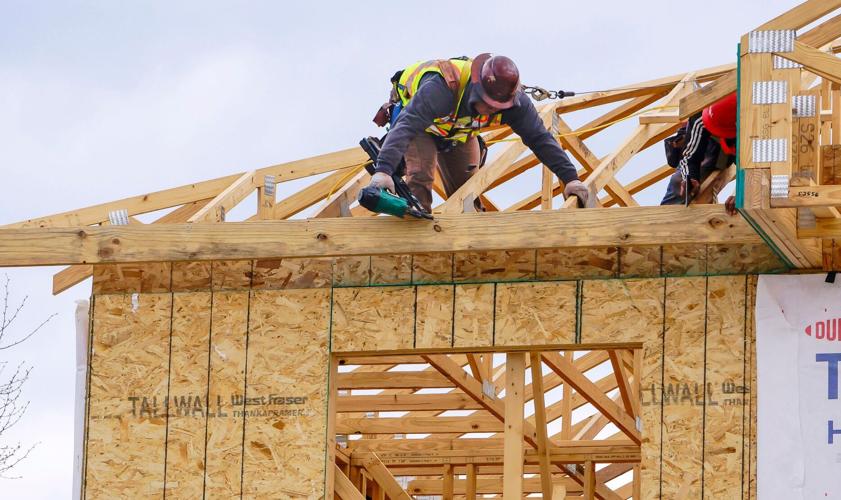
Construction workers assemble roofing frames May 5 at an under-construction apartment complex in Sheboygan, Wis.
Immigration policy
Trump returned to office promising a crackdown on immigration and his fulfillment of that pledge left its mark on the labor market. Immigrant workers accounted for most, if not all, growth in the workforce and employment under Trump's predecessor, Joe Biden. Trump's policies helped flip that script during the early months of his term last year. Through mid-2025, all job gains and workforce growth were attributable to rising employment and workforce participation by native-born workers, while those levels fell for immigrants.
Since the fourth quarter of last year, though, those trends largely reversed, and overall employment and participation among native-born workers is about where it was when Trump returned to the White House in January 2025. They are down for immigrants but not by as much as they were in mid-2025.
Narrow hiring
On the establishment side of the report, it bears watching not just how many jobs overall were created in any month, but how broad the hiring was across industries. Hiring in fact has been heavily concentrated in a handful of services sectors, healthcare in particular.
The Labor Department's diffusion index tracks hiring breadth, and that shows a slightly greater number of industries with expanding employment than contracting employment in the last few months, but the 12-month average remains tilted to narrowing employment.
What's more, the manufacturing sector, which Trump placed enormous emphasis on reviving through policies like tariffs on imported goods, continues to see poor hiring breadth. The report showed 2,000 manufacturing jobs were lost in April, snapping a three-month run of factory employment gains, and there are 77,000 fewer factory jobs now than when Trump came back to power.