WASHINGTON — Matt Lambert’s problems began more than two years ago, when he claims in court filings that his million-dollar Washington, D.C., penthouse became unlivable.
For more than a year, mold grew on his walls, water saturated the ceiling and fire suppression system pipes leaked, Lambert alleged in a March 2025 lawsuit against his homeowners' association.
The dispute spiraled into an expensive, yearslong court battle over who, if anyone, was responsible for the damage.
Police now believe the issues likely motivated Lambert to kill his building manager, James Stuart, and wound five other people in a Nov. 12 shooting that led him to kill himself.
Evidence suggests Lambert “plotted” the attack, city Chief of Police Jeffery Carroll said.
Cameras inside the VIDA Fitness gym show Lambert waited for more than an hour for Stuart to arrive, before he approached and shot Stuart from behind. Then he ran up to his unit, barricaded himself, began firing a rifle from a balcony, cut a natural gas line to his fireplace and started a fire.
People are also reading…
“We found several 100 rounds of ammunition in there,” Carroll said, adding police also found the broken gas line and fire accelerants.
Online posts before the shooting appear to show Lambert’s growing frustration with his condo issues and building management.
An 8:06 a.m. Nov. 12 post on a social media account associated with Lambert read: “My manifesto is an engineering report,” and attached screenshots of problems with his Metropole Condominium.
Hours before that, he posted screenshots of an email Metropole sent residents warning about a tripped air duct sensor. The email explained that the building’s fire alarm was disengaged as a result.
Joel Braithwaite, Lambert’s attorney, said the doctor spent more than $300,000 on legal fees and home maintenance since the water and mold issues first began in 2024. Braithwaite said Lambert felt he was treated differently than other tenants and that his issues went unaddressed by management.

Law enforcement officers work Nov. 12 at the site of a shooting in Washington.
Inside Lambert's lengthy legal battle
Lambert bought the two-bedroom penthouse condo in the trendy Logan Circle neighborhood for $1,095,000 in 2016, according to property records.
The problems, he says in the lawsuit, began after the Metropole Condominium Association began work on the condo's façade to remediate the building envelope in 2023. The repairs cost Lambert about $15,000, according to court documents. During construction, the condo association asked residents to report water intrusion, the lawsuit alleges.
A year later, in March 2024, Lambert began to notice water flooding into his unit. By that fall, excess moisture began collecting behind the drywall and mold was visible, according to the lawsuit. The mold, he claimed, was “detectable by smell” and his electrical curtains stopped working.
The building denied the presence of mold and Lambert hired independent contractors to assess the property, the lawsuit says. When those investigations revealed “visible mold contamination," he requested the HOA begin mold remediation, remove the drywall and reimburse the costs of his contractors.
“These intrusions have been reported to James Stuart from EJF since March,” Lambert wrote in an October 2024 email, according to the lawsuit.
By the time Lambert filed the lawsuit in March 2025, he “deconstructed” his condo down to the metal frames, which showed “signs of the water intrusion and elevated moisture in the unit,” according to court documents.
In its July 2024 response, the Metropole Condominium Association denied the façade project was the cause of the problems, citing the year between when the project ended and when Lambert’s water and mold problems appear to have begun.
By October 2025, Metropole filed a complaint against Urban Adventure Companies, the group that owns VIDA Fitness, and the owners of VIDA’s retail space.
“The elevated moisture levels identified within Unit 704, owned by Plaintiff Lambert, are more than likely caused by the use of the dryers and a failure of the dryer exhaust system that exclusively serves Unit C9,” the HOA argued in the third-party lawsuit.
Stuart was a witness in the lawsuit, which was ongoing when Lambert killed Stuart.
A lawyer for the retail space owners declined a request for comment. Attorneys for the condo association and VIDA Fitness could not be immediately reached.
At a Nov. 12 news conference, Braithwaite said the discovery process in lawsuits can “take a toll” on clients. Pending motions and depositions, which he said Lambert recently was involved in, could be exhausting.
“When a matter is in litigation, there's never a need to resolve these things by violence," Braithwaite said. “Ultimately, these matters should have been resolved in court.”
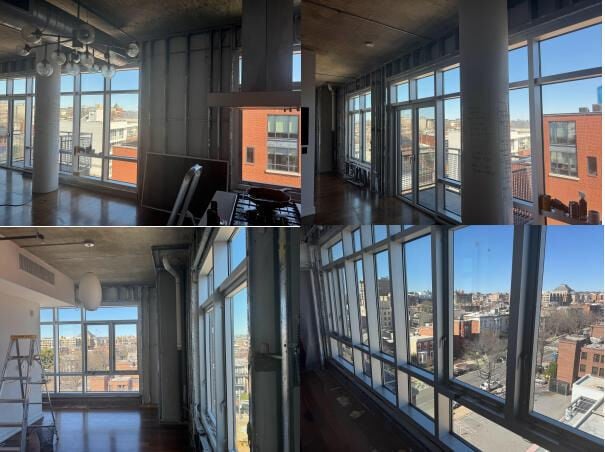
Photos in Matt Lambert's 2025 lawsuit against his condo association show his unit stripped down to metal beams amid concerns of water intrusion and mold.
Was Lambert’s health affected by mold?
For more than a year prior to the shooting, Lambert had not been primarily living in his mold-infested condominium, his attorney said. It is unclear whether Lambert stayed in the unit the night prior to the shooting.
Black mold is a fungus that grows in warm, moist areas — such as basements, showers and windows as well as naturally in the environment — and may cause the human immune system to react, especially if a person is sensitive to it, according to the Cleveland Clinic.
"Black mold exposure is most strongly associated with breathing issues, like asthma, nasal congestion, wheezing and coughing,” family physician Dr. Brintha Vasagar said.
Other symptoms may include itchy eyes or throat, runny nose, sneezing and chest tightness or difficulty breathing, the Cleveland Clinic adds.
Despite misconceptions, “black mold isn’t any more dangerous than any other type of mold,” the clinic noted. “All types of fungi can affect you if you have mold allergies.”
Vasagar added there is “not data that mold causes changes in mental health,” but adds “damp conditions and mold have both been linked to feelings of depression and anxiety.”
“This may be due to an increase in stress or worsening of sleep rather than a direct impact of mold,” she explained.