President Donald Trump said Sunday the triumphal arch he plans to build near Washington would double as a "military complex" housing drones and snipers, the second major construction project he sought to justify on national security grounds.
The president cited national security concerns for the move, though he did not identify specific threats. It echoes the rationale he offered for the estimated $400 million ballroom complex under construction on the site of the White House's former East Wing.
The arch and ballroom are part of Trump's broader effort to remake the nation's capital, including the renovation of the Lincoln Memorial Reflecting Pool, the redevelopment of a golf course in East Potomac Park and a push to add his name to the John F. Kennedy Center for the Performing Arts. The initiatives drew criticism from preservationists and others who argue they would alter some of Washington's most prominent historic landmarks.
People are also reading…
Trump said in a social media post that, at the "strong request" of the military, he agreed to turn the 250-foot arch "into a top grade Military Complex/Triumphal Arch, to house, store, and have the rapid ability to use large numbers of drones, plus Snipers, on both the roof and plaza areas, and additionally have and hold large quantities of sniper ammunition in storage."
A U.S. military official told Reuters that the Defense Department had nothing to add beyond Trump's social media post. The White House did not immediately respond to a request for comment.
Trump did not elaborate on why such capabilities would be needed at the arch. His proposed White House ballroom already was touted as a drone facility to protect Washington.

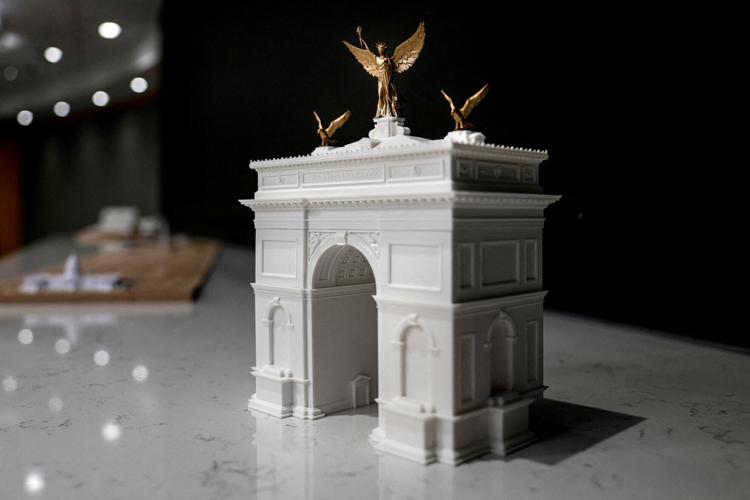
A model of a proposed arch is displayed June 4 ahead of a public comment period during a National Capitol Planning Commission meeting in Washington.
Expert questions military rationale
Mark Cancian, a retired Marine colonel, said the move appeared aimed at countering opposition to the arch, which is planned for a traffic circle near Arlington National Cemetery, about a mile from Fort Myer, an active Army installation, and about 2 miles from the Pentagon.
"It looks like it's tacked on in order to strengthen the rationale for construction," Cancian, a senior adviser with the Defense and Security Department at the Center for Strategic and International Studies, a Washington-based think tank, told Reuters. "There is this military facility (Fort Myer) long established with a variety of military capabilities one mile away. So why you need this one isn't clear."
Cancian also questioned the value of positioning snipers at the arch and said storing ammunition there would create logistical challenges.

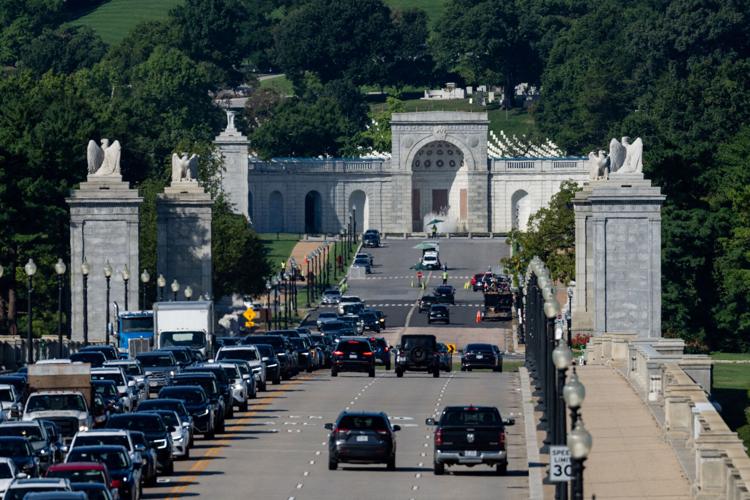
Vehicles move Sept. 8 on the Memorial Bridge near Memorial Circle in Arlington, Va., the proposed site for U.S. President Donald Trump's "Triumphal Arch," seen from the Lincoln Memorial in Washington.
Legal challenges mount
U.S. District Judge Tanya Chutkan this month ordered the Trump administration to give 48 hours' notice before engaging in any activity on the site of the triumphal arch. Her ruling came a day after the U.S. Interior Department announced plans to move forward soon with work on the arch despite legal challenges and the lack of final approval from a government planning authority.
Aviation experts raised safety concerns given the proposed site’s proximity to Reagan Washington National Airport.
The Federal Aviation Administration said last week that the arch would not pose a hazard to aircraft but would be required to have an "eternal flame" light on top and floodlight projectors pointed at the arch to make it noticeable for pilots. The determination cleared an aviation hurdle for the arch, which Trump proposed to mark the nation's 250th anniversary.
U.S. Rep. Don Beyer, a Democrat whose Virginia district includes Arlington National Cemetery, posted Sunday that operating drones so close to the airport would be dangerous and impractical, and suggested the move was aimed at bolstering the administration's legal position.
"Trump clearly expects to lose a lawsuit and therefore wants to set up a pretext to argue that the arch is tied to national security," Beyer, who introduced legislation to block the arch's construction, wrote in a social media post.
Three veterans and a historian filed a lawsuit in February opposed to the arch, arguing that Congress hadn't authorized it, USA Today reported. The opponents said the arch would be larger than the Lincoln Memorial and disrupt the view across Memorial Bridge to the cemetery, which was designed to represent the country’s reunification after the Civil War.

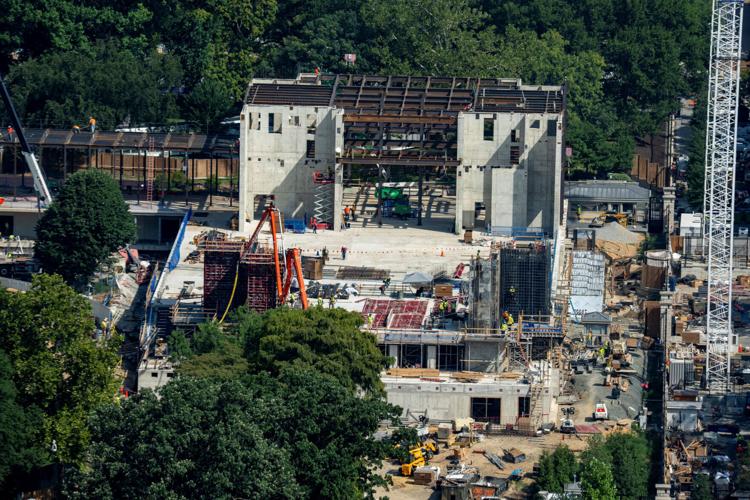
Construction continues Aug. 26 on the White House ballroom in Washington.
Echoes of ballroom arguments
The nonprofit National Trust for Historic Preservation sued last year after the administration tore down the White House’s East Wing and began building the 90,000-square-foot ballroom without seeking approval from Congress.
The Republican president said the ballroom project is a security necessity, and he referred to the structure as a "military center." Justice Department lawyers echoed his contention that the project is a security necessity, citing assassination attempts against the president and other recent threats.
In a 2-1 ruling Aug. 7, the U.S. Court of Appeals for the District of Columbia Circuit upheld a judge’s order that directed the administration to halt above-ground construction while allowing below-ground construction to continue, as well as work deemed "strictly necessary" for the safety and security of the White House. The D.C. Circuit panel said national security arguments "are not an automatic get-out-of-law-free card."
The Supreme Court, in a 5-4 ruling Aug. 31, allowed the Trump administration to continue construction of the ballroom complex while Trump challenges the judicial order. In a dissent, Chief Justice John Roberts called the project "likely unlawful."