GENEVA — Top U.S. and Ukrainian officials said Sunday they'd made progress toward ending the Russia-Ukraine war but provided scant details after discussing the American proposal to achieve peace that has sparked concerns among many of Washington’s European allies that the plan is too conciliatory to Moscow.

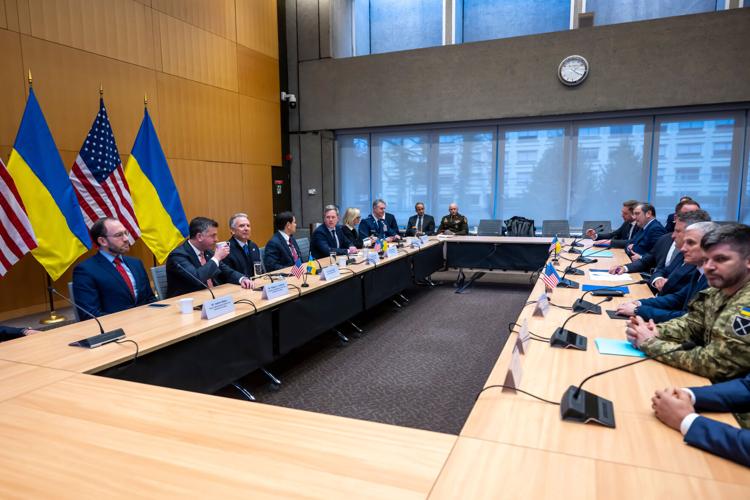
U.S., left, and Ukrainian, right, delegations begin peace talks Sunday at the U.S. Mission to International Organizations in Geneva, Switzerland.
U.S. Secretary of State Marco Rubio said high-stakes talks in Geneva were “very worthwhile” and constituted the most productive day in “a very long time."
“I feel very optimistic that we can get something done,” Rubio said.
But he offered little information on what was discussed. He also downplayed a Thursday deadline set by President Donald Trump for Ukraine to respond to the plan, saying simply that officials want to see fighting stop as soon as possible and that officials could keep negotiating Monday and beyond. He said that higher-level officials may eventually have to get involved.
People are also reading…
“This is a very delicate moment,” Rubio said of what still needed to be worked out. “Some of it is semantics, or language. Others require higher-level decisions and consultations. Others, I think, just need more time to work through.”
The 28-point blueprint drawn up by the U.S. to end the nearly four-year war has sparked alarm in Kyiv and European capitals. Ukrainian President Volodymyr Zelenskyy has said his country could face a stark choice between standing up for its sovereign rights and preserving the American support it needs.
The proposal acquiesces to many Russian demands that Zelenskyy has categorically rejected on dozens of occasions, including giving up large pieces of territory.

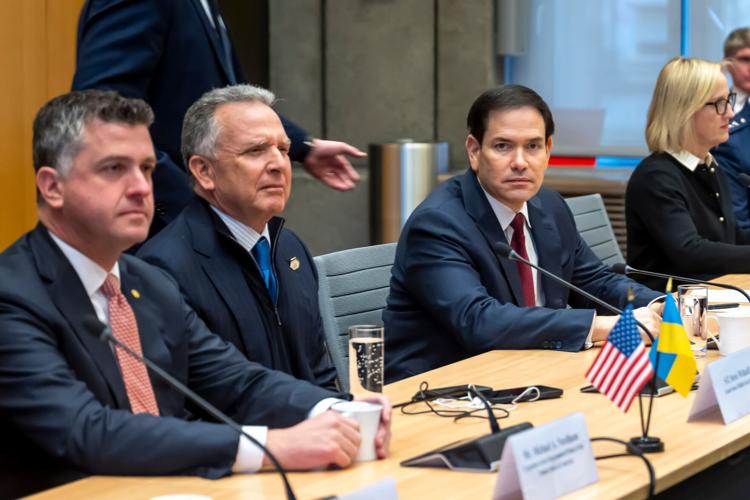
U.S. special envoy Steve Witkoff, second left, and U.S. Secretary of State Marco Rubio, right, sit at the beginning of talks with the Ukrainian delegation Sunday at the U.S. Mission to International Organizations in Geneva, Switzerland.
Concerns intensified after a bipartisan group of U.S. senators said Rubio told them Saturday that the plan originated with Russia and was actually a “wish list” for Moscow, rather than a serious push for peace.
The Ukrainian leader vowed that his people “will always defend” their home.
In a statement Sunday night, the White House said the Ukrainian delegation “affirmed that all of their principal concerns — security guarantees, long-term economic development, infrastructure protection, freedom of navigation, and political sovereignty — were thoroughly addressed during the meeting.”
It added that the Ukrainians “expressed appreciation for the structured approach taken to incorporate their feedback into each component of the emerging settlement framework.” The White House said changes made to the proposal now reflect “their national interests" and provide "credible and enforceable mechanisms to safeguard Ukraine’s security in both the near and long term.”
But language of such positive steps came only after concerns about the original, Trump-endorsed deal intensified. A bipartisan group of U.S. senators said Rubio told them Saturday that the plan had originated with Russia and was actually a “wish list” for Moscow, rather than a serious push for peace.
German Chancellor Friedrich Merz said he spoke to Trump and made clear there were some parts of the plans key European nations could agree on but others where they could not.
“I told him that we are fully in line with Ukraine, that the sovereignty of this country must not be jeopardized,” Merz said in an interview with DW.
Rubio called the U.S. proposal a “living breathing document” that would continue to change. He also made clear, though, that any final product — once it’s ready — will still have to be presented to Moscow. “Obviously, the Russians get a vote here,” he said.
The head of the Ukrainian delegation, presidential chief of staff Andrii Yermak, said of the talks, “We have made very good progress and are moving forward to a just and lasting peace.”
The rosy assessment of what was discussed defied Trump himself. Before talks began, the president blasted Ukraine for a lack of gratitude for U.S. military assistance while shying away from criticizing Russia.

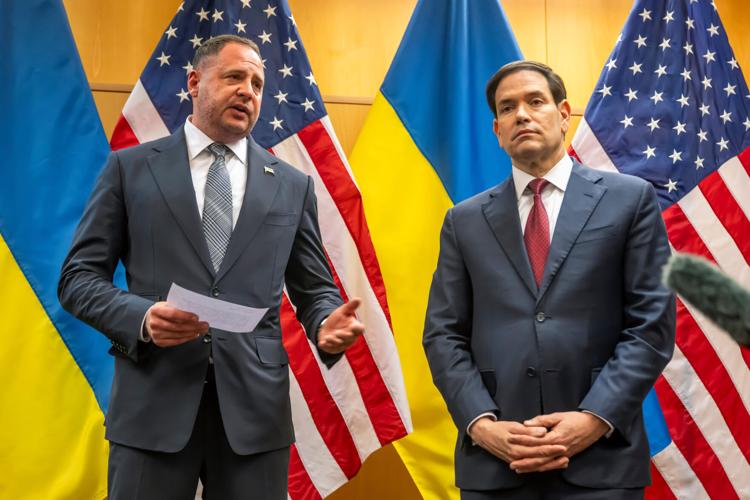
Head of the Office of the President of Ukraine Andriy Yermak, left, and U.S. Secretary of State Marco Rubio talk to the press Sunday as their consultations continue at the U.S. Mission to International Organizations in Geneva, Switzerland.
Trump set a Thursday deadline for Ukraine to respond to the plan but also suggested it could slide if there was proof of real progress. He also said the plan was not his final offer — without offering further details on what that meant.
“UKRAINE ‘LEADERSHIP’ HAS EXPRESSED ZERO GRATITUDE FOR OUR EFFORTS, AND EUROPE CONTINUES TO BUY OIL FROM RUSSIA,” Trump posted on his social media site Sunday morning.
After Trump’s post, Zelenskyy cheered U.S.-led efforts on security while also stressing that “the crux of the entire diplomatic situation is that it was Russia, and only Russia, that started this war.”
“Ukraine is grateful to the United States, to every American heart, and personally to President Trump,” Zelenskyy wrote in a post on Telegram, adding, “We thank everyone in Europe.”
“It is important not to forget the main goal: to stop Russia’s war and prevent it from ever igniting again,” he added.
Before convening with U.S. officials, Yermak and his team also met with national security advisers from the U.K., France and Germany. The allies have rallied around Kyiv in a push to revise the plan.
Alice Rufo, France’s minister delegate at the Defense Ministry, told broadcaster France Info before the talks began that key points of discussion would include the plan’s restrictions on the Ukrainian army, which she described as “a limitation on its sovereignty.”
“Ukraine must be able to defend itself,” she said. “Russia wants war and waged war many times in fact over the past years.”
On Sunday, Zelenskyy said that there was an understanding the U.S. would take into account “a number of elements” in a peace deal that are important for Ukraine, but did not elaborate further.
“There have already been brief reports from the team about the results of the first meetings and conversations,” he said. “There is now an understanding that the American proposals may take into account a number of elements based on the Ukrainian vision and are critically important for Ukraine’s national interests.”
Polish Prime Minister Donald Tusk said Sunday that Warsaw was ready to work on the plan with the leaders of Europe, Canada and Japan, but also said that it “would be good to know for sure who is the author of the plan and where was it created."