NEW YORK — Daniel Ellsberg, the history-making whistleblower who by leaking the Pentagon Papers revealed longtime government doubts and deceit about the Vietnam War and inspired acts of retaliation by President Richard Nixon that helped lead to his resignation, has died.

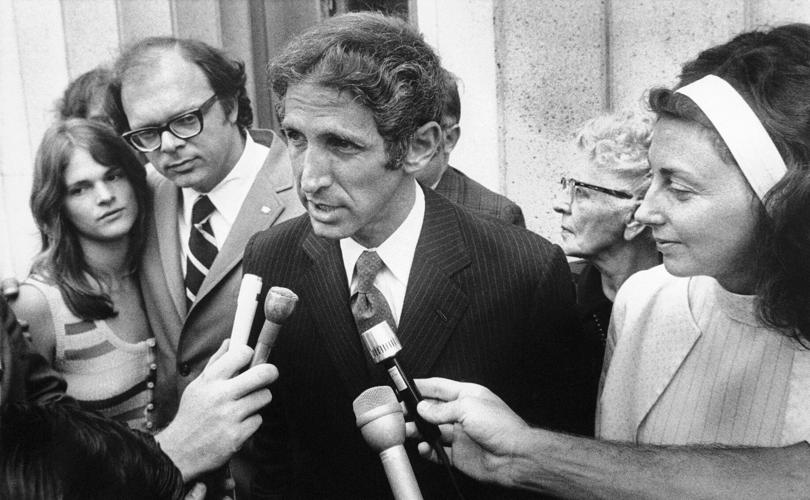
Daniel Ellsberg, with his wife, Patricia, right, speaks to reporters on July 11, 1972, in Los Angeles during a recess in his trial over the leak of the top-secret Pentagon Papers.
He was 92.
Ellsberg, who announced in February that he was terminally ill with pancreatic cancer, died Friday morning, according to a letter from his family released by a spokeswoman, Julia Pacetti.
Until the early 1970s, when he revealed that he was the source for the stunning media reports on the 47-volume, 7,000-page Defense Department study of the U.S. role in Indochina, Ellsberg was a well-placed member of the government-military elite. He was a Harvard graduate and self-defined “cold warrior” who served as a private and government consultant on Vietnam throughout the 1960s, risked his life on the battlefield, received the highest security clearances and came to be trusted by officials in Democratic and Republican administrations.
People are also reading…
He was especially valued, he would later note, for his “talent for discretion.”
But like millions of other Americans, in and out of government, he had turned against the yearslong war in Vietnam, the government’s claims that the battle was winnable and that a victory for the North Vietnamese over the U.S.-backed South would lead to the spread of communism throughout the region. Unlike so many other war opponents, he was in a special position to make a difference.
“An entire generation of Vietnam-era insiders had become just as disillusioned as I with a war they saw as hopeless and interminable,” he wrote in his 2002 memoir, “Secrets: A Memoir of Vietnam and the Pentagon Papers.” “By 1968, if not earlier, they all wanted, as I did, to see us out of this war.”
As much as anyone, Ellsberg embodied the individual of conscience — who answered only to his sense of right and wrong, even if the price was his own freedom. David Halberstam, the late author and Vietnam War correspondent who had known Ellsberg since both were posted overseas, would describe him as no ordinary convert. He was highly intelligent, obsessively curious and profoundly sensitive, a born proselytizer who “saw political events in terms of moral absolutes” and demanded consequences for abuses of power.
As much as anyone, Ellsberg also embodied the fall of American idealism in foreign policy in the 1960s and 1970s and the upending of the post-World War II consensus that Communism, real or suspected, should be opposed worldwide.
The Pentagon Papers had been commissioned in 1967 by then-Defense Secretary Robert S. McNamara, a leading public advocate of the war who wanted to leave behind a comprehensive history of the U.S. and Vietnam and to help his successors avoid the kinds of mistakes he would only admit to long after.

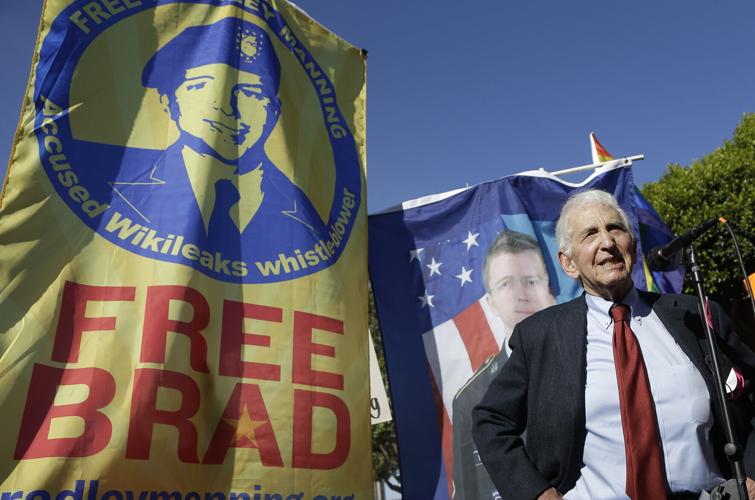
Daniel Ellsberg speaks at a rally supporting Bradley Manning in San Francisco on April 30, 2013.
The papers covered more than 20 years, from France’s failed efforts at colonization in the 1940s and 1950s to the growing involvement of the U.S., including the bombing raids and deployment of hundreds of thousands of ground troops during Lyndon Johnson’s administration.
Ellsberg was among those asked to work on the study, focusing on 1961, when the newly-elected President John F. Kennedy began adding advisers and support units.
First published in The New York Times in June 1971, with The Washington Post, The Associated Press and more than a dozen others following, the classified papers documented that the U.S. had defied a 1954 settlement barring a foreign military presence in Vietnam, questioned whether South Vietnam had a viable government, secretly expanded the war to neighboring countries and had plotted to send American soldiers even as Johnson vowed he wouldn’t.
The Johnson administration had dramatically and covertly escalated the war despite the “judgment of the Government’s intelligence community that the measures would not” weaken the North Vietnamese, wrote the Times’ Neil Sheehan, a former Vietnam correspondent who later wrote a Pulitzer Prize winning book on the war, “A Bright Shining Lie.”
The leaker’s identity became a national guessing game and Ellsberg proved an obvious suspect, because of his access to the papers and his public condemnation of the war over the previous two years. With the FBI in pursuit, Ellsberg turned himself in to authorities in Boston, became a hero to the anti-war movement and a traitor to the war’s supporters, labeled the “most dangerous man in America” by National Security Adviser Henry Kissinger, with whom Ellsberg had once been friendly.
The papers themselves were seen by many as an indictment not just of a given president or party, but of a generation of political leadership. The historian and philosopher Hannah Arendt would note that growing mistrust of the government during the Vietnam era, “the credibility gap,” had “opened into an abyss.”
“The quicksand of lying statements of all sorts, deceptions as well as self-deceptions, is apt to engulf any reader who wishes to probe this material, which, unhappily, he must recognize as the infrastructure of nearly a decade of United States foreign and domestic policy,” she wrote.
The Nixon administration quickly tried to block further publication on the grounds that the papers would compromise national security, but the U.S. Supreme Court ruled 6-3 in favor of the newspapers on June 30, 1971, a landmark First Amendment ruling rejecting prior restraint. Nixon himself, initially unconcerned because the papers predated his time in office, was determined to punish Ellsberg and formed a renegade team of White House “plumbers,” endowed with a stash of White House “hush money” and the mission of preventing future leaks.
“You can’t drop it,” Nixon fumed privately to his chief of staff, H.R. Haldeman. “You can’t let the Jew steal that stuff and get away with it. You understand?”
Ellsberg faced trials in Boston and Los Angeles on federal charges for espionage and theft, with a possible sentence of more than 100 years. He had expected to go to jail, but was spared, in part, by Nixon’s rage and the excesses of those around him. The Boston case ended in a mistrial because the government wiretapped conversations between a defense witness and his attorney. Charges in the Los Angeles trial were dismissed after Judge Matthew Byrne learned that White House “plumbers” G. Gordon Liddy and E. Howard Hunt had burglarized the office of Ellsberg’s psychiatrist in Beverly Hills, California.
Byrne ruled that “the bizarre events have incurably infected the prosecution of this case.”
Meanwhile, the “plumbers” continued their crime wave, notably the June 1972 break-in of the Democratic Party’s national headquarters, at the Watergate Hotel in Washington, D.C. The Watergate scandal didn’t prevent Nixon from a landslide reelection in 1972, but would expand rapidly during his second term and culminate in his resignation in August 1974. U.S. combat troops had already left Vietnam and the North Vietnamese captured the Southern capital, Saigon, in April 1975.
“Without Nixon’s obsession with me, he would have stayed in office,” Ellsberg told The Associated Press in 1999. “And had he not been removed from office, he would have continued the bombing (in Vietnam).”
Ellsberg’s story was depicted in the 2009 documentary “The Most Dangerous Man in America: Daniel Ellsberg and the Pentagon Papers.” The movie had its West Coast premiere only a few blocks from the Rand Corp. headquarters in Santa Monica, Ellsberg former workplace. He sent college students with fliers to urge old colleagues to attend the screening, but none attended.
Ellsberg was born in Chicago in 1931, to Jewish parents who converted to Christian Science. His father was an unemployed engineer in the early years of the Great Depression and the family later moved to suburban Detroit, where his father worked in a plant making B-24 bombers. Daniel held vivid memories of learning that the Japanese had bombed Pearl Harbor in 1941, and of reports of the Nazis bombing London and the U.S. bombing Germany and Japan.
Leaking to the Times was not his first choice. He had hoped that government officials, including Kissinger, would read the study and realize the war was hopeless.
In his later years, a spry, silver-haired Ellsberg became a prominent free speech and anti-Iraq war activist, drawing parallels between U.S. involvement in Iraq and Vietnam, and called for impeachment of President George W. Bush. He expressed similar fears about Afghanistan during the Obama administration, saying it had the potential to become “Vietnamistan” if the U.S. increased troops there.
He was active in campaigns to prevent nuclear arms proliferation and drew upon his history in government for the 2017 book “The Doomsday Machine: Confessions of a Nuclear War Planner,” in which he included a once-top secret document showing that the U.S. had considered launching nuclear attacks on the Chinese in 1958. He also defended other leakers and whistleblowers., among them WikiLeaks founder Julian Assange, former Army intelligence analyst Chelsea Manning and Edward Snowden, the government contractor who disclosed details of secret U.S. surveillance programs and is now living in Russia.
“Many of the people whistleblowers work with know the same things and actually regard the information in the same way — that it’s wrong — but they keep their mouths shut,” Ellsberg told The New York Times in 2023.
Ellsberg is survived by his second wife, the journalist Patricia Marx, and three children, two from his first marriage. He and Marx wedded in 1970, the year before the Pentagon Papers were made public. In a New York Times wedding announcement, he was identified as a “senior research fellow at the Massachusetts Institute of Technology’s Center for International Studies, where he was writing a critical study of United States involvement in Vietnam.”
Read the full story:
Panama, Pandora and Pentagon Papers: 10 of the most groundbreaking leaks in history
Panama, Pandora, and Pentagon Papers: 10 of the most groundbreaking leaks in history

The biggest secrets aren’t revealed in a traditional way. Leaking information can be dangerous—even fatal—but many people throughout history have risked their safety in the name of the truth. In some cases, whistleblowers remain maligned for their work even long after their deaths. But time has changed the way we see many of the leaks from years ago.
Stacker chose the top 10 most groundbreaking leaks in history, containing the largest scale of information and the most impactful aftermaths. Their stories are as dramatic and riveting as any spy novel, but anything but fictional. Some of the following leaks uncovered massive amounts of data and some released very little, but shaped wars and the way we view our governments. Whatever secrets they brought to light, these leaks changed history forever.
Ordered chronologically, the leaks take you through how leaking information has changed over almost 200 years, from strictly newspapers to complicated and encrypted computer data. The future of leaking information is bound to be groundbreaking, especially after looking back at what has occurred already.
You may also like: Defining historical moments from the year you were born

Treaty of Guadalupe Hidalgo

At the end of the Mexican-American War, the document that would end the war was leaked to journalist John Nugent before it was signed. He published the treaty in the New York Herald in its entirety, revealing the negotiations for peace before they were settled or agreed upon. Mexico would secede over half of its territory in the treaty, establishing most of America’s southern border as we know it today. The United States Senate tried to get Nugent’s source from him through gruelling interrogations and a month-long house arrest. He never did reveal his source, even though investigations long after the leak point towards James Buchannan, who was secretary of state at the time and would become president a decade later. This leak demonstrated the hidden workings between media and politicians very early in our nation’s history.
Manhattan Project Soviet Leaks

Spies recruited by the Soviet Union knew about the United States’ atomic bomb plans before our own FBI in 1941. Americans and Brits fed information and diagrams of bombs to Russia all through World War II, some in service to communism and some to prevent one country from having a monopoly on nuclear weapon technology. While this information leak was not public until the Soviet codes were cracked after the war and the cases were declassified in the 1990s, this leak made the Cold War arms race between the Soviet Union and the United States an almost equal race. These leaks led to the execution of two Americans, Ethel and Julius Rosenberg, despite the fact that they denied their involvement until their death. To this day, we don’t know how much information was leaked to the Soviets during World War II, or all of the spies involved, making it a mysterious leak in history.
Operation Mincemeat

This leak from the Allied Forces during World War II proved that not all leaks were necessarily the truth. Operation Mincemeat was a planned “leak” consisting of fake “top secret” information planted on a dead body that washed up on a beach on the coast of Spain. The purpose of this trickery was to fool the Nazis into thinking that the Allies were going to invade Greece and Sardina instead of Italy. British intelligence officers invented an entire fictional life for the corpse they planted on the beach, with fake correspondence and even photographs of a fake fiancee. The plan fooled both Spanish authorities, who seized the body, and German leaders in 1943, who sent all of their troops to Greece just as the Allies invaded Sicily. As Axis powers were losing the battle of Sicily, Italian dictator Mussolini was dismissed as prime minister and imprisoned. While historians disagree with the level of impact that Operation Mincemeat had on the defeat of the Axis powers, it remains one of the most interesting leaks in history.
The Pentagon Papers

The Vietnam War shaped how we viewed our government unlike any war before it. However, there was much the country didn’t know about the war until 1971. Daniel Ellsberg leaked confidential government records in the Report of the Office of the Secretary of Defense Vietnam Task Force, popularly referred to as the Pentagon Papers. In them, details of unreported expansions of America’s involvement in the Vietnam War uncovered that multiple presidential administrations had lied to the public regarding the war. The New York Times, The Washington Post, and Ellsberg faced criminal charges in court for their efforts to get the papers into public knowledge, but the Supreme Court eventually allowed for further publication of the papers. This leak bred major distrust in the United States government, which would only grow with the next major leak.
Watergate and the Nixon Tapes

Initially, President Nixon and his conspirators hid their involvement in the 1972 burglary attempt upon the Democratic National Committee headquarters in the Watergate complex. As the 1972 presidential election approached, an anonymous source named “Deep Throat” fed Washington Post reporters Carl Bernstein and Bob Woodward leaked info that “the Watergate bugging incident stemmed from a massive campaign of political spying and sabotage conducted on behalf of President Nixon’s re-election and directed by officials of the White House.” Despite this, Nixon was reelected, but he did not avoid investigation. The court hearings investigating the abuses of the presidential campaign captured America’s attention every day for weeks in 1973. Only after the Supreme Court ordered him to present the tapes did Nixon have no other choice but to resign and admit guilt. The leak, subsequent court hearings, and media revelations revealed corruption beyond most of America’s imagination at the time, and changed the way we viewed government leaders forever.
You may also like: 25 terms you should know to understand the health care debate
The Iraq War Logs (WikiLeaks)

In 2010, documents leaked on WikiLeaks uncovered shocking details about the Iraq War. Australian Julian Assange created the website WikiLeaks in 2006 with the goal of “analysis and publication of large datasets of censored or otherwise restricted official materials involving war, spying and corruption.” Some 400,000 U.S. military documents were unleashed to the public, and with them came details of Iraqi civilian deaths, abuse of war prisoners, and Iran’s involvement in the war. It became the largest U.S. military leak at the time. Unlike many of the other leaks before this, the information was not analyzed or assembled before being released to the public, which journalists considered irresponsible. The Iraq War Logs, as they are known, detailed ugly aspects of a war that the government wanted to prove was worth the effort.
Edward Snowden and the NSA

Edward Snowden was forced to flee the country when he leaked government information to The Guardian in 2013. As a former contractor for the CIA, Snowden had access to U.S. surveillance documents, which he stole before fleeing to Hong Kong to leak portions of thousands of documents to journalists. The documents detailed the National Security Agency’s collection of personal data, including phone records, social media data, and emails belonging to U.S. and non-U.S. citizens. Snowden’s leak left him stranded in a Russian airport for a month while seeking asylum in Russia. It wasn’t until September 2020 that U.S. courts condemned the intelligence programs Snowden uncovered for being illegal and unconstitutional. This leak was a revelation into government security practices post-9/11, most of which the U.S. citizens were unaware of and furious about.
The Panama Papers

The International Consortium of Investigative Journalists and German newspaper Süddeutsche Zeitung (SZ) released 11.5 million documents detailing offshore tax havens. The papers were anonymously shared with SZ anonymously from Panama, but the newspaper needed to spend a year deciphering encrypted files before they could release them to the public. In April of 2016, SZ published the findings, which showed the private financial information of celebrities, politicians, and business leaders from around the world. Most of the actions detailed in the documents were not technically illegal, but two arrests were made for wire and tax fraud, tax evasion, and forming a criminal organization. The largest arrest happened to Juergen Mossack and Ramón Fonseca, who were investigated by the Cologne and Panama governments. Thanks to the leak, they had to close their business in 2018.
The Dark Side of the Kremlin

In 2019, “hacktivists” infiltrated some of Russia’s most powerful figures and distributed over 170 gigabytes of data on a website called Distributed Denial of Secrets. Emails and documents published on the site confirmed what many people suspected of how the Russian government seeks to control its citizens. Journalist Roman Dobrokhotov claims they found “how the government controls media in Russia, how they spread their messages through members of parliament and loyal TV channels or newspapers.” Considering the danger that journalists have been in when going against the Russian government, this leak was a risk to take. The sheer amount of data and the rarity of information on the inner workings of Russia’s secretive government makes this leak memorable in history.
The Pandora Papers

In October of 2021, the International Consortium of Investigative Journalists published the first leaks of what would total almost 12 million documents. The dealings of the world’s wealthiest individuals and political leaders were uncovered to reveal the secret offshore accounts used to evade taxes. The ICIJ considers their investigation to be “the most expansive leak of tax haven files in history.” To uncover the massive amount of information, they worked with more than 600 journalists in 117 countries, making public the ways in which politics, business, and real estate are impacted by corruption. This leak changed the course of a Czech Republic election and sparked calls for governments to crack down on money laundering, tax evasion, and other corrupted ways of hiding wealth.
You may also like: A timeline of WWII, the most devastating conflict in history