SAN DIEGO — Evolution works over millennia. Climate change is moving far faster.
That mismatch is killing some of the planet's most vital ecosystems, from California's towering redwoods to the seagrass meadows along its coast, both of which store vast amounts of carbon and support complex webs of life.
Marine heat waves, record wildfires and coastal development are pushing these systems beyond their limits as climate change, driven by emissions of fuels like oil and gas, accelerates. An estimated 1 million species face extinction, many within decades, largely due to human activities such as habitat destruction, pollution and overuse of natural resources, according to a 2019 report by a United Nations-affiliated intergovernmental scientific body.
Scientists are working to close the gap with an emerging discipline called conservation genomics: sequencing an organism's complete genetic blueprint to pinpoint individuals with traits suited to survive drought, disease and other climate extremes, then using that information to guide restoration.
People are also reading…
Coral reefs are among the first ecosystems where these genomic tools are being put to use. Repeated marine heat waves, which have caused mass bleaching, have devastated reefs worldwide. By sequencing corals and the algae that live inside them, researchers have identified colonies that naturally withstand higher temperatures and are beginning to test whether selectively breeding and growing those more resilient corals can support reef recovery.

Eelgrass sways in the current Dec. 2 in San Diego's Mission Bay.
Seagrass are under stress
In Southern California, researchers are applying the approach to eelgrass, a type of seagrass, as traditional restoration methods falter. The plant provides habitat for fish, crabs and plankton, feeds migratory birds and locks away carbon and methane — both heat-trapping greenhouse gases — in coastal sediments.
Conditions in San Diego's bays are changing. Waters are warming. King tides — the year's highest tides, which climate change is making more frequent and severe — stir up sediment and reduce the light that reaches the seafloor. Development sends runoff into bays, further clouding the water.
As a result, efforts to replant what's been lost fail about half the time.
"Conservation genomics is becoming particularly important because right now, the climate is changing — a plant that was growing great in San Diego Bay, now San Diego Bay might be too hot for it," said Todd Michael, a research professor at the Salk Institute for Biological Studies.

Todd Michael, a research professor at the Salk Institute for Biological Studies, works at his lab Dec. 3 in San Diego.
In Mission Bay, Michael and his colleagues discovered a clue to improving those odds: a naturally occurring hybrid eelgrass that outperformed its parent species. The plant, a cross between shallow water eelgrass Zostera marina and deeper water Zostera pacifica, persisted where both parent species struggled.
By sequencing its genome, the team identified genes tied to the plant's circadian clock that stayed active longer under low light conditions, a pattern scientists believe may help it photosynthesize more efficiently in murky water.
The findings suggest restoration could be improved by selecting or breeding eelgrass better suited to future conditions. But for now, that work remains largely experimental and has not yet been deployed at scale in the field. The researchers have partnered with ecologists at the Scripps Institute of Oceanography to explore how those insights could be applied in future restoration.

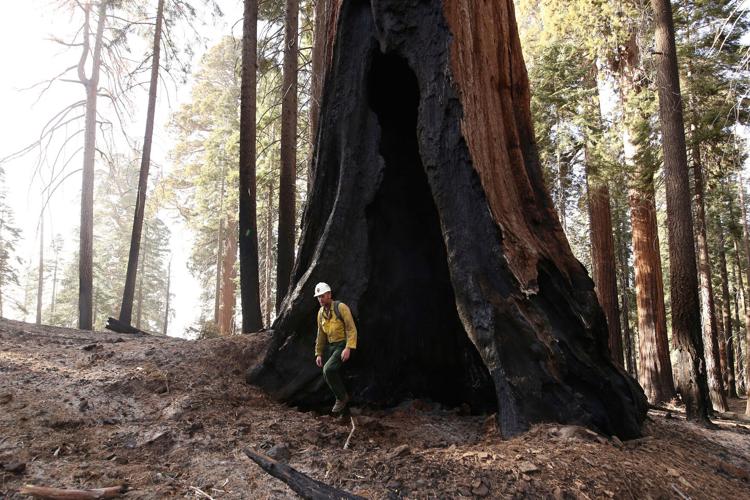
Assistant Fire Manager Leif Mathiesen, of the Sequoia & Kings Canyon National Park Fire Service, walks near a burned-out sequoia tree from the Redwood Mountain Grove, which was devastated by the KNP Complex fires Nov. 19, 2021, in Kings Canyon National Park, Calif.
Applying similar techniques to Northern California's redwoods
Redwoods are among the tallest and oldest trees on Earth and their forests store more carbon per acre than any other, according to a 2020 study by Save the Redwoods League and Humboldt State University.
While these trees evolved with frequent low intensity fire, today's hotter and more destructive wildfires, combined with drought, are taking a growing toll. Logging has had an even greater impact: about 95% of old growth redwoods were cut, drastically reducing genetic diversity.
Scientists have already sequenced the redwood genome — a massive undertaking given its size, which is nearly nine times larger than the human genome.

The Pacific Biosciences Revio, which can decode an entire human genome in one day, sits at the Salk Institute for Biological Studies Dec. 3 in San Diego.
However researchers say the work is not just about restoring what once existed, but preparing forests for a climate that no longer resembles the past.
"Where one organism was adapted to a certain location at one moment in time, it may no longer be," said David Neale, a forest geneticist and distinguished professor emeritus at the University of California, Davis. "It might require different genetic variation to adapt to the new environment."
Early analyses have begun to link genes to traits such as drought tolerance and temperature adaptation, but researchers say more rigorous work is needed to confirm those links before they can be used to guide restoration. That work has stalled due to limited funding.
Conservation genomics alone cannot solve climate change
"It can be helpful, but it's not a solution unto itself," said Karen Holl, a distinguished professor of environmental studies at the University of California, Santa Cruz. "What should be prioritized is reducing greenhouse gas emissions."
Genomic tools may help certain species, particularly long-lived ones like redwoods that cannot adapt quickly enough on their own, but they come with limits.
Ecosystems are built on complex relationships among plants, animals, microbes and fungi. Engineering or selecting for climate resilient traits in one species does not guarantee the survival of the many others that depend on it.
"Can you genetically engineer a few species that would be more tolerant? Absolutely. But that's not an ecosystem," said Holl. "We're not going to engineer our way out of climate change."


Photos capture destruction, heartache and resilience as climate change advanced in 2025

Joe Chyuwei, right, Addison Black, front center, James Black, front left, and back row from left, Helen Chyuwei, Jameson Black, Grace Chyuwei and Grayson Black watch the sunset in the heat at Zabriskie Point, Aug. 3, 2025, in Death Valley National Park, Calif. (AP Photo/John Locher, File)

The head of a dead fish lies in the almost dry Aume River, Aug. 14, 2025, in Saint-Fraigne, France. (AP Photo/Yohan Bonnet, File)

Local farmer Turkan Ozkan, 64, cries next to one of her animals killed during a fire Aug. 12, 2025, in Guzelyeli, Turkey. (AP Photo/Khalil Hamra, File)

Members of the Mura Indigenous community maneuver a boat Feb. 17, 2025, in the Lago do Soares village in Autazes, Amazonas state, Brazil. (AP Photo/Edmar Barros, File)

Afeli Bernice Adzo leans against the remains of her father's room as she looks at the ocean that destroyed her family home March 5, 2025, in Avegadzi, Ghana. (AP Photo/Misper Apawu, File)

Scientists and veterinarians capture a pink river dolphin in the Amazon River to perform health checks Sept. 7, 2025, in Puerto Narino, Colombia. (AP Photo/Fernando Vergara, File)

Wanona Harp rescues a cat stranded on her neighbor's porch flooded by the Kentucky River, April 8, 2025, in Lockport, Ky. (AP Photo/Carolyn Kaster, File)

Mamadou Gueye, a 39-year-old farmer who lost his left hand after a fight with a herder over cattle in May 2022, guards his fields of peanuts Oct. 12, 2025, in Ross Bethio, Senegal. (AP Photo/Andrea Ferro)

An environmental agent of the Chico Mendes Institute takes photos of turtle hatchlings Nov. 17, 2025, at the Abufari Biological Reserve in Tapaua, Brazil. (AP Photo/Edmar Barros, File)

Luciane Mengual, 22, an Indigenous woman from the Wayuu community, poses with her baby at home Feb. 4, 2025, in the Villa del Sur neighborhood, on the outskirts of Riohacha, Colombia. (AP Photo/Ivan Valencia, File)

A Sudanese farmer carries his livestock after his farm was destroyed by floods Oct. 1, 2025, in Wad Ramli village, Sudan. (AP Photo/Marwan Ali, File)

Members of the Gadaba Indigenous communities gather tendu leaves to sell April 16, 2025, in Hatipakna village, India. (AP Photo/Rafiq Maqbool, File)

Cows stand in floodwaters at a farm July 25, 2025, in Buenos Aires province, Argentina. (AP Photo/Natacha Pisarenko, File)

An Indigenous group attends the opening ceremony of the People's Summit offsite from the COP30 U.N. Climate Summit, Nov. 12, 2025, in Belem, Brazil. (AP Photo/Fernando Llano, File)

Schuyler Clogston, left, makes shadows puppets with Agnes Suárez after setting up a sheet and light to attract moths for observation Oct. 7, 2025, in Charleston, S.C. (AP Photo/Joshua A. Bickel, File)

Cassandra Garduño cleans a canal in her chinampa, an island farm built by the Aztecs thousands of years ago May 8, 2025, in San Gregorio Atlapulco, a borough of Mexico City. (AP Photo/Felix Marquez, File)

Members of the Navajo Scouts firefighter crew kick up dust as they clear debris from a landslide across a road on a hillside as they battle the Eaton Fire, Jan. 17, 2025, in Altadena, Calif. (AP Photo/John Locher, File)

Fisherman Sunil Kumar, bottom, spreads a fishing net to help remove the weeds floating on Doddajala Lake, Aug. 23, 2025, on the outskirts of Bengaluru, India. (AP Photo/Aijaz Rahi, File)

Young Indigenous guards play on the walls of an old military defense barrier made of sandbags, remnants of the military occupation in the area July, 19, 2025, in the Lopez Adentro reserve in Caloto, Colombia. (AP Photo/Nadège Mazars, File)

Women open freshly cooked oysters Aug. 6, 2025, in Tsokomey, Ghana. (AP Photo/Misper Apawu, File)

Firefighters work from a deck as the Palisades Fire burns a beachfront property Jan. 8, 2025, in Malibu, Calif. (AP Photo/Etienne Laurent, File)

A Navy officer helps a woman cross a flooded street Oct. 12, 2025, in Poza Rica, Veracruz state, Mexico. (AP Photo/Felix Marquez, File)

Relatives of Rosiclaire Lenchise mourn during a funeral of victims killed by a landslide triggered by Hurricane Melissa, Nov. 15, 2025, in Petit Goave, Haiti. (AP Photo/Odelyn Joseph, File)

Arturo Huidobro, center, and a worker prepare to remove dead pigs from a farm following heavy rainfall Oct. 11, 2025, in Poza Rica, Mexico. (AP Photo/Felix Marquez, File)

Tanzin Dolma milks a yak as her husband, Punchuk Namdol, collects dung in the background on an early morning July 8, 2025, in Maan village, Ladakh, India. (AP Photo/Dar Yasin, File)

Baby ostriches huddle after being moved into a barn following recent flooding July 9, 2025, at a farm in Bend, Texas. (AP Photo/Joshua A. Bickel, File)

Members of the Lion Intervention Brigade conduct a patrol Jan. 14, 2025, at Niokolo Koba National Park, Senegal. (AP Photo/Annika Hammerschlag, File)

Judy Bertuso, left, feeds her husband Apollo inside a tent at an evacuation center as Typhoon Fung-wong enters the country Nov. 9, 2025, in Quezon city, Philippines. (AP Photo/Aaron Favila, File)

Olsjen Mucobega, 32, uses his motorcycle to evacuate a sheep from a wildfire Aug. 13, 2025, in Patras, Greece. (AP Photo/Thanassis Stavrakis, File)

A man rides his bicycle through an inundated street during the aftermath of Hurricane Melissa, Oct. 30, 2025, in Black River, Jamaica. (AP Photo/Matias Delacroix, File)

Ari Rivera, rear, and Anderson Hao hold each other in front of their destroyed home Jan. 9, 2025, in Altadena, Calif. (AP Photo/John Locher, File)

Gentoo penguins nest at Neko Harbour in Antarctica, Saturday, Nov. 22, 2025. (AP Photo/Mark Baker)

A pod of orcas swim in the Drake Passage en route to Antarctica, Friday, Nov. 21, 2025. (AP Photo/Mark Baker)

Passengers walk inside the volcano at Deception Island in Antarctica, Wednesday, Nov. 26, 2025. (AP Photo/Mark Baker)

Gentoo penguins walk at Neko Harbour in Antarctica, Saturday, Nov. 22, 2025. (AP Photo/Mark Baker)

Gentoo penguins nest at Neko Harbour in Antarctica, Saturday, Nov. 22, 2025. (AP Photo/Mark Baker)

A member of the ship's crew looks at an iceberg near Yalour Islands in Antarctica, Monday, Nov. 24, 2025. (AP Photo/Mark Baker)

A crew member looks for whales at Yalour Islands in Antarctica, Monday, Nov. 24, 2025. (AP Photo/Mark Baker)

The sun sets near a iceberg in Antarctica, Friday, Nov. 21, 2025. (AP Photo/Mark Baker)

Passengers watch as a ship sails through the Lemaire Channel in Antarctica, Monday, Nov. 24, 2025. (AP Photo/Mark Baker)

Adelie penguins stand on a block of floating ice at Yalour Islands in Antarctica, Monday, Nov. 24, 2025. (AP Photo/Mark Baker)

A elephant seal reacts at Walker Island in Antarctica, Wednesday, Nov. 26, 2025. (AP Photo/Mark Baker)

Gentoo penguins nest at Walker Island in Antarctica, Wednesday, Nov. 26, 2025. (AP Photo/Mark Baker)

Gentoo penguins prepare to enter the water at Walker Island in Antarctica, Wednesday, Nov. 26, 2025. (AP Photo/Mark Baker)

An ice covered rock formation is reflected in the waters at Pleneau Island in Antarctica, Monday, Nov. 24, 2025. (AP Photo/Mark Baker)

A Pintado petrel flys over the Drakes Passage on the way to Antarctica, Thursday, Nov. 20, 2025. (AP Photo/Mark Baker)

Sea ice covers the ocean at Yalour Islands in Antarctica, Monday, Nov. 24, 2025. (AP Photo/Mark Baker)
The Associated Press receives support from the Walton Family Foundation for coverage of water and environmental policy. The AP is solely responsible for all content. For all of AP's environmental coverage, visit https://apnews.com/hub/climate-and-environment