

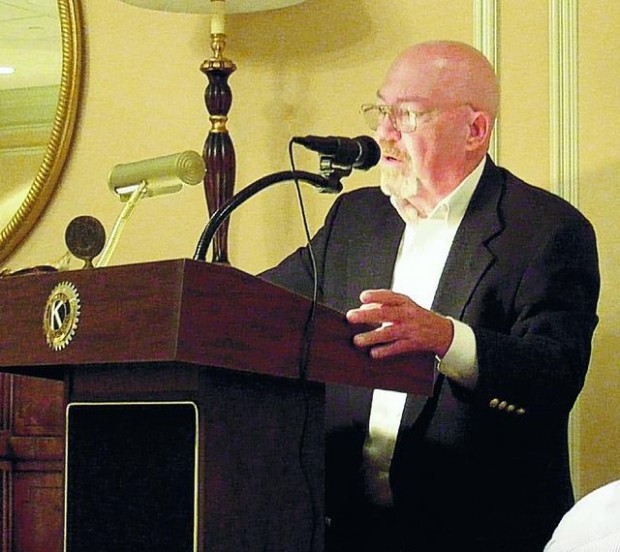
COLUMBUS, Ga. — Speaking in a soft, sometimes labored voice, the only U.S. Army officer convicted in the 1968 slayings of Vietnamese civilians at My Lai made an extraordinary public apology while speaking to a small group near the military base where he was court-martialed.
"There is not a day that goes by that I do not feel remorse for what happened that day in My Lai," William L. Calley told members of a local Kiwanis Club, the Columbus Ledger-Enquirer reported Friday. "I feel remorse for the Vietnamese who were killed, for their families, for the American soldiers involved and their families. I am very sorry."
Calley, 66, was a young Army lieutenant when a court-martial at nearby Fort Benning convicted him of murder in 1971 for killing 22 civilians during the infamous massacre of 500 men, women and children in Vietnam.
Frustrated U.S. troops came to My Lai on a "search and destroy" mission, looking for elusive Vietcong guerrillas. Although there were no reports of enemy fire, the U.S. troops began mowing down villagers and setting fire to their homes.
People are also reading…
The incident shocked Americans and undermined support for the war.
Though sentenced to life in prison, Calley ended up serving three years under house arrest after President Richard Nixon reduced his sentence.
After his release, Calley stayed in Columbus and settled into a job at a jewelry store owned by his father-in-law before he moved to Atlanta a few years ago. He shied away from publicity and routinely turned down journalists' requests for interviews about My Lai.
But Calley broke his long silence Wednesday after accepting a longtime friend's invitation to speak at a meeting of the Kiwanis Club of Greater Columbus.
Wearing thick glasses and a blue blazer, he spoke softly into a microphone answering questions for a half-hour from about 50 Kiwanis members gathered for their weekly luncheon in a church meeting room.
"You could've heard a pin drop," said Al Fleming, who befriended Calley about 25 years ago and invited him to speak. "They were just slack-jawed that they were hearing this from him for the first time in nearly 40 years."
Both Fleming and Lennie Pease, the Kiwanis president, told The Associated Press in phone interviews Friday that Calley's apology came at the beginning of his brief remarks before he began taking questions.
William George Eckhardt, the chief prosecutor in the My Lai cases, said Friday he was unaware of Calley ever apologizing before. Eckhardt said that when he first heard the news "I just sort of cringed."
"It's hard to apologize for murdering so many people," said Eckhardt, now a law professor at the University of Missouri-Kansas City. "But at least there's an acknowledgment of responsibility."
Calley didn't deny taking part in the slayings on March 16, 1968, but insisted he was following orders from his superior, Capt. Ernest Medina — a notion Eckhardt, the former prosecutor, rejects.
Medina was also tried by a court-martial in 1971 and was acquitted of all charges.
When asked if he broke the law by obeying an unlawful order, the newspaper reported, Calley replied: "I believe that is true."
"If you are asking why I did not stand up to them when I was given the orders, I will have to say that I was a second lieutenant getting orders from my commander and I followed them — foolishly, I guess," Calley said.
"It's hard to apologize for murdering so many people. But at least there's an acknowledgment of responsibility."
George Eckhardt,
chief prosecutor in the My Lai cases, now a law professor at the University of Missouri-Kansas City


