

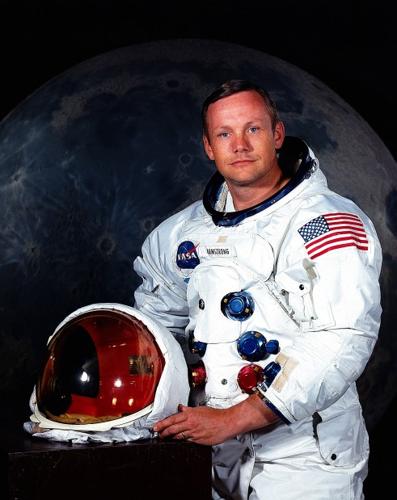
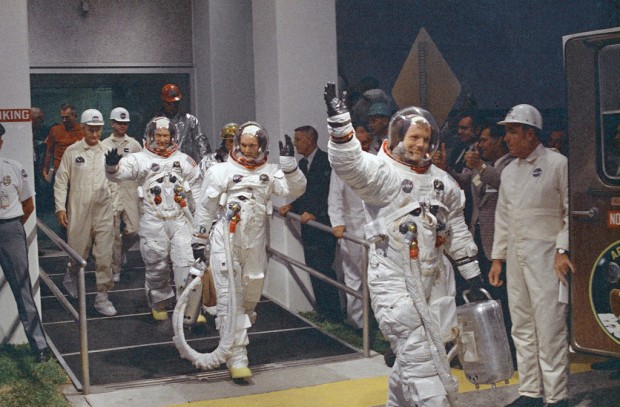
CINCINNATI - Neil Armstrong was a soft-spoken engineer who became a global hero when as a steel-nerved pilot he made "one giant leap for mankind" with a small step onto the moon.
The modest man, who had people on Earth entranced and awed from almost a quarter-million miles away but credited others for the feat, died Saturday. He was 82.
Armstrong died following complications resulting from cardiovascular procedures, his family said in a statement. Armstrong had had a bypass operation this month, according to NASA. His family didn't say where he died; he had lived in suburban Cincinnati.
Armstrong commanded the Apollo 11 spacecraft whose lunar module landed on the moon July 20, 1969, capping the most daring of the 20th century's scientific expeditions. His first words after becoming the first person to set foot on the surface are etched in history books and the memories of those who heard them in a live broadcast:
People are also reading…
"That's one small step for man, one giant leap for mankind," Armstrong said.
(Armstrong insisted later that he had said "a" before "man," but said he, too, couldn't hear it in the version that went to the world.)
In those first few moments on the moon, during the climax of a space race with the Soviet Union, Armstrong stopped in what he called "a tender moment" and left a patch to commemorate NASA astronauts and Soviet cosmonauts who had died in action.
"It was special and memorable, but it was only instantaneous because there was work to do," Armstrong told an Australian television interviewer this year.
Armstrong and Edwin E. "Buzz" Aldrin spent nearly three hours on the moon, collecting samples, conducting experiments and taking photographs.
"The sights were simply magnificent, beyond any visual experience that I had ever been exposed to," Armstrong once said.
The moonwalk marked America's victory in the space race that began Oct. 4, 1957, with the launch of the Soviet Union's Sputnik 1, a 184-pound satellite that sent shock waves around the world.
Although he had been a Navy fighter pilot, a test pilot for NASA's forerunner and an astronaut, Armstrong never allowed himself to be caught up in the celebrity and glamour of the space program.
"I am, and ever will be, a white-socks, pocket-protector, nerdy engineer," he said in 2000 in one of his rare public appearances. "And I take a substantial amount of pride in the accomplishments of my profession."
Fellow Ohioan and astronaut John Glenn, one of Armstrong's closest friends, recalled Saturday how Armstrong was down to the last 15 to 35 seconds of fuel when he finally brought the Eagle down on the Sea of Tranquillity.
"That showed a dedication to what he was doing that was admirable," Glenn said.
A man who kept away from cameras, Armstrong went public in 2010 with his concerns about President Obama's space policy that shifted attention away from a return to the moon and emphasized private companies' developing spaceships. He testified before Congress and, in an email to The Associated Press, said he had "substantial reservations" about the plan. Along with more than two dozen Apollo-era veterans, he signed a letter calling it a "misguided proposal that forces NASA out of human space operations for the foreseeable future."
Armstrong was among the greatest of American heroes, Obama said in a statement.
"When he and his fellow crew members lifted off aboard Apollo 11 in 1969, they carried with them the aspirations of an entire nation. They set out to show the world that the American spirit can see beyond what seems unimaginable - that with enough drive and ingenuity, anything is possible," Obama said.
Obama's Republican opponent, Mitt Romney, echoed those sentiments, calling Armstrong an American hero whose passion for space, science and discovery will inspire him for the rest of his life.
"With courage unmeasured and unbounded love for his country, he walked where man had never walked before. The moon will miss its first son of Earth," Romney said.
NASA Administrator Charles Bolden recalled Armstrong's grace and humility.
"As long as there are history books, Neil Armstrong will be included in them, remembered for taking humankind's first small step on a world beyond our own," Bolden said in a statement.
Armstrong's moonwalk capped a series of accomplishments that included piloting the X-15 rocket plane and making the first space docking during the Gemini 8 mission, which included a successful emergency splashdown.
In the years afterward, Armstrong retreated to the quiet of the classroom and his southwestern Ohio farm. Aldrin said in his book "Men from Earth" that Armstrong was one of the quietest, most private men he had ever met.
Derek Elliott, former curator of the Smithsonian Institution's U.S. Air and Space Museum, said the moonwalk probably marked the high point of space exploration.
It was a boon to the prestige of the United States and re-established U.S. pre-eminence in science and technology, Elliott said.
"The fact that we were able to see it and be a part of it means that we are in our own way witnesses to history," he said.
The 1969 landing met an audacious deadline that President John F. Kennedy had set in May 1961, shortly after Alan Shepard became the first American in space with a 15-minute suborbital flight. Soviet cosmonaut Yuri Gagarin had orbited the Earth and beaten the U.S. into space the previous month.
"I believe this nation should commit itself to achieving the goal, before the decade is out, of landing a man on the moon and returning him safely to Earth," Kennedy had said. "No single space project in this period will be more impressive to mankind or more important to the long-range exploration of space, and none will be so difficult or expensive to accomplish."
The third astronaut on the mission, Michael Collins, circled the moon in the mother ship, Columbia, 60 miles overhead while Armstrong and Aldrin descended. Collins told NASA Saturday that he will miss Armstrong terribly, spokesman Bob Jacobs tweeted.
In all, 12 astronauts walked on the moon from 1969 to the last moon mission in 1972.
For Americans, reaching the moon provided uplift and respite from the Vietnam War, from strife in the Middle East, from the startling news just a few days earlier that a young woman had drowned in a car driven off a wooden bridge by Sen. Edward Kennedy.
Armstrong was accepted into NASA's second astronaut class in 1962 - the first, including Glenn, was chosen in 1959 - and commanded the Gemini 8 mission in 1966. After the first space docking, he brought the capsule back in an emergency landing in the Pacific Ocean after a wildly firing thruster kicked it out of orbit.
Armstrong was backup commander for the historic Apollo 8 mission at Christmastime 1968. In that flight, commander Frank Borman, Jim Lovell and Bill Anders circled the moon 10 times, paving the way for the lunar landing seven months later.
Aldrin said he and Armstrong were not prone to sentiment.
"But there was that moment on the moon, a brief moment, in which we sort of looked at each other and slapped each other on the shoulder … and said, 'We made it. Good show,' or something like that," Aldrin said.
An estimated 600 million people - a fifth of the world's population - watched and listened to the landing, the largest audience for any single event in history.
At the Griffith Observatory in Los Angeles on Saturday, visitors held a minute of silence for Armstrong. For anyone else who wanted to remember him, his family's statement made a simple request:
"Honor his example of service, accomplishment and modesty, and the next time you walk outside on a clear night and see the moon smiling down at you, think of Neil Armstrong and give him a wink."
On StarNet: For some historical photos of Neil Armstrong, go to azstarnet.com/gallery


