WASHINGTON (AP) — Over the last year, President Joe Biden watched pieces of his domestic agenda get thrown overboard in an effort to keep it afloat. Free community college, child care funding, expanded preschool — all left behind.
But there was at least one critical piece that emerged largely intact, albeit not unscathed. The legislation approved by the Senate over the weekend includes nearly $400 billion for clean energy initiatives, the country's largest-ever investment in fighting global warming.
The measure, which includes other provisions on taxes and prescription drugs, is expected to be passed by the House on Friday before going to Biden's desk for his signature. In a statement to The Associated Press, Biden said the legislation will help fulfill his campaign promise to "build a clean energy future and create jobs for American workers building that future."
People are also reading…
"Our children and grandchildren will remember this for many years to come: this bill changes their lives and secures their future more than almost anything Washington has done for decades," he said.
For the White House, the final result is proof of an approach — more focused on incentives than regulations or penalties — that was born from the failure to advance climate policy more than a decade ago, when Biden served as vice president.
After President Barack Obama took office in 2009, Democrats began pushing legislation that would create a cap-and-trade program to limit greenhouse gas emissions.
The proposal would have limited emissions and forced industries to buy permits to release emissions, creating a financial incentive to operate more cleanly.
Story continues after breakdown of bill
What's in Democrats' big bill? Climate, health care, deficit reduction
What's in the 'Inflation Reduction Act'?

The biggest investment ever in the U.S. to fight climate change. A hard-fought cap on out-of-pocket prescription drug costs for Medicare recipients. A new corporate minimum tax to ensure big businesses pay their share.
And billions left over to pay down federal deficits.
All told, the Democrats' “Inflation Reduction Act” may not do much to immediately tame inflationary price hikes. But the package that won final congressional approval in the House on Friday and heading to the White House for President Joe Biden's signature will touch countless American lives with longtime party proposals.
Not as robust as Biden's initial ideas to rebuild America's public infrastructure and family support systems, the compromise of health care, climate change and deficit-reduction strategies is also a stunning election year turnaround, a smaller but not unsubstantial product brought back to political life after having collapsed last year.
Democrats alone support the package, with all Republicans voting against it Friday. Republicans deride the 730-page bill as big government overreach and point particular criticism at its $80 billion investment in the IRS to hire new employees and go after tax scofflaws.
Voters will be left to sort it out in the November elections, when control of Congress will be decided.
Here's what's in the estimated $740 billion package — made up of $440 billion in new spending and $300 billion toward easing deficits..
Lower prescription drug costs

Launching a long-sought goal, the bill would allow the Medicare program to negotiate some prescription drug prices with pharmaceutical companies, saving the federal government some $288 billion over the 10-year budget window.
The result is expected to lower costs for older adults on medications, including a $2,000 out-of-pocket cap for older adults buying prescriptions from pharmacies.
The revenue raised would also be used to provide free vaccinations for seniors, who now are among the few not guaranteed free access, according to a summary document.
Seniors would also have insulin prices capped at $35 a month.
Help paying for health insurance

The bill would extend the subsidies provided during the COVID-19 pandemic to help some Americans who buy health insurance on their own.
Under earlier pandemic relief, the extra help was set to expire this year. But the bill would allow the assistance to keep going for three more years, lowering insurance premiums for some 13 million people who are purchasing their own health care policies through the Affordable Care Act.
'Single biggest investment in climate change in U.S. history'

The bill would infuse nearly $375 billion over the decade in climate change-fighting strategies that Democrats believe could put the country on a path to cut greenhouse gas emissions 40% by 2030, and “would represent the single biggest climate investment in U.S. history, by far.”
For consumers, that means tax rebates to buy electric vehicles — $4,000 for used vehicle purchase and up to $7,500 for new ones, eligible to households with incomes of $300,000 or less for couples, or single people with income of $150,000 or less.
Not all electric vehicles will fully qualify for the tax credits, thanks to requirements that component parts be manufactured and assembled in the U.S. And pricier cars costing more than $55,000 and SUVs and trucks priced above $80,000 are excluded.
There's also tax breaks for consumers to go green. One is a 10-year consumer tax credit for renewable energy investments in wind and solar.
For businesses, the bill has $60 billion for a clean energy manufacturing tax credit and $30 billion for a production tax credit for wind and solar, seen as ways to boost and support the industries that can help curb the country's dependence on fossil fuels.
The bill also gives tax credits for nuclear power and carbon capture technology that oil companies such as Exxon Mobil have invested millions of dollars to advance.
The bill would impose a new fee on excess methane emissions from oil and gas drilling while giving fossil fuel companies access to more leases on federal lands and waters.
A late addition pushed by Sen. Kyrsten Sinema, D-Ariz., and other Democrats in Arizona, Nevada and Colorado would designate $4 billion to combat a mega-drought in the West, including conservation efforts in the Colorado River Basin, which nearly 40 million Americans rely on for drinking water.
How to pay for all of this?

One of the biggest revenue-raisers in the bill is a new 15% minimum tax on corporations that earn more than $1 billion in annual profits.
It's a way to clamp down on some 200 U.S. companies that avoid paying the standard 21% corporate tax rate, including some that end up paying no taxes at all.
The new corporate minimum tax would kick in after the 2022 tax year and raise more than $258 billion over the decade.
There will also be a new 1% excise tax imposed on stock buybacks, raising some $74 billion over the decade.
Savings from allowing Medicare’s negotiations with the drug companies is expected to bring in $288 billion over 10 years, according to the non-partisan Congressional Budget Office.
The bill sticks with Biden’s original pledge not to raise taxes on families or businesses making less than $400,000 a year.
Yet money is also raised by boosting the IRS to go after tax cheats. The bill proposes an $80 billion investment in taxpayer services, enforcement and modernization, which is projected to raise $203 billion in new revenue — a net gain of $124 billion over the decade.
Extra money to pay down deficits

With some $740 billion in new revenue and around $440 billion in new investments, the bill promises to put the difference of about $300 billion toward deficit reduction.
Federal deficits spiked during the COVID-19 pandemic when federal spending soared and tax revenues fell as the nation's economy churned through shutdowns, closed offices and other massive changes.
The nation has seen deficits rise and fall in recent years. But overall federal budgeting is on an unsustainable path, according to the Congressional Budget Office, which recently put out a new report on long-term projections.
What's left behind?

The package, nowhere near the sweeping Build Back Better program Biden once envisioned, remains a sizable undertaking and, along with COVID-19 relief and the GOP 2017 tax cuts, is among the more substantial bills from Congress in years.
While Congress did pass and Biden signed into law a $1 trillion bipartisan infrastructure bill for highways, broadband and other investments that was part of the White House's initial vision, the Democrats' other big priorities have slipped away.
Gone, for now, are are plans for free pre-kindergarten and community college, as well as the nation's first paid family leave program that would have provided up to $4,000 a month for births, deaths and other pivotal needs. Also allowed to expire is the enhanced child care credit that was providing $300 a month during the pandemic.
But with the economy still struggling to recover from the recession and Republicans in opposition, the legislation stalled in 2010. Joe Manchin, the West Virginia Democrat who was running for Senate at the time, released a campaign advertisement in which he fired a rifle at a copy of the bill.
Christy Goldfuss, the senior vice president for energy and environment policy at the Center for American Progress, was working on Capitol Hill at the time. She said the failure was "absolutely devastating to the climate community, and really led to deep reflection and introspection."

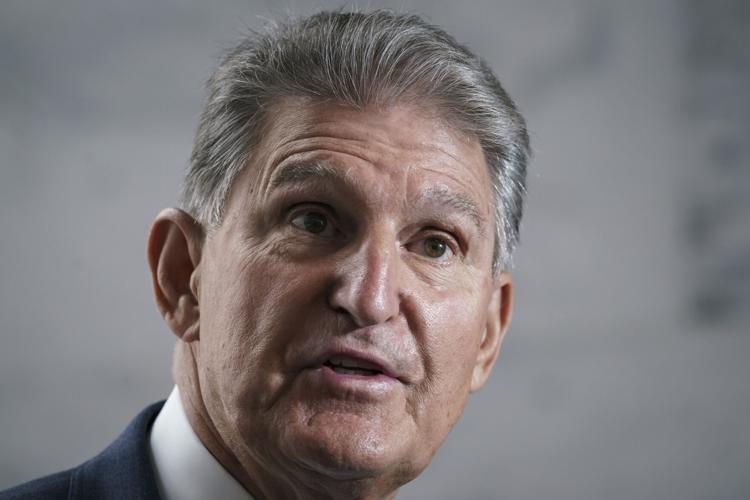
Sen. Joe Manchin, D-W.Va., speaks to reporters at the Capitol in Washington, Aug. 1, 2022.
Another setback came in 2018, when voters in Washington state rejected a carbon tax. If the idea couldn't even get traction in such a liberal corner of the country, Goldfuss said, what chance did it have nationally?
Stef Feldman, a domestic policy adviser, said Biden's experience as vice president informed his thinking about climate policy when he started running for the White House in 2019.
"He had seen President Obama work very hard to get cap and trade over the finish line," she said. "He knew that we had to try something different."
Ali Zaidi, the deputy national climate adviser, said Biden was helped by the fact that clean energy had become more affordable and recognizable in recent years.
"This is a set of technologies and a set of solutions for which time has come," he said. "He was able to speak to an American people who knew tangibly what this meant, and the economics lined up to propel action."
White House officials said they made a sustained effort to build — and hold together — a coalition involving unions, environmentalists and industry. For example, Zaidi and national climate adviser Gina McCarthy went to Colorado last September for the board meeting of the Edison Electric Institute, which represents utilities. Other meetings involved autoworkers, mineworkers and clean energy companies.
Climate policy was rolled into Biden's largest domestic agenda, which included expanded educational and safety net programs. Biden soon faced a roadblock when a central piece of his plan to push utilities off fossil fuels, known as the clean electricity standard, was left on the drawing board. Then whole thing ground to a halt when negotiations between the White House and Manchin stalled in December.
Manchin began talking again with Senate Majority Leader Chuck Schumer, D-N.Y., this year, starting with a dinner at an Italian restaurant on Capitol Hill. White House officials kept their focus on him too. Brian Deese, director of the National Economic Council, traveled to West Virginia with Energy Secretary Jennifer Granholm and and Interior Secretary Deb Haaland in March.

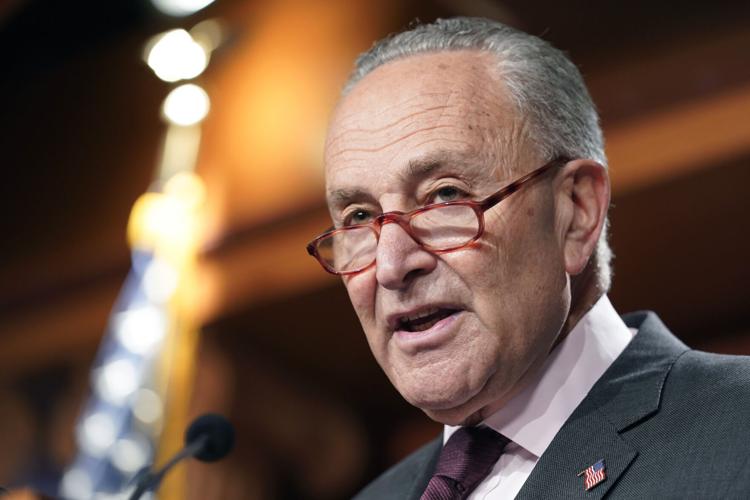
FILE - Senate Majority Leader Chuck Schumer of N.Y., speaks during a news conference Friday, Aug. 5, 2022, at the Capitol Hill in Washington.
However, negotiations began to break down again last month.
"People were holding their breath," Zaidi said.
Behind the scenes, White House counselor Steve Ricchetti kept talking with Manchin, according to administration officials who spoke on the condition of anonymity to describe private conversations. Other Democratic senators kept quiet pressure on Manchin as well to bring him back to the table.
As Biden considered whether to declare a climate emergency, Manchin and Schumer resumed negotiations. They announced a deal on July 27.
Schumer acknowledged in an interview with The Associated Press that "climate was hard" to figure out in the negotiations. Manchin is a longtime supporter of coal and oil and Schumer said that "I knew that he would add some tough stuff in."
Manchin successfully sought more government auctions for oil drilling on federal lands and waters. He also secured a commitment to help with a natural gas pipeline in his state.
Schumer said he had a "north star" during negotiations, which meant substantial reductions in greenhouse gas emissions.
"As long as we were reducing the amount of carbon that goes into the atmosphere by 40% — Biden's bill was 45 — we could swallow some bad stuff," he explained.
Schumer said, "And I talked to some of my caucus members and they said, 'Go for it, We'll have your back if you have to swallow bad stuff to get a good bill.'"
The final package of climate proposals has been trimmed from the original $555 billion plan, but it's still brimming with financial incentives for clean energy.
Manufacturing solar panels and wind turbines would earn companies tax credits. More money would help Americans buy electric vehicles or make their homes energy efficient.
"The bill gives people the tools to be part of the climate solution, and have that make sense for their pocketbook," Feldman said.
There are still some sticks to go along with the carrots.
A crucial element of the bill would charge oil and gas companies fees for excess methane emissions at drilling sites. Methane, the main component of natural gas, is a key contributor to global warming and packs a stronger short-term climate punch than even carbon dioxide.
The methane fee was top priority of Sen. Tom Carper, D-Del., a close Biden ally.
"If we want to make real progress on climate change in a short time, a great place to start is methane," Carper said in an interview.
But in a sign of the crucial role played by Manchin, the final version of the bill includes a grant program that rewards energy companies that take steps to lower methane emissions at drilling sites.
Carper called the provision a compromise, noting that he and his staff worked with Manchin to address a series of "concerns raised by Joe on behalf of the oil and gas industry."
Regardless of the compromises, environmentalists were thrilled by the outcome after girding themselves for another setback.
"This is a legacy-defining win for this administration and a signature achievement for the entire climate community who contributed to it," said Nathaniel Keohane, president of the Center for Climate and Energy Solutions. "After years of inaction in Congress we are now making remarkable and historic progress."
Associated Press writers Matthew Daly and Lisa Mascaro contributed to this report.