

LOS ANGELES — The smell struck undercover agent Ed Newcomer as soon as he entered the small, sparse apartment.
Faint and rancid, it permeated everything.
The smell was unmistakable: dead insects. Inside, the suspect grinned expectantly as he opened a container. Dozens of slimy, white grubs slithered in the dirt. Another box revealed a dead black beetle the size of a fist, its long, rhinoceroslike horn protruding in front.
"Dynastes hercules," the suspect said, his voice high-pitched and shrill.
Newcomer shuddered. But he smiled affably, the wide-eyed neophyte being inducted by the master. It was a role that Newcomer, 37, a special agent with the U.S. Fish and Wildlife Service, had been perfecting for two weeks.
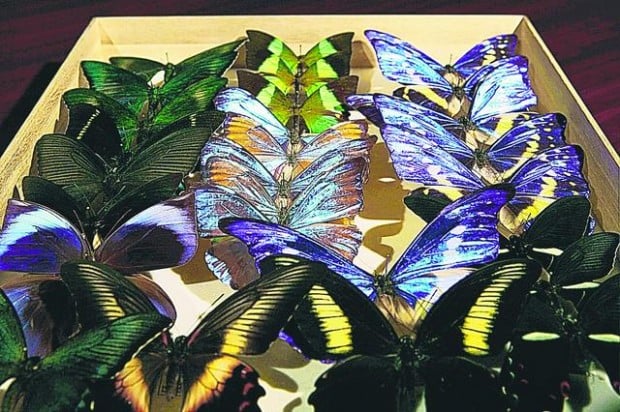
The suspect opened another box filled with dead butterflies, wings spread in iridescent glory — golds and greens and shimmering azures.
People are also reading…
Like fairy dust, Newcomer thought. Then he snapped back to reality. Newcomer's tape recorder had accidentally shut off. His cell phone was broken. His backup agent was lost in traffic. If the backup couldn't make contact soon, he would call the police.
It was Newcomer's first undercover case. He had won the trust of the world's most notorious butterfly smuggler, a man who made hundreds of thousands of dollars trading in endangered insects.
Global network of poachers
In the cutthroat world of butterfly poaching, Hisayoshi Kojima was king. He bragged he was the Indiana Jones of butterfly smugglers, that he commanded a global network of poachers.
From Jamaica he could get the giant swallowtail Papilio homerus, whose velvety, black-and-gold wings are depicted on the country's $1,000 bank note.
And from Papua New Guinea he could get what many dealers had never even seen: the prized Queen Alexandra's birdwing.
All are endangered, protected by international and U.S. wildlife laws. It is illegal to catch, kill or import them.
Kojima always found a way. Legitimate dealers had complained about him for years. And for years, Fish and Wildlife agents had investigated him. But Kojima, a Japanese native who lived in Los Angeles and Kyoto, always eluded capture.
When an informant tipped off agents that Kojima would be at the annual insect fair at the Los Angeles County Museum of Natural History in May 2003, Newcomer was put on the case.
The agent knew nothing about butterflies. But he knew the law. And under the law a Queen Alexandra butterfly is as protected as a snow leopard.
"He's no Indiana Jones"
Kojima, 53, ran the busiest stall in the cavernous exhibition hall, where thousands of collectors swarmed among booths filled with everything from gold scarab beetles to red-backed spiders.
"He's no Indiana Jones," Newcomer thought, sizing up the stocky man with the pudgy face, narrow eyes and poor English.
Newcomer is trim and athletic, with an easygoing manner. He had left behind his gun and his badge. He had assumed a false name.
Insect "mafias"
These days the worldwide illegal trade in endangered species is worth an estimated $10 billion to $15 billion a year, according to law enforcement reports. It can be as perilous as it is lucrative.
"We've been bushwhacked and waylaid and run out of villages by guys with bows and arrows and spears," said Joshua Lewallen of Insects International in Fort Davis, Texas.
Lewallen has heard tales of insect "mafias" in Thailand, and poaching gangs in Central Asia. "Collectors want rare things," Lewallen said. "And if people are willing to pay, others are willing to go to great lengths to provide."
Newcomer immersed himself in this world. There are about 18,000 known species of butterfly. Newcomer started learning their names, their markings, the prices that rare ones bring. At work Newcomer became known as "the butterfly agent." Undercover, he was becoming "Yoshi's friend."
They met for coffee at Starbucks. They went to Kojima's favorite Korean restaurant.
Kojima fabricated a wife and son in Japan. Newcomer invented a father and girlfriends.
Kojima taught Newcomer the delicate art of moistening the wings of dead butterflies so they could be unfolded and pinned precisely to mounting boards.
Kojima shrugged off the law. Under the Convention on International Trade in Endangered Species of Wild Fauna and Flora, permits are required to transport endangered animals across borders. The convention also bans global trade of species on the verge of extinction.
It wasn't like he was dealing in drugs, Kojima said.
Kojima suggested that the two men start an eBay account together: Kojima would provide the specimens and Newcomer would run the Internet side. As part of the deal, Kojima gave Newcomer a disc containing photographs of his entire collection. Kojima returned to Japan, promising to send samples.
Newcomer alerted U.S. Customs. Then he served subpoenas for Kojima's U.S. bank accounts.
Agent bides his time
After nearly four months, Newcomer was worried. He had given Kojima a fake address and a special cell-phone number. He e-mailed. He called. Nothing.
Finally, he saw his chance. Trolling the chat rooms of Insectnet.com, he noticed other dealers complaining about Kojima. Newcomer jumped in. He could vouch for "Yoshi," he wrote. He was working with him and could get anything from his collection.
Dealers contacted Newcomer immediately. Proudly, Newcomer e-mailed Kojima, telling him he'd found new customers and asking for specimens.
But instead of being pleased, Kojima got mad. He berated Newcomer, warning him not to trust people with whom he had not developed a relationship. They could be undercover agents, Kojima said.
It would be seven months before Kojima resumed contact.
Newcomer decided to set up a decoy eBay account. He would use butterfly photos from Kojima's disc and rig auctions so the specimens would go for exorbitant prices to other agents. He would prove to Kojima that he was serious about making money in butterflies.
Again, the plan backfired. Kojima wrote angry notes to Newcomer accusing him of stealing his photographs.
Next, the local game warden's office called and told Newcomer about a tip it had received from a Japanese insect dealer who mistakenly thought he was contacting Fish and Wildlife. Kojima had turned Newcomer in.
"I can get you Alexandra"
For two years Newcomer turned to other cases. But he couldn't get the butterfly smuggler out of his head.
Then in May 2006, he was tipped that Kojima was at the Los Angeles bug fair.
To Newcomer's astonishment, Kojima hailed him warmly. He'd had open-heart surgery, Kojima said, which is why he'd been out of touch. And he had moved permanently to Japan.
Newcomer pretended to have built up a trusted base of customers, including one who would pay top dollar for a Queen Alexandra.
"I can get you Alexandra," Kojima said.
Using his Web camera, Kojima would show specimens from Japan that Newcomer could buy and sell to his customers.
A month later Newcomer found himself staring at a grainy image of Kojima on his computer screen. Breathlessly, Kojima was offering two Alexandras. He needed $8,500.
The butterflies arrived by express mail.
It was the end of July. Newcomer had spent $14,997 on 42 butterflies in two months. He estimated the black market value of all the butterflies that Kojima had offered him at $294,000.
Newcomer had all the proof he needed.
Kojima was arrested at Los Angeles airport July 31, 2006. He pleaded guilty to 17 charges of selling and smuggling endangered butterflies. This April, he was sentenced to 21 months in prison and fined $38,731.


