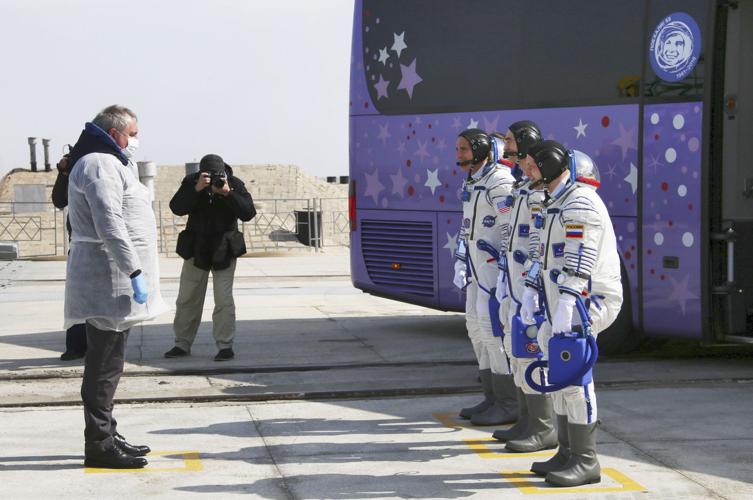
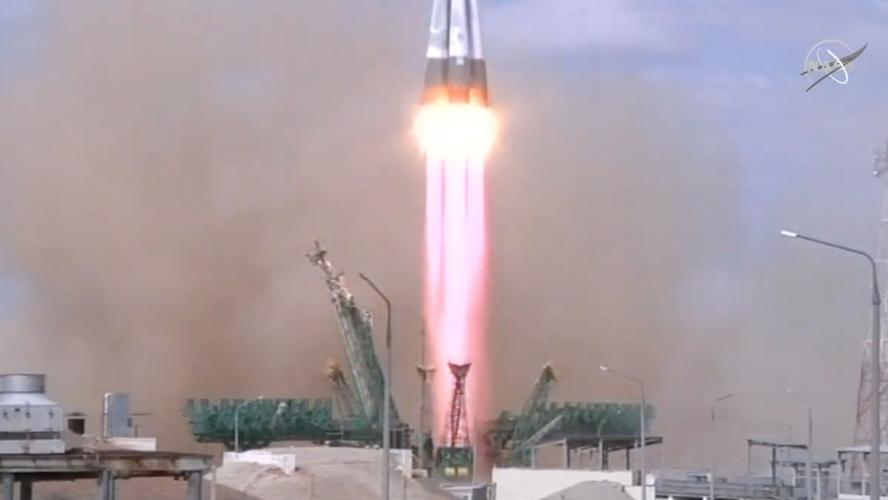
In this handout photo released by Roscosmos Space Agency Press Service U.S. astronaut Chris Cassidy, left, Russian cosmonauts Anatoly Ivanishin, centre, and Ivan Vagner, members of the main crew of the expedition to the International Space Station (ISS), report to head or Russian space agency Dmitry Rogozin prior the launch of Soyuz MS-16 space ship at the Russian leased Baikonur cosmodrome, Kazakhstan, Thursday, April 9, 2020.
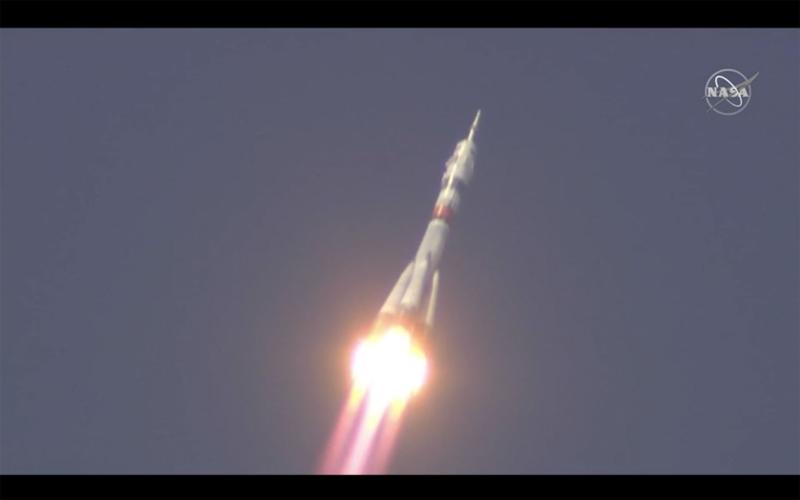
Two Russian cosmonauts, Anatoli Ivanishin and Ivan Vagner, and NASA astronaut Chris Cassidy launched to the International Space Station from the Baikonur Cosmodrome in Kazakhstan on Thursday morning at 4:05 a.m. ET.
The planned launch comes at a time when many events have been postponed or canceled due to the coronavirus pandemic. Travel restrictions prevented some of the astronauts' families, media and industry officials from attending the launch. Those involved in the launch were all seen keeping six feet apart and wearing masks.
But many of the health and safety precautions taken were standard for astronauts launching to the space station.
NASA has a long history of quarantining astronauts before they go to space to prevent illnesses like cold and flu from occurring off our planet. It was a concern even in the early days of the agency's astronaut program.
People are also reading…
"The health and welfare of the crew is always paramount," said Courtney Beasley, communications specialist at NASA's Johnson Space Center. "All of our crew must stay in quarantine for two weeks before they launch. This ensures that they aren't sick or incubating an illness when they get to the space station, and is called 'health stabilization.'"
Ahead of quarantine, the astronauts followed the US Centers for Disease Control and Prevention recommendations regarding coronavirus. NASA and the Russian Space Agency, Roscosmos, maintained the standard quarantine period of two weeks for the crew, Beasley said.
"During quarantine, the astronauts live in their crew quarters — NASA has crew quarters for this purpose at Kennedy and Johnson Space Centers — and Roscosmos has them in Baikonur," she said. "They don't have direct contact with anyone who has not been pre-cleared by NASA flight surgeons. The time is spent preparing for flight, studying and resting, as well as working out and making video calls to friends and family members."

Expedition 63 launches Thursday, headed to the International Space Station.
About six hours after Thursday morning's launch, the astronauts docked with the International Space Station at 10:13 a.m. ET. About two hours later, the hatches will open and they will join Roscosmos cosmonaut Oleg Skripochka and NASA astronauts Jessica Meir and Andrew Morgan.
Skripochka and Meir will return to Earth on April 17 after spending six months on the station. Morgan, who will also return to Earth with them, launched to the station on the 50th anniversary of the Apollo 11 moon landing and had an extended mission of eight months.
When Skripochka, Meir and Morgan return from their stay in space, they will be coming back to a very different Earth. When they launched, coronavirus wasn't a threat. Now, it's a pandemic.
NASA already has a protocol in place for returning astronauts that includes a post-landing medical check by flight doctors. The doctors and other NASA teams help the astronauts reacclimate to Earth's gravity, getting them up and walking soon after landing. In the weeks after, they're monitored to make sure they're healthy.
This time, the protocols will be more extensive.

Expedition 63 launches Thursday, headed to the International Space Station.
"NASA will closely adhere to the CDC's recommendations on infection control for the coronavirus as Andrew Morgan and Jessica Meir return to Earth and begin their post-flight medical testing and readaptation period," Beasley said.
"This includes cleaning of surfaces, social distancing, emphasizing hand hygiene, encouraging NASA team members who are sick to stay home, and limiting contact with the crew members."
On April 15, two days before the current crew returns to Earth, a "change of command ceremony" will take place on the station as the new crew takes over, according to NASA.
This is the third spaceflight for Cassidy and Ivanishin, and it's the first for Vagner.
Cassidy was selected by NASA to be an astronaut in 2004. The Navy captain also served for 11 years as a member of the US Navy SEALs Team. His previous spaceflight experience includes a shuttle mission on Endeavour to help with assembly of the Space Station in 2009. During that flight, he became the 500th person in history to fly in space.
He also spent six months on the space station in 2013, one of the first crew members to participate in the new rendezvous system that shortened docking with the space station from two days to six hours.
Cassidy, Ivanishin and Vagner will also welcome NASA astronauts Bob Behnken and Doug Hurley when they arrive at the space station in mid-to-late May on NASA's SpaceX Demo-2 flight test.
It will be the first time astronauts will launch into space aboard an American rocket and spacecraft from American soil since the final space shuttle mission in 2011. Since then, crews launching to the International Space Station have been leaving from Baikonur aboard the Russian Soyuz spacecraft.
Demo-2 is the final flight test of the system before SpaceX is certified to carry out operational crew flights to and from the space station for NASA, the agency said.
The agency is monitoring CDC guidance with regards to mission planning, they said. The launch date could be postponed.
Photos: Remembering Apollo 13 at 50
March 26, 1970: The preparations

Apollo 13 astronaut James A. Lovell stops on the ramp from the crew quarters and looks skywards, March 26, 1970, as the Apollo 13 crew went through the final rehearsal before blasting off from Cape Kennedy on April 11 in a rain storm. Behind Lovell is astronaut Thomas K. Mattingly.
March 26, 1970

Members of the Apollo 13 crew leave the launch site after finishing a countdown demonstration in the Apollo 13 spaceship, March 26, 1970, at Cape Kennedy in Florida. Leading the astronauts is Fred W. Haise, command pilot James A. Lovell in middle and Thomas K. Mattingly, in rear.
April 10, 1970: The day before launch

In this April 10, 1970 photo made available by NASA, Apollo 13 astronauts, from left, Fred Haise, Jack Swigert and Jim Lovell gather for a photo on the day before launch.
April 11, 1970

In this April 11, 1970 file photo, Apollo 13 commander James A. Lovell Jr., foreground, speaks during a news conference in Cape Kennedy, Fla. before the spacecraft launched on its ill-fated journey to the moon. At center is astronaut Fred Haise.
April 11, 1970

The crew of the Apollo 13 lunar landing mission are shown in their space suits on their way to the launch pad at Kennedy Space Center in Cape Kennedy, Fla., Saturday, April 11, 1970. Flight Commander James A. Lovell Jr., is waving, followed by Lunar Module pilot John L. Swigert Jr., and Command Module pilot Fred W. Haise Jr.
April 11, 1970: The launch

In this April 11, 1970 photo made available by NASA, the Saturn V rocket carrying the crew of the Apollo 13 mission to the moon launches from the Kennedy Space Center in Florida.
April 11, 1970

Florida palms frame the Apollo 13 spacecraft as it lifts from its pad at Cape Kennedy carrying astronauts Jim Lovell, Fred Haise and John Swigert to the moon, April 11, 1970.
April 11, 1970

The huge Saturn rocket carrying the Apollo 13 spacecraft on its moon mission, lifts off the launch pad at Cape Kennedy, Fla., April 11, 1970.
April 1970: The view from space

This April 1970 photo made available by NASA shows the Earth as the Apollo 13 mission heads towards the moon.
April 1970

This April 1970 photo made available by NASA shows the Earth as the Apollo 13 crew traveled towards the moon.
April 1970

This April 1970 photo made available by NASA shows astronaut Jim Lovell during the Apollo 13 mission.
April 14, 1970: Reports of trouble

In this April 14, 1970 file photo, people in Rome look at newspapers headlining the trouble that developed aboard the U.S.'s Apollo 13 mission which led to the cancellation of the attempt to land on the moon.
April 14, 1970: America reacts

Chicago Cubs co-captains Ernie Banks and Ron Santo, right, bow heads as master of ceremonies Milton Berle leads the Opening Day crowd in prayer for safe return of the Apollo 13 astronauts Tuesday, April 14, 1970 in Chicago.
April 14, 1970

Little 4-year-old Jeffrey Lovell, youngest of Apollo 13 astronaut James Lovell’s four children, curls up in the backseat of a car that took him and other small children to a nursery school near their homes at the Manned Center, April 14, 1970, in Houston. Meanwhile, Lovell and his two fellow crewmen, Fred W. Haise and John L. Swigert, were in a battle to bring back to earth their disabled spacecraft.
April 1970: Heroic actions

In this April 1970 photo provided by NASA, Apollo 13 command module pilot John Swigert helps to hook up a lithium hydroxide canister in the lunar module, in an effort to get rid of carbon dioxide in the cabin as the spacecraft attempts to return to Earth. The explosion of an oxygen tank in the service module forced the three-man crew to rely on the lunar module as a "lifeboat."
April 1970

This April 1970 photo made available by NASA shows the interior of the Apollo 13 lunar module with the "mail box," an ad hoc device which the crew assembled while in space to remove carbon dioxide from the air. It was designed and tested on the ground in Houston. Because of the explosion of one of the oxygen tanks in the service module, the three men had to use the lunar module as a "lifeboat" on their way back to Earth.
April 1970

This April 1970 photo made available by NASA shows the moon through a window on the lunar module as the Apollo 13 crew heads back toward the Earth.
April 1970

In this April 1970 photo made available by NASA, the Earth is seen though a window on the lunar module as the Apollo 13 crew heads toward home.
April 15, 1970: Mission Control in Houston

In this April 15, 1970 photo made available by NASA, a group of flight controllers gather around the console of Glenn S. Lunney, foreground seated, Shift 4 flight director, in the Mission Operations Control Room (MOCR) of Mission Control Center (MCC) in Houston. Their attention is drawn to a weather map of the proposed landing site in the Pacific Ocean. At this point, the Apollo 13 lunar landing mission had been canceled, and the problem-plagued Apollo 13 crew members were in trans-Earth trajectory attempting to bring their crippled spacecraft back home.
April 16, 1970

The wives of Apollo 13 astronauts, Marilyn Lovell, left, and Mary Haise, are a little more relaxed on April 16, 1970 after the crippled spacecraft made a successful midcourse correction and appeared to be on target for a safe reentry into the earth’s atmosphere and splashdown. They are shown at the Donald K. Slayton home near the Manned Spacecraft Center, Houston, Tex., where they attended a luncheon.
April 17, 1970: Preparing for splashdown

In this April 17, 1970 photo made available by NASA, astronaut Jim Lovell, inside the Apollo 13 lunar module, prepares it for jettison before returning to the command module for splashdown in the Pacific Ocean.
April 17, 1970

This April 17, 1970 photo provided by NASA shows the Apollo 13 lunar module photographed from the command module just after the lunar module was jettisoned, about an hour before splashdown of the command module in the Pacific Ocean. The explosion of an oxygen tank in the service module forced the Apollo 13 crew members to rely on the lunar module as a "lifeboat."
April 17, 1970

This April 17, 1970 photo made available by NASA shows the severely damaged Apollo 13 service module after separation from the lunar module/command module. An entire panel on the service module was blown away by the explosion of an oxygen tank. The damage forced the Apollo 13 crew members to use the lunar module as a "lifeboat." The lunar module was jettisoned just prior to Earth re-entry by the command module.
April 17, 1970

In this April 17, 1970 photo made available by NASA, the command module carrying the Apollo 13 crew parachutes to a splashdown in the Pacific Ocean.
April 17, 1970

In this April 17, 1970 file photo, crowds watch a television screen in New York's Grand Central Station waiting for the safe arrival of the Apollo 13 astronauts in the Pacific Ocean.
April 17, 1970: Rescue operations in the Pacific

In this photo provided by NASA, a water level view of the Apollo 13 recovery operations in the South Pacific Ocean, April 17, 1970. The three astronauts are seen leaving their spacecraft. John L. Swigert Jr. (back to camera), command module pilot, is already in the life raft. Fred W. Haise Jr., lunar module pilot, facing camera, is stepping into the life raft. James A. Lovell Jr., commander, is leaving the spacecraft in the background. A United States Navy underwater demolition team assists with the recovery operations. The three crew members were picked up by helicopter and flown to the prime recovery ship, USS Iwo Jima. The Apollo 13 Command Module splashed down at 12:07:44 p.m. (CST) to safely conclude a perilous space flight. Though the Apollo lunar landing mission was canceled, a disastrous loss of three astronauts was averted.
April 17, 1970

In this April 17, 1970 photo made available by NASA, astronaut Jim Lovell, commander, is hoisted aboard a helicopter from the USS Iwo Jima, after splashdown of the Apollo 13 command module in the Pacific Ocean.
April 17, 1970

Apollo 13 astronauts Fred W. Haise, James A. Lovell and John L. Swigert, left to right, leave a helicopter to step aboard carrier Iwo Jima in the Pacific Ocean after their successful recovery on Friday, April 17, 1970.
April 17, 1970

Playing hard to get with the news photographers, Jeffrey Lovell, 4, hides his eyes as his mother, Marilyn Lovell talks with newsmen at their home in Houston, April 17, 1970, after the successful splashdown of Apollo 13. Sister Barbara, 16, is amused by her little brother’s antics.
April 17, 1970

James Lovell III, 15-year-old cadet at St. John's Military Academy at Delafield, Wis., intently watches his father on television at the home of the academy's commandant, April 17, 1970, Delafield, Wis. Young Lovell sat tensely throughout the recovery of the Apollo 13 command capsule and later broke into a wide smile of relief.
April 19, 1970

In this April 19, 1970 file photo, Apollo 13 astronaut Jim Lovell carries his son, Jeff, 4, on his shoulders as he arrived at Ellington Air Force Base in Houston.
April 19, 1970

Residents of Timber Cove near the Manned Spacecraft Center greet their favorite neighbor, Apollo 13 commander James Lovell Jr., as he arrived at his home, April 19, 1970, Houston, Tex. Barbara Lovell, 16, sits beside the driver and Marilyn Lovell holding Jeff, 4, is behind the driver. Next to Mrs. Lovell are James, 15, and Susan, 11, wearing a lei.
April 21, 1970

In this April 21, 1970 file photo, Apollo 13 commander Jim Lovell uses a scale model during a televised news conference at the Manned Spacecraft Center, Houston to explain how the crew managed to survive after the explosion that damaged the service module during their mission to the moon. At center is John Swigert, command module pilot, and at right is Fred Haise, lunar module pilot.
May 1, 1970: Parade honors astronauts

In this May 1, 1970 file photo, confetti falls from the skyscrapers in Chicago's financial district as Apollo 13 astronauts John Swigert and Jim Lovell ride in a motorcade during a parade in their honor.
May 1, 1970

Apollo 13 astronauts John Swigert Jr., with his arms upraise and James Lovell ride in parade in their honor, Friday, May 1, 1970, through Chicago’s financial district as confetti streams from the skyscrapters.
The years since: July 26, 1995

President Clinton poses with actor Tom Hanks, left, and former astronaut James Lovell in the Oval Office of the White House Wednesday, July 26, 1995, after presenting Lovell with the Congressional Space Medal of Honor. Hanks joined in after portraying Lovell in the movie "Apollo 13."
The years since: June 29, 2008

Former NASA astronaut Jim Lovell, commander of Apollo 13, throws out the first pitch before the Houston Astros and Boston Red Sox baseball game Sunday, June 29, 2008, in Houston.
The years since: Aug. 29, 2008

In this Friday, Aug. 29, 2008 file photo, astronauts Neil Armstrong, left, the first man to walk on the moon, John Glenn Jr., center, the first American to orbit earth, and James Lovell, right, commander of Apollo 13, stand at a gathering of 19 of the astronauts who call Ohio home in Cleveland. The gathering of Ohio astronauts was part of NASA's 50th Anniversary celebration.
The years since: July 13, 2009

In a July 13, 2009 file photo, Astronaut Jim Lovell arrives for an event sponsored by Louis Vuitton celebrating the 40th anniversary of the lunar landing at the Museum of Natural History, in New York. In an interview Monday, Feb. 7, 2011, Lovell, commander of the Apollo 13 mission that limped back to Earth after an explosion crippled its flight to the moon in 1970, said compartmentalizing is a way of thinking that helps you survive: "You focus on what has to be done immediately... One by one you overcome each crisis as they come along."
The years since: April 12, 2010

Apollo 13 crew members Commander Captain James A. Lovell, Jr. right, and Lunar Module Pilot Fred W. Haise pose for a photo during a 40th anniversary reunion of the moon mission at the Adler Planetarium on Monday, April 12, 2010, in Chicago.
The years since: April 12, 2010

Apollo 13 Commander Captain James A. Lovell, Jr. right, introduces Lunar Module Pilot Fred W. Haise left, and mission flight directors Milton Windler second from left, Eugene "Gene" F. Kranz middle, and Gerald "Gerry" D. Griffin during a 40th anniversary reunion of the moon mission at the Adler Planetarium Monday, April 12, 2010, in Chicago.
The years since: Sept. 9, 2011

This Sept. 9, 2011 file photo shows a statue of former NASA astronaut John "Jack" Swigert, Jr., at the Capitol Visitors Center, part of the U.S. Capitol complex. Swigert was elected to Congress, but died before being sworn in.
The years since: March 18, 2015

Former astronaut Fred Haise, speaks to reporters after being honored by the Mississippi House and Senate on Wednesday, March 18, 2015, at the Capitol in Jackson, Miss. Haise, a Biloxi native, was the lunar module pilot on the Apollo 13 flight nearly 45 years ago. He was commended with a House Concurrent Resolution recognizing his career and leadership. Haise, 81, was at the Capitol for Stennis Space Center recognition day.
The years since: Nov. 11, 2016

Astronaut Jim Lovell, center, speaks, accompanied by fellow astronaut Tom Stafford, right, during the ribbon cutting ceremony for the Heroes and Legends exhibit at the Kennedy Space Center Visitor Complex in Florida on Friday, Nov. 11, 2016. At left is the master of ceremonies, John Zarrella, formerly of CNN.
The-CNN-Wire™ & © 2020 Cable News Network, Inc., a WarnerMedia Company. All rights reserved.