

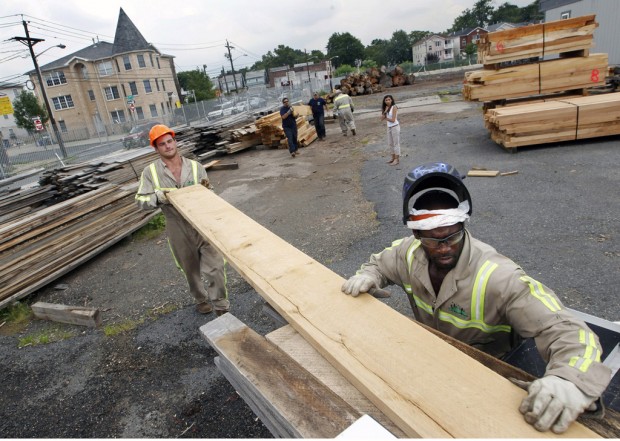
NEWARK, N.J. - It looks like any sawmill in the forest - piles of cherry, walnut and oak tree trunks stacked high, trucks rumbling in and out, workers operating a saw. There's one exception, though: There's seemingly no forest near its location, right off the highway in New Jersey's largest city.
Citilog begs to differ. The Newark company takes unwanted trees from the so-called urban forest - parks, yards, streets and wherever else a tree might grow in a city - and turns them into furniture, flooring and other materials.
Although there are many benefits of having trees, they can become a nuisance if they become damaged, fall down or outgrow their space.
"Every community in the U.S. has this problem," said Citilog's founder, Stubby Warmbold.
Around the country, companies like Warmbold's are giving new purpose to unwanted trees. The goal is to harness the so-called locavore movement, which advocates growing and consuming foods within the same community, and applying it to products made from trees in a way that benefits the community and environment.
People are also reading…
Cities often pay to send trees to landfills when they are removed because of blight, lightning strikes, storm damage or other causes. But more are starting to use companies like Warmbold's to save money on tree disposal.
"We're all hard and heavy about having local food and local jobs and generating value-added products in the local community," said Alex Johnson, the urban forestry manager for Durham, N.C. "Why not have the same model be applied to the trees that grow in our cities?"
Some states, including California and North Carolina, have held statewide summits on using local lumber, and the Urban Wood Project started to reclaim trees in southeastern Michigan in 2005.
Durham has sold some of its downed trees to a local wood yard, making back some of the $12,500 it budgets each year for tree dumping.
Don Seawater, owner of Pacific Coast Lumber in San Luis Opisbo, Calif., said the cities of San Luis Opisbo and Morro Bay give him some of their trees.
"It's a resource that has been completely neglected for a long time and now is viable," Seawater said.
The California Department of Forestry and Fire Protection is resurrecting a program that brings saw-mills to communities, allowing them to process trees that would otherwise be taken to a landfill.


