

It's the perfect "green" building.
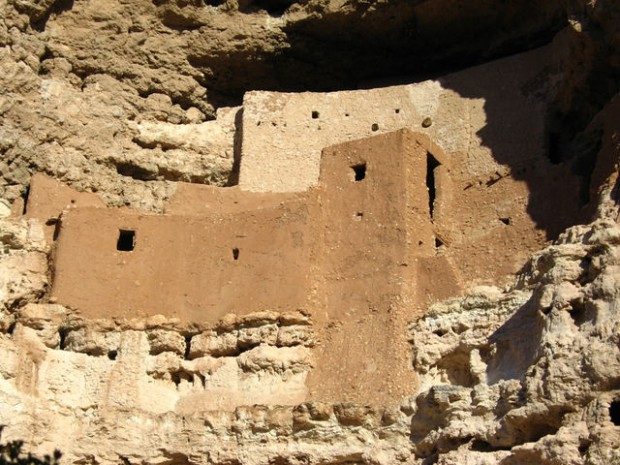
It faces south, taking advantage of passive solar features. Its east and west ends are insulated with a mountain of limestone. It stays cool in summer, warm in winter.
It is made from materials that are found nearby or manufactured on-site and recycled generation after generation.
No commute. The work site is on-site or a stone's throw away. Food and water are available nearby.
It is the perfect zero-carbon home, though nobody has lived in it for centuries.
Still, we can learn something from the cliff dwelling, says architect Dave Burns, who has spent much of his professional career trying to approach the sustainability of our ancestors in buildings that must be air conditioned, lighted and powered for the various jobs they perform. He is spending his time now persuading others to go along, forming a Southern Arizona chapter of the U.S. Green Building Council.
People are also reading…
The crusade for greener buildings has accelerated with the recognition that powering our homes, offices and factories requires 70 percent of the electricity generated in this country and accounts for 30 percent of our contribution to climate change — the release of greenhouse gases caused by our daily activities.
Arizona's three universities have now all pledged to build green. The Tucson Unified School District has built its first certified green school, Davidson Elementary, designed by Burns' firm, Burns Wald-Hopkins Architects.
Just this year, the city of Tucson, Pima County, Oro Valley and the University of Arizona decided to officially join the green-building movement by meeting certified standards on all new projects.
The mayor of Tucson and the president of the university have both signed promises to reduce emissions of greenhouse gases. The city established an office of Conservation and Sustainable Development to monitor progress. The county has hired a green-building-code coordinator and a sustainability coordinator for the county administrator's office.
The National Association of Home Builders is creating its own green-building standards, and building-code officials are working with local home builders to create a green code for residential development in Pima County.
It's about time, says architect Rich Franz, who persuaded Pima Community College's Board of Governors to sign on to the "silver" standard of Leadership in Energy and Environmental Design (LEED) more than a decade ago. Pima's Desert Vista campus has the region's first LEED-certified buildings.
The LEED certification program is run by the U.S. Green Building Council, a nonprofit group that uses a point system to certify construction projects that conserve resources in four levels from "certified" to "platinum."
His ground-floor experience convinced him that buildings could be built to environmentally friendly standards with minimal added costs and huge long-term savings, Franz said.
Gradually, other entities agreed, though it has taken time to get over the "two buckets" approach to building, said Peter Dourlein, associate director of Facilities, Design and Construction at UA.
You can't add to the "bucket" of construction funds given the universities by the Legislature by identifying savings from the "bucket" used for heating, cooling and maintaining the buildings over time, he said.
Arizona's other universities are a step ahead in bragging rights. The state's first "platinum" LEED building is at Arizona State University, where President Michael Crow wants his campus to be known for sustainability.
Northern Arizona University, burnishing its green image, will soon have its first certified platinum LEED building.
Both schools require at least "silver" LEED rating in new construction, and both have programs to involve the entire campus in sustainable practices.
The UA is now planning to build to silver LEED standards, and a green-roots movement of faculty, staff and students is pushing campuswide awareness of sustainable practices.
Marketing green is important in academia and is becoming more important to governments led by elected officials.
"Green is sexy now. Green is very, very hot," said U.S. Rep. Gabrielle Giffords, D-Ariz., in an address recently to a green-building symposium.
It's not enough to simply build energy-efficient buildings, said the UA's Dourlein. His staff of architects and engineers has considered sustainability in projects for years, but the university now recognizes the need to certify them. Campus commitment to sustainability is now one of the things that students consider in making decisions about college, he said.
The marketing aspect rankles some architects, such as Les Wallach, who has built a reputation over 30 years for buildings that are sensitive to the environment.
Building to a bureaucratic standard may raise the level of some construction, he concedes, but it's not a lofty goal. It may raise the bar for some otherwise bad buildings, but it doesn't challenge or reward innovation, he said.
Wallach, principal of Line + Space Architects, said he has worked on projects where ideas that would actually conserve resources were rejected in favor of ones that would gain LEED points.
"A code is supposed to be a minimum standard — that's what I have to do and not one thing more. If you get a point for using a carpet that has a high content of recycled bottles in it — great. But what if you use no carpet? Isn't that even better? You get no points for it," said Wallach.
Wallach also rankles at the word "sustainability."
It means building and operating in a way that does not rob future generations of resources.
"If you want to be sustainable, the answer is always 'Don't build' and also 'Don't be here,' " Wallach said.
"I'd rather hear terminology like 'resource conserving.' Can I make it last 200 to 300 years, instead of 20?"
Franz, who pioneered LEED building standards at Pima college, said the third-party verification required by the U.S. Green Building Council ensures that people are actually doing what they say they are doing.
LEED certification has a cost, said Burns, who is organizing the council's Southern Arizona chapter, but it's a small percentage of the building's overall price. "It depends on what you're building. If it's a good building it won't cost more," Burns said.
Those costs should continue to go down as building practices and materials that gain points toward LEED certification become more common, Burns said. People need to get over the up-front costs and concentrate on the long-term savings to society, he said.
Today's building practices evolved during a period of cheap energy and before awareness of the societal costs of adding construction debris to landfills. "It's all about market creation," said Burns. When he began looking for recycled building materials and furnishings, they were a scarce commodity; now there are choices.
In an era of shrinking energy resources, such things make sense, he said.
The original green buildings weren't designed to save energy or the planet, said E. Charles Adams, anthropologist and curator of archaeology at Arizona State Museum. Our ancestors used what was at hand because they had no choice.
Still, they managed to build homes that survived for thousands of years. The cliff dwelling is a prime example, he said. "Build something of wood or adobe and put it in a cave, you'll never have to replace it. In an era of declining resources, it's a good choice. Unfortunately, we can't all live in cliff dwellings."
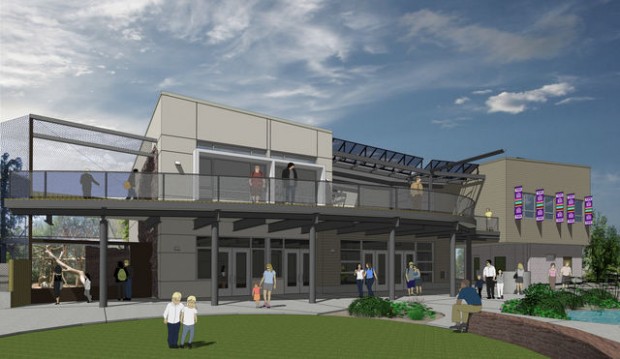
Two green buildings, ancient and modern, compared THE REID PARK ZOO CONSERVATION LEARNING CENTER
The modern green building is an amalgamation of those early lessons and high-tech systems.
Site planning
Oriented mainly toward north and south with shade configured to warm the building in winter, cool it in summer. Breezeway allows outdoor classroom, and two-story design minimizes building footprint.
Water management
Rainwater captured from roof irrigates native or adaptive plants, and excess is directed to nearby recycled-water pond in Reid Park; toilets are flushed with recycled water; gray water from sinks and showers is used for on-site watering.
Building also has waterless urinals, ultra-low-flow faucets and a pervious-concrete in parking lot, which allows rain to seep back to water table.
Energy management
Solar panels provide shade and generate at least 20 percent of the building's energy needs. Skylights and windows provide "daylighting," reducing energy demand. Lights, heating and cooling adjusted to reduce use in sunny and warm areas of the building. White reflective roof, insulated-concrete-form walls with average R-32 insulative properties, double-paned, low E glass. HVAC system downsized to 35 percent of energy that would otherwise be required.
Material use
Made on site: rammed-earth patio walls. Concrete and asphalt on site was ground and recycled for new paving. Recycled fly ash in new concrete. Most building materials manufactured within 500-mile radius.
Recycled: Originate Natural Building Materials donated a salvaged countertop of Ice Stone, a totally recycled product. Window shading salvaged from former Tucson General Hospital; cotton batt insulation made from recycled jeans in Chandler; linoleum flooring made from scrap wood and sawdust; Trex decking and carpet made from recycled plastic. Steel frame is 99 percent recycled; 90 percent of construction debris was sorted and recycled.
Rapidly renewable materials: Bamboo; wood from certified renewable forests.
Commuting
Located along multiuse paths with bus line nearby. Showers (of limited duration) in restrooms and bike lockers to encourage bike use by staff. Parking set aside for car pools and alternative-fuel vehicles.
Indoor environment
All paints and adhesives are free of volatile organic compounds. Operable windows allow fresh air to circulate (and reduce heating and cooling needs) on balmy days. Plywood and particle board used in construction are formaldehyde-free. Carpet doesn't give off gas. Green-cleaning program uses environmentally friendly products.
Other
White roofs, shade trees and light-colored paving reduce heat-island effect. Tucson Zoological Society will purchase "green" energy credits comparable to four years' operation of building. The building and its resource-saving components will become part of the Zoo School's education about conserving resources. Vegetation removed was fed to the zoo animals. Animals will snack in the future on bamboo grown on-site.
THE CLIFF DWELLING
One of the original "green" buildings
Site planning
You find a cave on a south-facing cliff, oriented toward winter sun for heating, shaded in summer.
Water management
The same seeps that hollowed out the sandstone cliff provide a ready source of water. Stream at cliff bottom provides water for crops grown in flood fields.
Material use
Stone, mud and adobe walls manufactured on-site from nearby found or mined materials. If flooding produced a good supply of driftwood, more wood was used.
Commuting
Living and working spaces for artisans were developed on-site, aided by total lack of zoning regulations.
Daily labor was a short commute to flood fields in canyon and rain fields atop mesa. Hunting, gathering and trading required energy, but it was of the human, mechanical kind. Today we'd call that an alternate mode.
Indoor environment
Occasional smoke from cooking and warming fires was swept off by the breezes created by perennial streams.
Nearby riparian vegetation also captured carbon dioxide from the wood fires.
Food storage and preservation
You dig a hole in a dry spot to keep things cool. Some granaries were located on north-facing cliffs for maximum cooling.
Part one of a two-part series
Today: The push to build "green" buildings goes wide in Southern Arizona —where it actually has ancient roots.
Monday: Students lead the drive to go green at the University of Arizona. Plus, the prospect for more environmentally cutting-edge homes.


