

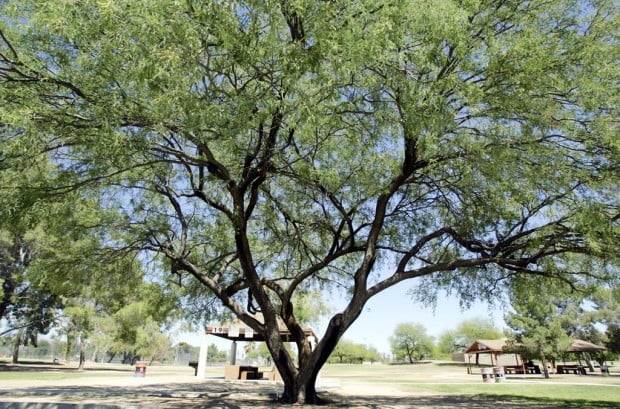
It's big, imposing and beautiful, no doubt. But what is one velvet mesquite worth?
About $185,000, say arborists and other tree experts on a city of Tucson advisory committee. This tree was the highest-valued of 15 Reid Park trees whose total value was pegged at about $678,000 in an Earth Day project these experts just undertook.
In a separate city study, a University of Arizona scientist looked separately at trees on public streets downtown and citywide. A downtown tree got an average value of $52.29 annually based on its aesthetics and its ability to save energy and reduce air pollution. A tree located anywhere in the city got a $72.31 annual value.
In reaction, a University of Arizona economist said he thinks the values placed on the Reid Park trees were too high and those on the citywide trees, too low.
Here are some questions and answers on the studies:
People are also reading…
Q. How can anyone put a dollar value to a tree?
A. Over the past 20 years, researchers have increasingly done that, by looking at how trees reduce air pollution, energy costs and greenhouse-gas emissions, among other things, according to a recent article in the scholarly journal the Wilson Quarterly. In Chicago in 1994, a team of researchers concluded that city's average tree was worth $402 over its life span. In 2006, researchers using more sophisticated techniques concluded that New York City's 592,000 street trees delivered $209 per tree in benefits, the Wilson article said.
Q. How did researchers come up with $185,000 for a Tucson native mesquite, known as a velvet?
A. They looked at what it would cost to buy a young, very small version of that and the other trees, and assumed that as a tree grew, its value would grow as much. Then, they used a formula devised by the Council of Tree and Landscape Appraisers. Assuming a hypothetical $200 tab for a 2-inch-diameter velvet mesquite, this mesquite, with a 45-inch diameter, is worth about $227,000, according to Libby Davison, an arborist who worked on the study. She is the retired director of the UA Arboretum.
Then, the group discounted the value to reflect possible weaknesses: its condition or location. The native mesquite had few deductions, since it's easy to care for, uses little water, sits in a park and provides afternoon shade, Davidson said.
Q. What does an outside economist think?
A. Paul Portney, a UA economist, said he doesn't dispute the arborists' methodology, "but let me ask you, do you think the people in Tucson think it's worth $678,000 of the city's money for 15 trees? It just doesn't seem realistic to me." Portney, who stepped down last December as head of UA's Eller School of Management, teaches environmental economics.
Q. What was done with these values?
A. Davison and her colleagues posted tags with the financial value of each of the 15 trees on Earth Day, April 22.
Urban heat island
Now, here's a look at the second study, which was presented Thursday at a city-sponsored workshop on ways to fix the urban-heat-island effect, or the gradual increase in urban nighttime temperatures caused by a proliferation of pavement:
Q. How many trees did the researchers find?
A. They relied on two surveys, said UA research scientist Alison Meadow, who conducted the study. Downtown, a new city survey found 1,199 live trees standing on downtown's total 11 miles of roadway. A 2007, city-commissioned survey found 924 trees on 21 miles of roadway all over the city. Since those 21 miles are about 5 percent of all major streets and roads, researchers extrapolated to assume that the city's total public street tree population was about 18,840, covering 0.7 percent of all land.
Q: How did they figure what the trees are worth?
A. To calculate dollar values, researchers used a software program called ITree. That's a peer-reviewed methodology developed by researchers at University of California-Davis and the U.S. Forest Service. The local researcher, Meadow, calculated the trees' aesthetic values, which made for the largest share of the benefits.
She also looked at trees' energy savings, air pollution removal (trees trap and hold dust, ash, pollen and smoke), carbon dioxide reductions and ability to slow stormwater runoff, which in turn reduces erosion and increases groundwater recharge.
Q. What does Portney think?
A. "It's just a seat of the pants estimate, but if these are fully mature trees and the estimate is $52 per year per tree, I'll bet a fully mature tree adds more than that to the value of a home it sits in front of," the UA economist said.
Q. If we planted a lot more trees, what good could it do?
A. The study noted that the advocacy group American Forests urges Southwestern cities to cover 25 percent of their land with trees. If Tucson reached that goal, it could gain $44 million in annual environmental benefits, the new report said. The study said that's at least theoretically possible, with 80 percent of land in the city not covered with trees or hard surfaces.
Q. How will this study be used?
A. Irene Ogata, the city's urban-landscape manager, hopes to help prepare a new management plan for the city's urban forest that is expected to go to the City Council by the end of 2011.
Contact reporter Tony Davis at tdavis@azstarnet.com or 806-7746.


