

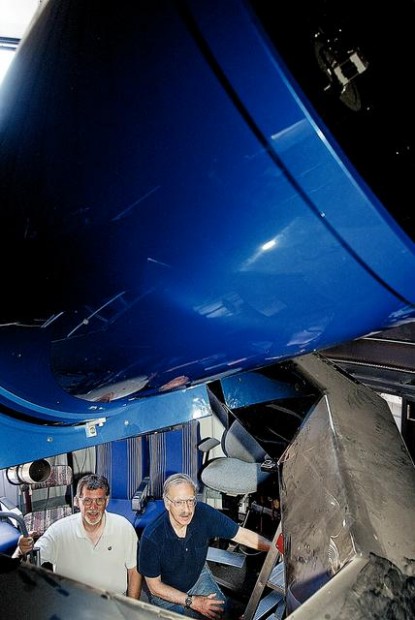
SIERRA VISTA — "This was a hobby that got out of control," said David Healy as he stood inside his private observatory in the backyard of his home southeast of Sierra Vista.
"It's an addiction."
After discovering more than 500 asteroids from his Junk Bond Observatory in his backyard, Healy was ready for another challenge.
"A lot of amateurs were discovering asteroids," he said, "but no amateur has discovered an exoplanet yet."
An extrasolar planet, or exoplanet, is any planet not in our solar system.
"We're trying to be the first nonprofessionals to discover a planet since Pluto," said fellow astronomer Tom Kaye.
The two partnered up last fall and have looked at more than 50,000 stars since they began searching for a new planet.
People are also reading…
Southern Arizona provides plenty of opportunities for their efforts.
"You have maybe 300 nights a year here which are at least partly clear," Healy said. "The climate is free of a lot of clouds."
Each clear night, Kaye sends a new set of coordinates to Healy, celestial latitudes and longitudes that plot the course of "Big Blue" for the night. The massive, cobalt-colored Casse-grain reflecting telescope directs its 32-inch-diameter mirror at a total of four separate collections of stars, or star-fields, and follows their paths through the heavens throughout the night.
"We look at about 1,000 stars a night," Kaye said.
The stars are examined for changes in brightness, which could indicate a planet moving between the star and the telescope's viewpoint from Earth.
"We'll never see the planet itself. We just measure the shadow, basically," Kaye said.
A number of things can cause false positives, making their search even more difficult.
"It's challenging, because stars fluctuate in brightness for a number of reasons," Healy said.
Interference from Earth's atmosphere and the natural, random pulsing of stars are some of the things that can affect the apparent brightness of a star. To get around this, the astronomers look for sustained, repeated dips in brightness of only 1 or 2 percent by taking hundreds of photographs each night, and then processing those images through a computer program that looks for such patterns.
"We're looking for a planet that's the size of Jupiter and that's in the position of Mercury," Kaye said. "Close to the star, and big enough so that it makes enough of a dip in the light that we can see it."
Each of the two men have been looking up at the stars for years. For Healy, it was a school field trip that sparked his interest.
"I first got interested in astronomy when our teacher took us to an observatory and we looked at Saturn through their big refracting telescope," said the retired market analyst. He was 9 years old at the time.
"I was hooked," he said.
It was a historic astronomical event that brought Kaye, who formerly made his living in the paintball industry, into the field.
"I didn't do much astronomy until the mid '90s, when the Shoemaker-Levy comet hit Jupiter," he said.
In 1994, the fragments of the Shoemaker-Levy comet, some measuring up to more than a mile wide, collided with Jupiter. As the two nurtured their interests, they found themselves in Sierra Vista and became members of the local Huachuca Astronomers Club. The group hosts public viewing events, or star parties, each month, and group members bring telescopes to schools to get children interested in science.
"My theory is, if you don't turn the 9-year-olds on to astronomy, where is the next generation of scientists going to come from?" Healy said. "That's probably more important than looking for exoplanets or asteroids."
Experts predict that only about 5 percent of stars have orbiting planets, and only a fraction of that 5 percent have planets whose orbits align in such a way that can be observed from Earth. These statistics do little to dampen the hopes of the two, however.
"We're observing as many as we can and measuring as many as we can," Healy said. "I think our chances are pretty good."
Kaye agreed. "We'll get one eventually. The question is, how long is eventually?"


