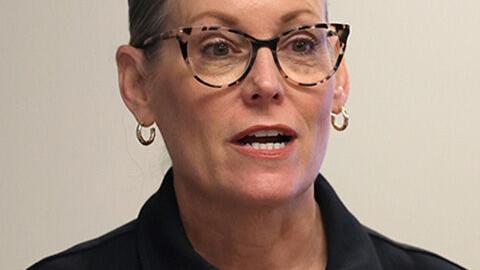
She wore the black turtleneck. She spoke in a deep voice. Her wide eyes seemed not to blink. Elizabeth Holmes was at the Arizona Capitol in 2015 and displayed the Holmes-ish traits that have made the new documentary about her a hit.
Holmes was in Arizona to urge lawmakers to pass a bill that would allow the state's residents to obtain blood tests without a doctor’s order.
The bill would benefit Theranos, the company she had started that promised to use revolutionary technology to perform a host of tests with a small amount of blood. Those promises proved faulty. Holmes was found guilty of fraud in a federal trial.
Two filmmakers followed Holmes in the weeks leading up to the start of her prison sentence. The resulting documentary, “You Can See Everything,” was released in October.
The documentary does not make reference to Theranos starting in Arizona, though the connection was part of the 2022 Hulu series "The Dropout" that starred actress Amanda Seyfried.
People are also reading…
Theranos produced blood testing machines that tested blood from a finger prick rather than a needle stuck in an arm. They were deployed at Walgreens drug stores, but the business was built on consumers being able to order up their own tests.
Which is why Holmes appeared before the Health Committee of the Arizona House of Representatives on Feb. 16, 2015. She came to the committee as a celebrated entrepreneur who had picked Arizona to launch her innovative company, but needed the change in law about testing without a doctor's order to make the business model work.
The chair of the committee, Rep. Heather Carter, R-Phoenix, introduced Homes as “probably one of the most renowned entrepreneurs in this space.” She said it was an “honor” to have her speak before her committee.
Carter said the two had met at a ribbon-cutting ceremony. They started talking about ways to reform the healthcare system. “I found a friend in Elizabeth,” Carter said.
Carter, who no longer serves in the Legislature, did not return a request for comment.
Holmes told the panel about losing her uncle to brain cancer. The two, she said, would spend summers, weekends and holidays at the beach. He was diagnosed with skin cancer, she said, which quickly spread to his brain.
“He was gone before I ever got to say goodbye,” Holmes said.
“I learned what it meant to have to say goodbye too soon to someone,” she said. “And I learned what it meant to say, ‘If only I had known sooner.’”

Nathan Fielder, left, and convicted Theranos founder Elizabeth Holmes in the documentary "You Can See Everything." The film follows Fielder and his documentary crew as they spend 34 days with Holmes, her husband and their two kids at a beachside rental home outside San Diego before she surrendered to prison in 2023, after being convicted of defrauding her investors.
What Holmes told lawmakers
Throughout her 45-minute testimony, Holmes spoke in an even cadence, showing no emotion whether she was speaking about a family tragedy or the promised revolution in healthcare her technology promised to bring.
“My life’s work in building Theranos,” she said, “is about redefining the paradigm of diagnosis.”
She said patients typically were only authorized to get medical tests because they show symptoms of a disease. That meant they were already sick, she said.
She hoped to have someone get a medical test they pay for because they wanted to know they had a disease — diabetes, heart trouble — before symptoms appeared.
At one point, Rep. Randall Friese, a Democrat and physician from Tucson, asked Holmes whether her clinics, which required a person to pay out-of-pocket, would leave out poor people unable to pay.
Holmes said her aim with Theranos was to lower the costs of lab tests, making them more available to the public.
“I’ve seen here in Phoenix what it means,” she told the committee. She said she met a pregnant woman who needed a lab test but couldn’t afford it. At a Theranos center, Holmes said, the woman saw the test she needed was priced at $11.95.
“She broke down in tears,” Holmes said.
Friese, in a phone interview, said he had a brief conversation with Holmes after the hearing. He said he told her he was fascinated by how she “could get all this information from this tiny (blood) sample.”
Holmes told Friese that she could, though Friese said she didn’t say how she was able to do so.
It would turn out she could not.
Disgraced Theranos CEO Elizabeth Holmes on Friday faced her fate for duping investors and endangering patients while peddling a bogus blood-testing technology.
Theranos crumbled amid questioned data
In 2015, The Wall Street Journal published an article casting doubt on the company’s promises. It was the beginning of the end.
By 2016, federal regulators took steps to shut down one of her labs in California. In 2017, the company agreed to pay $4.6 million to settle a fraud claim filed by the Arizona Attorney General's Office.
According to the book "Bad Blood: Secrets and Lies in a Silicon Valley Startup" by Wall Street Journal reporter John Carreyrou, nearly 1 million test results for patients in Arizona and California were voided or corrected. Patients had false alarms, according to the book, including an Arizona teenager who worried she was at risk of a heart attack and an Arizona woman who went to the emergency room the day before Thanksgiving fearing an imminent stroke.
In 2022, Holmes was found guilty of four charges of fraud. She was sentenced to 11 years in prison.
At the 2015 hearing, Rep. Paul Boyer, R-Glendale, asked what Theranos meant. The Latin high school teacher wondered if it was Latin.
Holmes told him it was not.
Theranos was a made-up word. Though, in her answer, she did not make that clear.
She said the word was based on the definition of the word “diagnosis,” which means to determine the presence of a disease by its symptoms.
“Theranos means the ability to determine the onset of disease in time for therapy to be effective,” she told Boyer and the committee.
At the end of the committee’s questions, Carter thanked Holmes for testifying. She then went on to take testimony from another supporter of the bill, a lobbyist for the libertarian Goldwater Institute think tank, who said Holmes was a hard act to follow.
The bill passed unanimously.
Holmes returned for signing of law
Holmes returned to Arizona when Republican Gov. Doug Ducey signed the bill.
He touted it as part of his business-friendly administration. The bill, like other moves he pushed, removed regulations that he said were barriers to business.
Freise said he was invited to the bill signing. Mainly, he said, because he was a doctor. The other doctor in the Legislature, Eric Meyer, he said, was also there.
Freise said the bill allowed something worthwhile: letting Arizona residents order their own tests from labs. The fact that a fraudulent lab made the ask was unfortunate, he said, but that doesn't diminish the concept.
“I separate in my mind the bill from her goal,” he said.
Holmes’s plan to do blood tests might have brought down the costs of testing, he said. “if she could do what she claimed to do.”