WINDOW ROCK — Navajo citizens confronted elected leaders on the future of Diné natural resources, seeking answers and input on what they say are significant issues at stake.
Voters have voiced concerns that industries involved in coal mining, uranium development, gas and oil, data centers and proposed hydrogen pipeline projects have captured the attention of Navajo leaders. Those concerns have also fueled broader debates over land use and, most importantly, the increasing demand for the Navajo Nation's limited water resources.
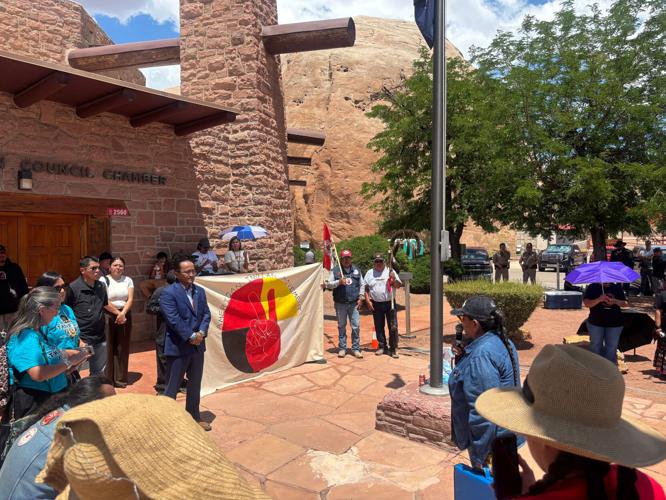
During the first day of the Navajo council's summer session on July 20, a crowd of demonstrators convened outside to talk about issues they say are critical for leaders to deal with. One critical issue first reported in The Arizona Republic is the expansion of the Navajo Mine by the Navajo Transitional Energy Company, a plan that could keep the operation running for 110 years, even though the only coal-fired power plant in the area is set to close in 2031.
People are also reading…

Navajo President Buu Nygren standing outside the Council Chamber on the first day of council's summer session to hear citizens' concerns.
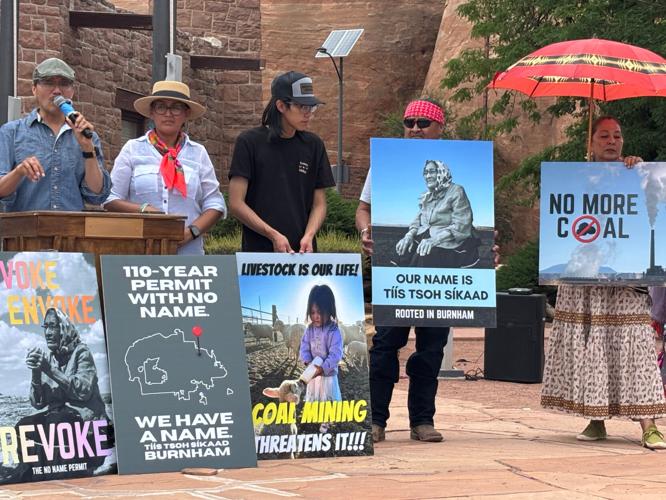
NTEC has submitted an application for the “No Name Permit,” after the No Name arroyo that runs through the area. It would expand coal mining operations across about 11,526 acres. NTEC proposes to mine 9,042 acres of the area, with a maximum annual production rate of 5 million tons of coal per year, starting in 2031. The total mined coal would be approximately 503 million tons, extending the mine’s life to 2136.
During a February public scoping meeting, officials said a draft Environmental Impact Statement would be released in August. Some attendees expressed concern that this timeline appeared rushed, as it would come less than a year after NTEC submitted its permit application package.
"We want our Navajo Nation Council to revoke the permit," Dailan Long, with his relatives and other members of the Navajo community in Burnham, New Mexico, said during a news conference held in front of the Council Chamber. "It's 110 years of a permit that they are asking for. Our family has five generations living within the area and 110 years is basically selling off and committing the Navajo tribe to 110 years of coal mining."
The Burnham Chapter issued a resolution in February 2026 opposing the No Name permit, citing incomplete permit materials, insufficient evaluation of environmental and cultural impacts, and an expedited timeline that undermines community participation and public transparency.
The resolution calls for a thorough Environmental Impact Statement and full disclosure of coal supply plans beyond 2031. The Office of Surface Mining Reclamation and Enforcement will issue a decision on the permit in August.
"Today we haven't received any feedback from NTEC or even from our Navajo leaders," said Joni Lapahie. "The No Name permit impacts generations to come, the children, the environment, the health. We repeatedly requested health studies in regards to coal mine in our region. As a community leader, we see and we hear about a lot of the impact and struggle the community is living with today. We have elders who were coal miners at Navajo Mine, who have passed or suffering from black lung."
Opposition to data centers grows
The news conference followed an encounter between Navajo Nation President Buu Nygren and demonstrators who raised concerns about Missing and Murdered Indigenous Relatives, veterans' housing, uranium mining, proposed data centers, and water resources. Once again, Nygren did not deliver a State of the Navajo Nation address, an issue that has remained a point of contention between the president and the Navajo Nation Council.

Dailan Long and Joni Lapahie held a press conference urging the Navajo Nation Council to revoke a proposed permit for Navajo Transitional Energy Company's No Name Mine. The permit would expand coal mining operations and extend the mine's lifespan to 110 years.
As Nygren stood outside the council chamber, the disappointment and frustration among citizens and some delegates were evident. Although he briefly stopped at the tent where Long and Lapahie were gathered, he was no longer present when they held their news conference. Among those who spoke directly to Nygren outside the council chambers was Alyssa Begay, who raised concerns about data centers and their potential impacts.
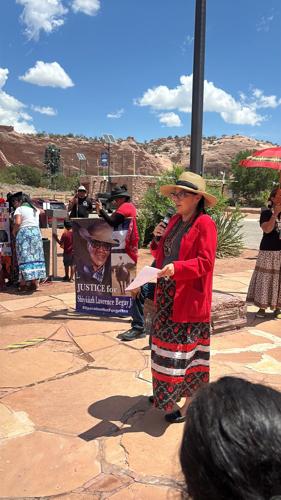
Begay stood in front of Nygren and some of his staff who were also present to tell him about the template chapter resolution she drafted, which would ban "expensive, energy-intensive data centers on the Navajo Nation permanently safeguard our sacred lands, waterways, livestock ranchers, and traditional farmers for all future generations."
She said chapters can download the template from her social media pages, complete the form, print it, and bring it to their next chapter planning meeting. She also pointed to what she described as a long-standing pattern by industries seeking to extract resources: promises of job creation. But these jobs are temporary.
"These data centers are going to emit a sound. I ask you start talking to your leaders," said Begay. "Not just the executive, the legislatures need to know about this. DOJ needs to know about this. Let's put our government to the test, lets see if we can ban data centers. The Seminole Tribe banned data centers on their nation. The Muscogee tribe also banned data centers. We can do it. We are the most powerful nation."

Alyssa Begay addresses Navajo President Buu Nygren about the concerns over data centers. She encouraged the public to submit resolutions to their chapters demanding they ban data centers.
In March, the Seminole Nation of Oklahoma became one of the first tribal governments in the country to establish an indefinite moratorium on all hyperscale data center development and generative AI infrastructure on tribal lands. In 2025, the Muscogee Nation likewise rejected a massive hyperscale data center proposal on its Oklahoma tribal lands.
The resolution template notes that the Navajo Nation recognizes Navajo Fundamental Law as the supreme law of the land, which mandates that the elements of life — water, earth, and air — are sacred, interconnected relatives that must be protected, preserved, and utilized only in ways that maintain harmony and balance.
"Please take that resolution to ban data centers... we need our council delegates to be a part of this conversation," said Begay. "Our council delegates, they make the law. With these resolutions, they are supposed to take it and make law."
'Who is making these deals without our input?'
Begay also talked about what many believe are undisclosed agreements between tribal leadership and extractive industries, negotiated without full transparency for the citizens who will be directly affected by their outcomes.
"Who is making these deals without our input?" she asked.
In March, the Navajo Nation Council's Resource and Development committee approved a controversial 234-mile hydrogen and natural gas pipeline that will run through 13 communities on the Navajo Nation. The resolution allows GreenView Logistics, LLC, a subsidiary of Tallgrass, to complete remaining technical requirements and proceed through the federal government's multi-year, multi-agency review. It's a process that includes additional studies, consultation, further opportunities for community input and the establishment of a community benefits program for each of the 13 chapters.
Tallgrass agreed to provide approximately $400,000 in annual grants to the chapters along the right-of-way.
"The Resources and Development Committee exercised its responsibility carefully and deliberately, and I respect the process that led to this vote," said RDC Chair Brenda Jesus. "The RDC remains committed to ensuring that any project of this scale is held to the highest standards of transparency, environmental stewardship, and genuine benefit to our people.”
One of the most controversial decisions made during the Nygren-Montoya administration was an agreement with Energy Fuels Inc. to transport uranium ore from the company's Pinyon Plain uranium mine to its uranium mill in Utah through the Navajo Nation. Critics say the agreement was negotiated without public input, and the full agreement has yet to be provided to the public.
The Navajo Nation has experienced frequent rainfall in recent weeks. On July 21, a truck hauling uranium ore rolled over. According to the Navajo Nation Police Department, the truck was empty, and no hazardous materials were released. However, it marked the second vehicle accident involving uranium transport in less than three months. Nicole Horseherder, executive director of the group Tó Nizhoni Ani, was also at the news conference to support Burnham community members and said the Navajo Nation needs to create a just, equitable and sustainable transitional plan from coal. She referred to NTEC as "a rogue enterprise" that says it speaks and represents the Navajo people and works on behalf of the Navajo Nation government, to only make decisions that "benefit only their non-Native executives."
"One of the problems I have with most enterprises is there are no regulatory body for these enterprises," said Horseherder. "In a way that they're accountable to the people. NTEC is one of them. They were supposed to work on transitioning the Nation away from a diminishing resource, not just coal, but oil and gas, and that is not happening."


 Tucson business halts water sales to Project Blue contractor