

Red light. Green light. Red light. Red light. Red light.
That’s about how Road Runner reader Dale Keyes describes his experience driving in Tucson.
The 30-year Tucson resident remembers the promise of more efficient roadways that came with the installation of car-sensing traffic cameras in the early 1990s.
Keyes said when he cruises Speedway between Oracle Road and Campbell Avenue, it doesn’t seem like the timing has gotten better.
“Has the system stopped working, or have the cameras been turned off?” Keyes asked. “Or — worse — is the system now being manipulated to slow traffic?”
The Road Runner visited the Department of Transportation and didn’t see any malfeasance when it came to traffic light manipulation. After all, city employees have to drive to work too.
People are also reading…
But synchronizing traffic signals is complicated. The number of greens or reds a driver encounters on any given stretch of road is the result of a tricky equation including vehicle speed, traffic level and pedestrian crossings.
The earliest attempts to sync the lights were already underway when Bob Hunt started at the city of Tucson Department of Transportation in 1983. At the time, signals were controlled by a central computer.
“It looked like the old NASA pictures — computers the size of your fridge,” said Hunt, who retired but sticks around as a consultant.
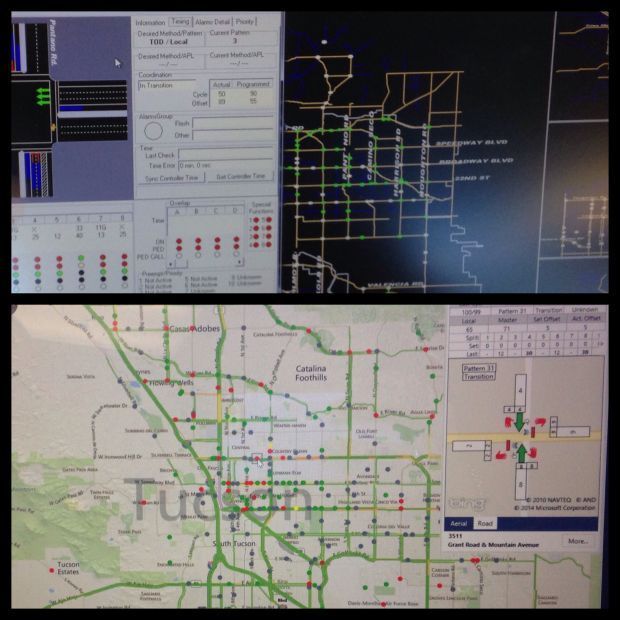
Today, each signal has its own separate control box nearby, and the software has a variety of traffic patterns programmed for different times of the day.
For example, westbound routes toward the city center are favored during the morning commute, and the opposite is true for the early evening.
Cameras on top of the traffic signals sense how many cars are waiting in a given lane. If there’s no cross traffic, a light will stay green in the opposite direction for a longer period of time.
The hardware used monitor intersections shrunk from appliance to cookie-sheet size. With a few taps on a tablet computer, staff members can check any light in the city and they receive text alerts when a signal goes on the fritz.
But there have been some bumps in the road to zippier commutes.
Light cycles got longer in 2009 after the Federal Highway Administration determined pedestrians needed more time to cross the street. The light cycle for traffic signals changed from 90 seconds to 120 seconds at many Tucson lights east of Campbell.
Combined with the standard half-mile spacing between the lights, it was more difficult to synchronize the lights.
“Today, with the longer cycle, I don’t know that we have area of town that we can just say ‘Wow — that’s pretty sweet,’ ” Hunt said.
Streets such as the ones near the University of Arizona are plagued by much more closely spaced traffic signals and unpredictable pedestrian and bicycle traffic.
“We’ve tried, and they’re never going to be perfect,” Hunt said.
The city hopes to find new solutions in data collection by collaborating with the Pima Association of Governments and the UA department of civil engineering.
If the city can measure how efficient its traffic signal patterns are without investing the manpower, it could make changes more easily.
“It would cost a lot to hire a person to drive on Speedway for 12 hours a day,” explained principal investigator Yao-Jan Wu, who took on the project from another professor, Larry Head.
Instead, the program he created with students pings the Bluetooth devices in people’s phones, headsets and cars as they drive by to see how long it takes to get from one intersection to another.
Computers housed in the lights’ control boxes can pick up the signal as cars pass.
Each signal is identified by a number, Wu said. So they can’t tell what kind of device the signal comes from, let alone the user’s identity.
The goal is for the Department of Transportation to use the data to track how or if changing the signal timing impacts the flow of traffic.
Michael Hicks, a manager in the Department of Transportation, hopes that another developing technology — self-driving cars — might one day lead to more efficient commutes.
“We time it for the optimal driving experience, and sometimes that’s not what we truly get,” Hicks said.
Hunt and Hicks, in their decades of experience, have seen people do everything (shaving, eating lunch, texting and reading the newspaper) but pay attention as they trundle down Tucson roads.
“People are people,” Hunt said. And no technology revolution will change that.


