

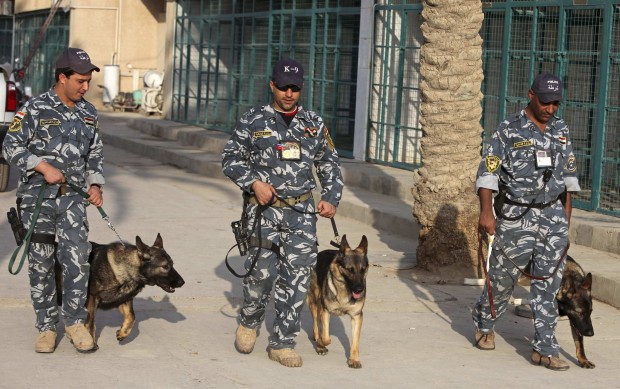
BAGHDAD - The American military is rushing delivery of dozens of bomb-detection dogs to Iraq after accusations that widely used mechanical devices are ineffective to pinpoint explosives at checkpoints and other search sites, U.S. and Iraqi officials said.
The first shipment of dogs - 25 expected today - comes amid pressure on Prime Minister Nouri al-Maliki for security lapses after suspected Sunni militants scored a series of successes in carrying out major bombings in Baghdad, killing hundreds since August. The attacks have hurt his government's standing before next month's elections to pick Iraq's next parliament and leaders.
Another 120 bomb-sniffing dogs are scheduled to arrive in Iraq over the next 12 months in Iraq, Army Maj. Sylvester Wegwu, a senior military adviser at the Baghdad Police College, told The Associated Press.
"We have more requests than we have dogs and handlers," added police Brig. Gen. Mohammad Mesheb Hajea, who is in charge of the training program.
People are also reading…
The worries over security are strong enough to overcome reluctance among Iraqi forces to use canines because of Islamic religious taboos that consider dogs unclean animals. While U.S. troops and foreign private security firms often used sniffing dogs, Iraqis relied on them far less - both because troops didn't like using them and Iraqi citizens didn't like being searched by them.
"Our culture is different from the European culture and the American culture," said Hajea, who also runs his own veterinary clinic in Baghdad.
It's part of a wider re-evaluation of tactics and equipment by Iraq's security forces.
Some shifts have been prompted by new strategies by insurgents, including car-bomb makers hiding explosives deep inside frames or engines.
Gen. Raymond Odierno, the top U.S. commander in Iraq, has said Iraqi authorities have requested scanners capable of peering inside sealed portions of vehicles.
But Iraq also had faced charges of relying on flawed devices - a wandlike, hand-held mechanism known as ADE-651. Last month, British authorities banned its export to Iraq and Afghanistan after a BBC report raised serious questions about its ability to detect explosives.
Iraq initially defended the hand-held machine, but now appears to be backing down and looking for alternatives.
Use of bomb-hunting dogs has become more pronounced in some areas of Baghdad in recent weeks, appearing to coincide with news that the detection devices were faulty. U.S. military canine units have also joined patrols and searches with Iraqi patrols because of the high demand.
The order for the dogs was put in last year, though the U.S. stepped up delivery of the first group at the Iraqi government's request.
Besides the religious sensitivities, Iraqi forces are also simply not used to working with dogs, causing some initial resistance to expanding the program, Hajea said. During Saddam Hussein's regime, only a limited number of dogs were deployed at sites such as airports, bus terminals, train stations and ports.
Iraq's current canine program has only 47 bomb, narcotic and patrol dogs in Baghdad, and another 20 dogs divided up among the provinces.
Even the addition of the dogs will fall far short of the 1,000 dog teams Hajea estimates are needed to meet Iraq's security needs.
Because of the sensitivities, the job of dog handler is volunteer only, and dogs will be used to search cars, buildings and other areas - not people, unless they are suspected of being a bomber, Hajea said.
The military did not respond to a request for how much the dogs and training being provided by the U.S. to Iraq cost.
The dogs, themselves, cost about $7,500 to $8,500 a piece, Hajea said. That does not include the cost of the dogs' needs - from food to medical care - over their working life span. A bomb-detection dog works an average of 12 years. Each dog-and-trainer team needs at least 45 days of training together.
US Toll in Iraq
• Deaths: 4,378
• Wounded: 31,648
Source: Department of Defense


