

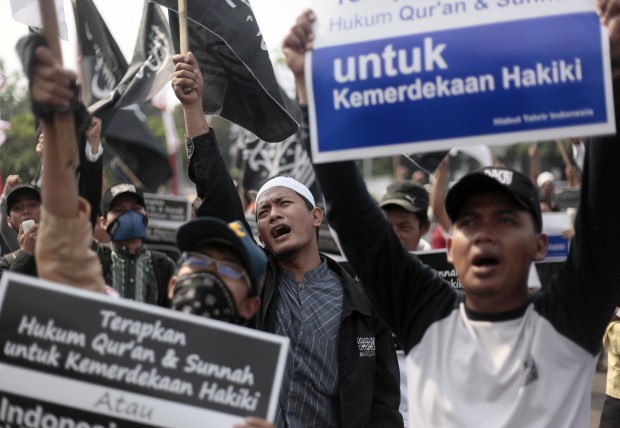
JAKARTA, Indonesia - The chanting crowd at the radical Muslim protest in Indonesia stood out for its normalcy: smartly dressed businessmen, engineers, lawyers, smiling mothers, scampering children.
At a time when al-Qaida seems to be faltering, the recruitment of such an educated, somewhat mainstream following is raising fears that Hizbut Tahrir, an enigmatic global movement, could prove more effective at radicalizing the Islamic world than outright terrorist groups.
Active in 45 countries, Hizbut is now expanding in Asia, spreading its radical message from Indonesia to China. It wants to unite all Muslim countries in a globe-spanning bloc ruled by strict Sharia law. It targets university students and professionals, working within countries to try to persuade people to overthrow their governments.
The movement's appeal to an often influential part of society worries experts. Its goal of an Islamic state may be far-fetched, but it could still undercut efforts to control extremism and develop democracy in countries such as Indonesia, which the U.S. hopes will be a vital regional partner and a global model for moderate Islam.
People are also reading…
"Our grand plan over the next five to 10 years is to reinforce the people's lack of trust and hope in the regime," said Rochmat Labib, the group's Indonesia chairman in a rare interview with a Western reporter. "That's what we are doing now: converting people from democracy, secularism and capitalism to Islamic ideology."
Hizbut Tahrir, which means The Party of Liberation, is also raising its profile in the U.S. after operating largely underground since the 1990s. Its first major event was a 2009 conference, followed by another one in Chicago this June.
Starkly conflicting views swirl around Hizbut. It has been described as both a peaceful movement to restore one-time Islamic glory and a breeding ground for future suicide bombers, "a conveyer belt to terrorism," in the words of Zeyno Baran, an expert on Islam in the modern world.
Banned in most countries, Hizbut remains legal in others, including the United States, Great Britain, Australia and Indonesia, where its leaders say it has spread to all 33 provinces. It is closely monitored everywhere and often operates on the knife-edge of legality.
"The rhetoric they have goes to the fringe of democracy," said Hans Joergen Bonnichsen, the former head of Denmark's intelligence service. But the Danish Justice Ministry has twice asked the nation's top prosecutor if Hizbut could be banned under Danish law, and both times the answer was no.
Its new frontier in Asia ranges from Indonesia and neighboring Malaysia to Pakistan and China, where Beijing has accused it of inciting violence among Muslim Uighurs in the remote west. It has also become the most widespread, and persecuted, radical Muslim group in Central Asia.
The Indonesia chapter is believed to be the largest, with a following estimated in the hundreds of thousands, according to Sidney Jones, an expert on Islam in Southeast Asia.
"They are a real force here. They are a greater long-term threat to Indonesia than people who use violence," said Jones, a Jakarta-based analyst with the International Crisis Group think-tank. "Collectively, hardline civil society can have a bigger effect than jihadists and terrorists."
Her words are echoed by anti-terrorism expert Zhang Jiadong of China's Fudan University, who said Hizbut is "more harmful than terrorist organizations, because it has more influence on ordinary people." The group, estimated at up to 20,000 members in China, is more likely to foment riots or rebellions than terrorist attacks, he said.
Ismail Yusanto, the group's urbane spokesman in Indonesia, insists that "we are a peaceful Islamic movement."
"We believe people can be influenced by their environment, so so-called terrorists could be influenced by everyone, not just us. But Hizbut itself is committed to not being violent. There is no evidence," he says, when asked whether some adherents later veer to violence.


