The following is the opinion and analysis of the writer:
Will Pattiz
In the midterm elections, voters gave America's data center industry a beating. In 40 of 41 local ballot contests across 10 states, they backed restrictions or rejected measures favoring these sprawling developments.
In Boulder City, Nevada, nearly 71% voted against allowing data centers in a large area of city-owned land. But now, the Trump administration is opening federal land to the same industry, including places where residents have spent months fighting to keep it out.
In May, after fierce public opposition, Boulder City’s planning commission recommended rejecting a developer's proposed data center on city land. But the company had also sought permission from the Bureau of Land Management to replace a solar project with a data center on nearby federal land. In June, BLM approved the change without a new environmental review, treating a massive data center as substantially the same project as a solar farm.
People are also reading…
“We were not consulted,” city attorney Brittany Walker told reporters. As one resident warned at a packed meeting, “Even if the project is now on adjacent BLM land, the impact does not stop at a property line.”
An Interior appeals board halted the approval in September, and in October, the decision was set aside for further BLM review. The project remains alive, while meaningful environmental review and public participation remain unresolved.
This is one project in a much larger building spree. The nonprofit More Than Just Parks has mapped more than 2,000 large data centers operating, under construction, or proposed across the country, along with hundreds halted or delayed by community opposition. Each appears as a local land-use decision. Together, they represent a national transformation.
In Utah, one company is seeking roughly 9,000 acres of BLM land for a nuclear-powered data-center complex. The Energy Department has selected four of its own federal sites for potential private data-center development.
The buildings are just the beginning. They require power plants, substations, transmission lines, pipelines and water. A 2025 Energy Department report projects data centers could consume nearly 12% of America's electricity by 2030.
We've seen what happens when Washington embraces a colossal building spree — the last one to build as many federal dams as possible — without reckoning with the costs.

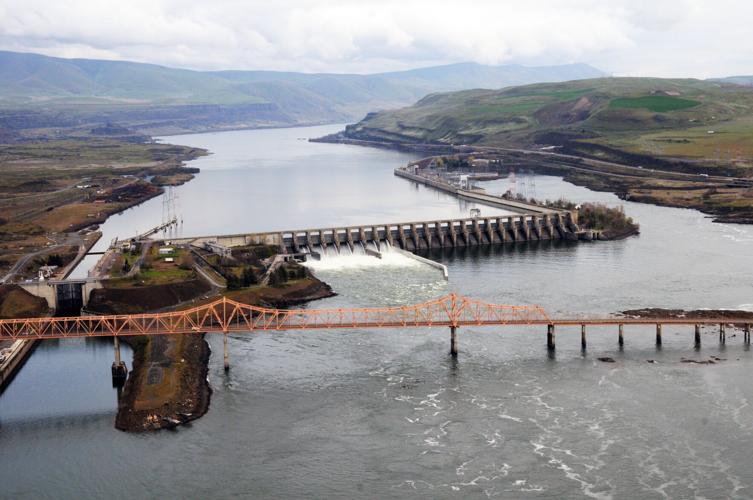
In 1957, the federal Dalles Dam drowned Celilo Falls on the Columbia River, where Native families had fished for thousands of years. Treaty-protected fishing grounds vanished beneath the reservoir. Forty-nine years later, Google built its own data center in The Dalles, drawn partly by the region's power infrastructure.
In 1957, the federal Dalles Dam drowned Celilo Falls on the Columbia River, where Native families had fished for thousands of years. Treaty-protected fishing grounds vanished beneath the reservoir. Forty-nine years later, Google built its own data center in The Dalles, drawn partly by the region's power infrastructure.
Today, the Bonneville Power Administration markets electricity from 31 federal dams across the Northwest. The machinery of one great building spree is helping power the next.
Federal dams powered cities and irrigated farms. They also drowned Glen Canyon and more than 350,000 acres across seven Native American reservations on the Missouri River. The benefits spread far and wide. The people whose homes, fisheries and sacred places disappeared bore the cost.
David Brower, who helped spare Dinosaur National Monument from another dam, later regretted his part in Glen Canyon's destruction. He hadn't even seen the place before its fate was sealed. “When we began to find out, it was too late,” he wrote.
The secrecy is familiar, too. Google's initial land deal in The Dalles was negotiated under “extreme confidentiality,” according to The Dalles Chronicle.
In Tucson, officials and a utility signed nondisclosure agreements over a proposed data center. Residents did not learn what was coming until later, though packed public meetings helped persuade the City Council to reject the project. The developer revised its plans and moved forward under county jurisdiction, with construction underway now.
The Trump administration is working to speed up permitting for data centers. A 2025 executive order directed the Army's civil-works leadership to examine a nationwide permitting pathway. The same Corps of Engineers that built The Dalles Dam is being enlisted to accelerate the next boom.
Congress has an opportunity to intervene. Bills from Sen. Ron Wyden, D-Oregon, and Rep. Rashida Tlaib, D-Michigan, would ban data centers on federal land. Rep. Dina Titus, D-Nevada, has proposed stronger environmental review and public participation for such developments.
Midterm election voters made their wishes plain. Before Washington commits more public land, water and electricity, communities deserve a say in what gets built and who pays for it. Once the land is sacrificed, no public hearing can bring it back.
Follow these steps to easily submit a letter to the editor or guest opinion to the Arizona Daily Star.
Will Pattiz is a contributor to Writers on the Range, an independent nonprofit dedicated to spurring lively conversation about the West. He co-founded More Than Just Parks, a public lands advocacy and media organization.