

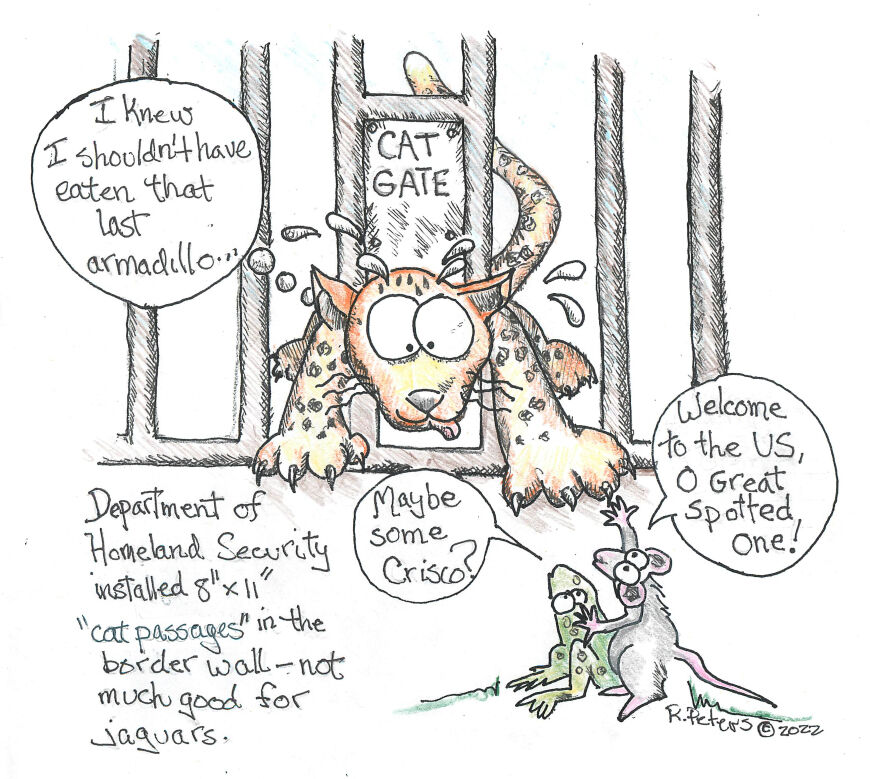
The following is the opinion and analysis of the writer:
El Jefe, the world-famous male jaguar who once roamed Arizona’s Santa Rita Mountains, but disappeared in 2015, has been sighted again, this time in Mexico’s northern state of Sonora.
This happy rediscovery underscores the importance of open borders for wildlife, particularly large carnivores that travel long distances in search of food, mates and other resources. In times of drought, a jaguar might only survive if it can cross the border to find water or food. Two more jaguars, the males El Bonito and Valerio, are a few miles south of the Arizona border in the Cuenca Los Ojos nature reserve, but their way north is blocked by the recently constructed border wall.
Most of Arizona’s border with Mexico is now walled with 20- to 30-foot-tall bollards embedded in concrete. Because the bollards are only some four inches apart, nothing much bigger than a mouse can cross. Repeated pleas to the Department of Homeland Security (DHS) for wildlife openings continue to fall on deaf ears. Their primary concession has been a few tiny 8-inch by 11-inch openings, the size of a sheet of notebook paper.
People are also reading…
Last year, DHS closed one of the most likely jaguar crossing points, the bed of the San Pedro River, blocking it with a bridge and massive gates. A second possible crossing where the Patagonia Mountains run down into Mexico is still open, but the entire Patagonia Mountains could soon be off-limits to jaguars if the foreign mining companies that have claimed more than 100,000 acres are permitted to excavate enormous mines. Corridors essential for jaguars along the Arizona-Mexico border include critical habitat in the Pajarito, Patagonia, and Huachuca mountains.
It is a basic tenet of conservation biology that large, connected populations persist longer than small ones. Large predators like jaguars need vast, connected areas where populations are substantial enough to be viable long term. For borderlands jaguars like El Jefe, this means roaming north and south of the border. Every bit of habitat that is walled off or nibbled away by development increases the chance that jaguars will disappear from the borderlands for good.
There is good news for those who want to see jaguars roam the U.S. Southwest once again. In 2021, Defenders of Wildlife scientists, along with colleagues from other organizations north and south of the border, published a pair of scientific papers that identified more than 20 million acres of potential jaguar habitat in north-central Arizona and New Mexico. Modelling suggests this habitat could support a breeding population of some 100 jaguars, which makes more realistic our hope that someday there will again be a robust cross-border population.
Making this vision a reality will take a long-term, coordinated effort by federal and state wildlife agencies, conservation groups, scientists, tribes, ranchers and other citizens.
But in the meantime, the crucial first step is making sure the border remains open to jaguars’ movements. The Biden Administration should not build any more walls across wildlife corridors and either remove existing blockades or replace them with vehicle barriers that allow wildlife to move freely.
Rob Peters, PhD, is a conservation biologist working in Tucson for Defenders of Wildlife.