

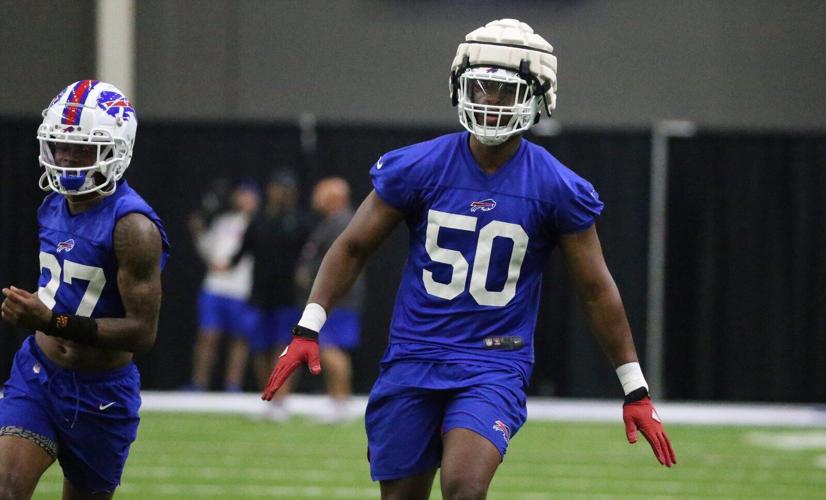
Center Mitch Morse and defensive tackle Justin Zimmer agree that they look like video game characters. From there, they diverge. Morse says the Buffalo Bills linemen look as if they’re in a first-person shooter game these days.
“You feel like you're playing Halo, like you're a Halo character with these big helmets,” Morse said. “You got people giving you hell, your family being like, ‘What the hell is this?’ "
Zimmer says they look like Toad from Mario Kart. Perhaps one of the two is more intimidating.
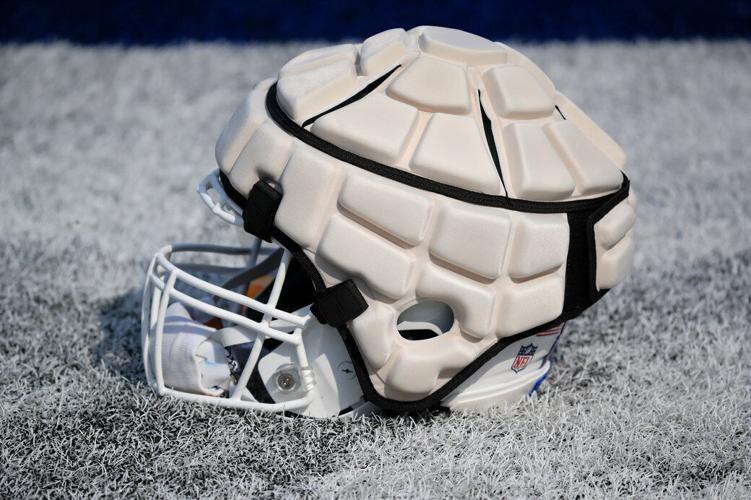
When the Buffalo Bills opened training camp, the linemen did so with an added accessory. This year, they are wearing Guardian Caps, a soft-shell helmet cover designed to reduce impact. The padding is strapped right on top of their regular helmets. Like many, coach Sean McDermott is focused more on the possible results and less on the avant-garde fashion.
People are also reading…
“It doesn't look great – I gotta be honest – and I don't think anything they would develop would look any better,” McDermott said. “I think it does its job.”
He’s heard that the players feel a difference, and that’s what matters to him.
“I can tell you anything that has to do with player safety and improving player safety, I'm all for it. I tip my hat, if you will, to our linemen and our equipment manager Jeff Mazurek of just being open-minded to doing it,” he said.
Guardian Caps came on the NFL’s radar through the HeadHealthTECH Challenges, which provide funding to explore new ways to prevent head injuries. Then, in 2020, NFL teams were cleared to use the caps by the league and the NFLPA after independent testing.
It was a big step for Guardian Caps, which stemmed from a material science and technology company. Owners Erin and Lee Hanson looked at developing lightweight helmet covers for high schoolers. Then, colleges, including perennial powerhouse Clemson, latched on. In addition to the helmet caps, the company also sells more durable lacrosse balls, climbing holds and turf infills.
“They're constantly looking for ways to make sports safer,” said Tony Plagman, the national sales manager for Guardian Caps.
Guardian Caps says the product can reduce up to 33% of an impact. That research comes from testing facilities that also performed high-speed testing with all different combinations: helmet to Guardian Cap, Guardian Cap to Guardian Cap, Guardian Cap to turf, to grass. The company was able to hold a videoconference with equipment managers from teams around the league to answer questions this summer. A handful of teams have started using them.
No exact data exists on how many would-be concussions have been prevented, as those numbers would be too speculative, with no way to prove if a head injury would have actually happened, Plagman said.
“We have to stick to what we can prove, and we can prove that it reduces the impact,” he said.
Part of that also comes from a focus on transparency. Plagman says the company doesn’t want to overpromise, especially when it comes to something as important as one’s brain.
“We're not trying to sell a magic pill,” Plagman said. “No product can prevent all injuries, but just reducing the accumulation of the blows and reducing a little bit of impact on each, we're hoping that that helps that athlete throughout his career.”
Players and viewers might remember bigger hits, but smaller impacts can be significant, too.
“We're trying to address those repetitive smaller sub-concussive blows that are adding up,” Plagman said. “A lot of that research is pointing to the accumulation of the blows, and so trying to reduce each impact and try and push that straw that breaks the camel's back out past the season, and let that athlete have some time to recover.”
Like any NFL team, the Bills hope to minimize head injuries and their lasting effects. Morse has had five concussions in his career, and he missed the bulk of training camp in 2019 with one. When he arrived for camp this year, and saw something that resembled the Michelin Man at his locker, he thought it might be tailored to him.
“At first, I just saw it on my helmet, so I'm like, ‘Damn, is this some kind of a subliminal message?’ " he said.
But he realized there were other poofier helmets in the locker room. Players put them on, gave each other some grief for what they looked like, and then took the field.
“Then after one practice, I looked at Justin Zimmer, I'm like ‘Man, I know we were getting after it, and I didn't feel anything,’ " Morse said.
For some, there was less of a visual adjustment. Defensive tackle Ed Oliver wore the caps at the University of Houston.
“You really don’t feel it,” he said. “The only thing that’s weird is when you watch film they tend to slide up, and it looks crazy on film. Other than that, they aren’t bad.”
Zimmer says it “just feels like you're playing with a pillow on your head.” That comes from both the weight and how that weight is distributed.
“I think the beauty of it is that it's covering the whole helmet, and so it's very evenly balanced,” Plagman said. “I think there have been some other products similar that maybe focused on one area. … Making sure we're covering that whole helmet has definitely helped kind of balance out that weight.”
It can also help protect against other injuries. Linemen going head to head are a clear situation where impacts could be minimized, but Plagman also pointed to the impact of a wide receiver hitting one’s head on the ground. Perhaps they could prevent soft-tissue injuries from body blows, too, Plagman said. Rams quarterback Matthew Stafford recently reinjured his surgically repaired thumb in training camp when it slammed into a defender's helmet.
The first goal is increasing player safety, but the company hopes that exposure from NFL teams could lead to more high school and youth teams adding the caps to their equipment rooms. The caps are approved for games and practice by the National Federation of State High School Associations.
“We'd love to get more of those guys in caps and start reducing each of the blows that they're taking at a younger age, obviously as their brains are developing,” Plagman said. “That's definitely one of our goals, do a better job with youth programs and in high schools as they learn and learn in the game, learning how to tackle, get tackled, hit the ground and so forth.”
Because of the material, some high school coaches have been able to point out scuff marks on the cap after a play to teach kids about keeping their head up.
Even if the Bills joke about how they might look like bobbleheads, the goal of playing safer has outweighed anything superficial. Zimmer noted that they’re optional for players, but no one has taken them off so far.
“I like it. I think it's beneficial,” Zimmer said. “I mean, I wish I could go back a couple years and just wear my whole career, just maybe help out long term. Who knows?”


