Wanna be a skunk at the party? Try bringing up chronic traumatic encephalopathy at a sports bar, tailgate, or family gathering while watching football. You won’t be appreciated.
Is watching college or pro football, even high school football, tacitly giving your approval of behavior that we know will lead to dementia in some of the players? This question will set up a cognitive dissonance that your family and friends won’t appreciate. You will be called a Debbie Downer, or worse, and told to shut up or leave and to quit spoiling everyone’s fun. Keep bringing up CTE and you won’t be asked back.
I’m as guilty as anyone. I’ve enjoyed watching football since I was an 8-year-old sliding down the grass in Kinnick Stadium knothole section. I played freshman-sophomore high school football as a 100-pounder until our school’s all-state 220-pound fullback flattened me and I decided to focus on wrestling kids my own size. The wind was knocked out of me, but not my enjoyment of seeing the big guys knock each other around. My wife and I have frequently held Super Bowl parties at our home.
People are also reading…
CTE is a progressive, degenerative brain disease found in people with a history of repetitive head impacts. It leads to memory loss, depression, cognitive impairment and impulse control issues. It can cause severe “hopelessness” among retired athletes. Studies show CTE isn’t caused just by major concussions. It accumulates from the thousands of minor, routine, sub-concussive hits that occur on almost every play. Each year of playing football is estimated to increase a player’s risk of developing CTE by roughly 30%, according to Boston University researchers.

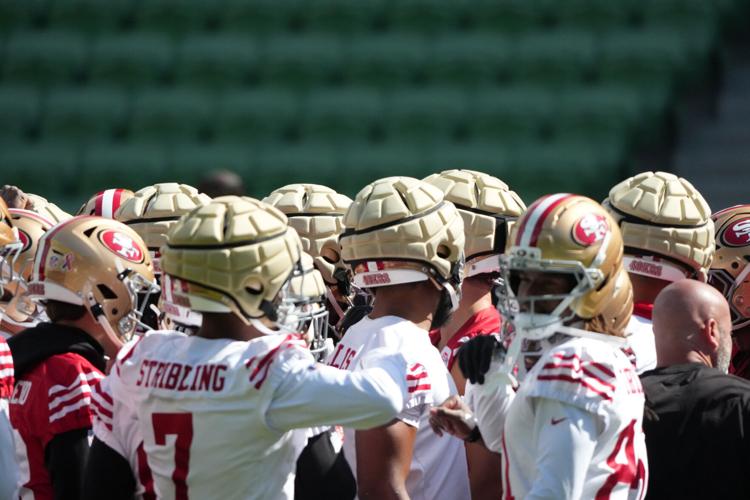
San Francisco 49ers players wearing Guardian helmet caps huddle at practice at AAMI Park on Sept. 9 in Melbourne, Australia.
We’ve known about a traumatic brain injury since 1928 when “punch drunk” syndrome (tremors, slowed movement, and confusion) was first described in career boxers. In 1949 the term CTE was first used in a medical paper, but it was still believed to occur only in boxers. It is associated with Parkinson’s disease. Muhammad Ali died of it.
In 2005, neuropathologist Dr. Bennet Omalu (later portrayed by Will Smith in the movie "Concussion") performed an autopsy on the brain of legendary former Pittsburgh Steeler Mike Webster. He described the first confirmed case of CTE in an American football player.
Former professional wrestler Chris Nowinski co-founded the Concussion Legacy Foundation with Boston University and the UNITE Brain Bank, which has diagnosed hundreds of former athletes and military veterans postmortem. In 2022 the National Institutes of Health formally acknowledged the direct causal link between repeated blows to the head and CTE.
Recently the Boston University CTE Center announced they have diagnosed 345 former NFL players with CTE out of 376 former players whose brains were examined. The BMJ data shows that at a minimum 1 in 4 NFL players will have the disease. The higher incidence could be many times higher but is not exactly known since the diagnosis can only be made on postmortem exam of the brain.

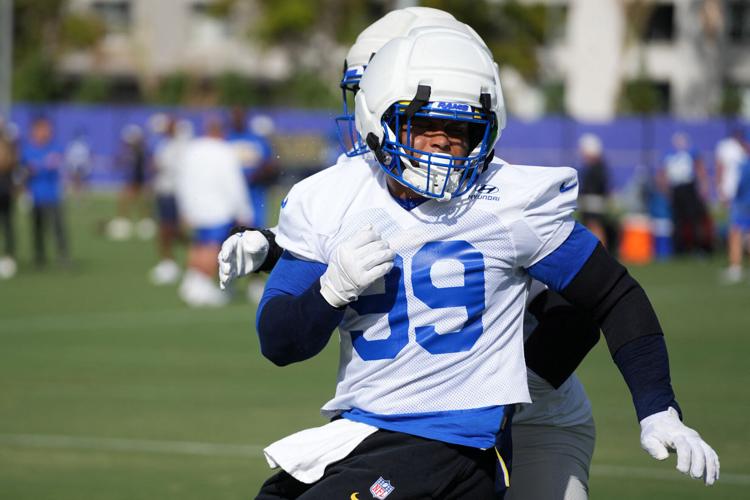
Los Angeles Rams defensive end Aaron Donald wears a Guardian helmet cap at practice on Aug. 30 in Woodland Hills, Calif.
The list of players who have died with CTE is long and includes such players such as Junior Seau, Ken Stabler, Steve McMichael, Aaron Hernandez, Demaryius Thomas, Irv Cross and Dave Duerson. Brett Favre estimates he had over 1,000 concussions throughout his 20-year career and has Parkinson's, likely in association with CTE. TV announcer and former Dallas Cowboys quarterback Troy Aikman had 10 documented concussions during his 12-year NFL career. So far he fortunately has no symptoms but has questioned whether he would ever encourage a son to play youth tackle football.
Former NFL and University of Iowa offensive lineman Robert Gallery has spoken about his severe post-career mental health struggles of brain fog and CTE-like symptoms stemming from repeated concussions. He is trying psychedelic treatment used for PTSD victims.
The NFL itself recognized the humanitarian and public relations disaster of CTE by setting up the NFL Concussion Settlement Fund, which includes provisions for CTE. It is an uncapped fund agreed on with the players union in 2013. The massive volume of approved claims from retired players suffering from severe neurological disorders pushed total payouts past $1.2 billion by early 2026. Living retired players submit claims for overlapping conditions that can be diagnosed while still alive such as ALS, Alzheimer's, Parkinson's and early dementia. Up to $4 million can be awarded for a CTE diagnosis made after death and brain autopsy.
In light of this documented health risk, why will there be no ban of tackle football? The answer is money. College sports is a $13 billion annual industry with the vast majority generated by and for college football. Multibillion-dollar television contracts, corporate sponsorships, and massive stadium gates have transformed college football into a professional business enterprise.

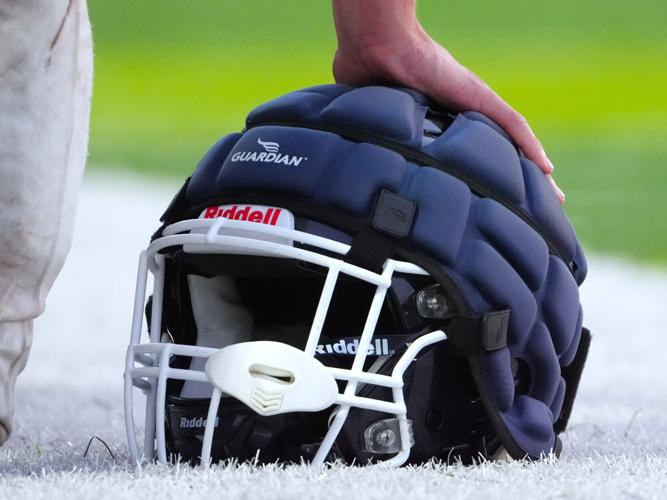
A football player puts his hand on his helmet with a Guardian cap on the sidelines during a high school scrimmage on Sept. 4 at Norton High School in Norton, Mass.
Professional football dwarfs this. The NFL generates over $23 billion in total revenue annually. Fueled by massive medial rights deals and rabid fan engagement, pro football is the most profitable sports system on earth. Team values are anchored by the shared national revenue of its $125 billion media package running through 2033 with networks like CBS, FOX, NBC, ESPN, Amazon and even YouTube. Each team is worth over $10 billion on average. Elite players like Patrick Mahomes take home more than $63 million per year, while others have over $100 million in total guarantees.
Those against banning the sport argue that adults have the right to assume physical risks. If pro and collegiate players (college players also can make millions now) understand the risk and choose to play — often for life-changing compensation — then the government should not interfere, the argument goes. Opponents would also argue that the sport has instituted regulations on full-contact practices, concussion protocols, more rules against head hits and safer padded “Guardian Cap” helmets (which players won't use much in games because they look dorky, and remind viewers of the CTE risk!)
There is no question that football is an economic powerhouse and a cornerstone of American culture. It funds education, creates jobs and provides community identity. And if football were banned, where would one stop? Soccer, rugby, boxing, hockey, and even wrestling all involve risks of head injury. Ban them, too?
Still, there is a moral dilemma of watching American football when one is aware of how many of these players later in life will develop CTE. Can one justify cheering for a game that actively destroys the minds of its players? Your choice is to boycott the sport, reform it by doing things like banning youth tackle football, or just accept our moral flaw while ignoring the facts of CTE and continuing to watch the game.
At a minimum it’s time to watch, promote and participate in sports that don’t involve getting brains repeatedly bruised.

Darrell Waltrip, one of the greatest drivers in NASCAR history, also happens to be one of its greatest storytellers. He no longer will be telling them in public.