

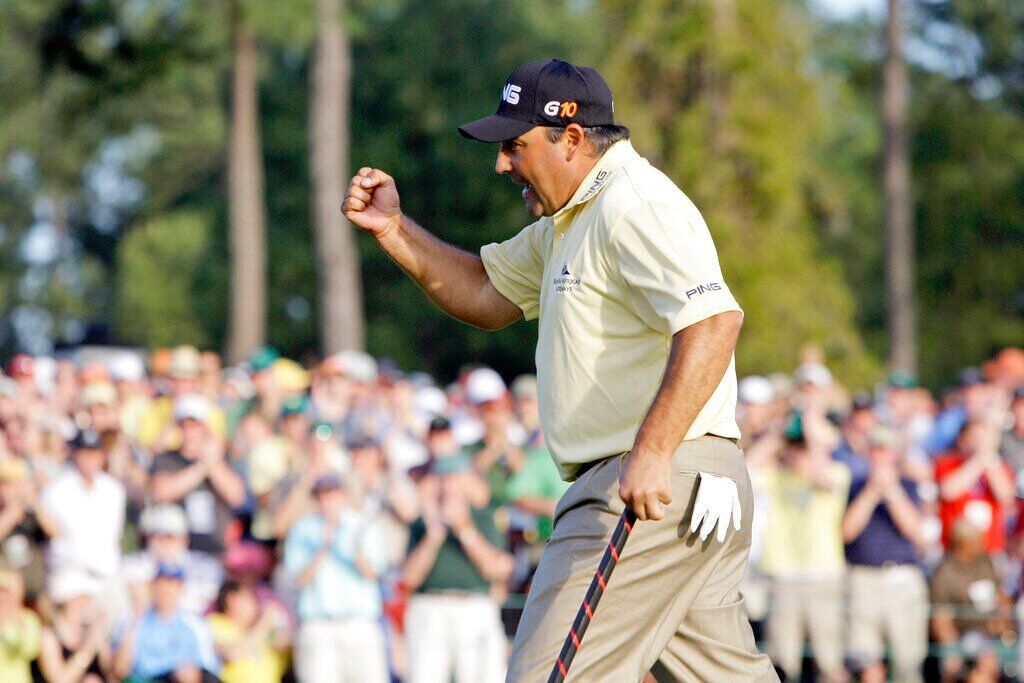
AUGUSTA, Ga. (AP) — His picture is still on the wall of champions in the press building at Augusta National, sandwiched between Trevor Immelman and Phil Mickelson. His chair at the champion’s dinner Tuesday night was empty, though, and if there was an invite to play the Masters this year, no one saw it.
As the Masters unfolds this week, Angel Cabrera sits in an Argentine prison. He’s serving two years for domestic abuse, and there’s a chance he could face an even longer sentence.
The glory of 2009 never seemed so far away.
“A lot of kids grow up without a role model and make some bad decisions, their anger within them takes over,” said Charlie Epps, a Houston golf pro who has a father-son relationship with Cabrera. “But it doesn’t justify doing the wrong thing.”
Cabrera was an unlikely champion to begin with, a street urchin who grew up without parents and never had a formal education. A huge crowd greeted him when he flew home after winning the 2007 U.S. Open and there was a parade in his honor.
People are also reading…
Then he became a two-time major champion — and the first South American to win a green jacket — by winning a three-way Masters playoff in 2009. His future in golf seemed unlimited.
But what was once a feel-good story has now gone bad, and no one can predict when Cabrera will be free, much less play golf again.
Meanwhile, Epps watches Cabrera's vacant house in Houston and wonders how it all went wrong.
“I saw a lot of it in his golf, he was a perfectionist early on and had a temper,” Epps said. “He never had a sports psychologist or anything like that and he grew up with a chip on his shoulder. Once he got it under control, he became a champion he is.”
While the details of Cabrera’s case remain somewhat murky, he was charged with gender violence with a former partner and could face additional time for allegedly threatening the woman by phone after being charged. Prosecutors are also looking at allegations from two other women, including the mother of his children, and his lawyer says there’s a chance he could be charged with more crimes.
What is clear is that Cabrera — who was arrested in Brazil in January 2021 after prosecutors issued an international warrant for not attending his first trial — was convicted in July 2021 of assaulting, threatening and harassing Cecilia Torres Mana, his partner between 2016 and 2018. He is not scheduled to be released from prison until next January at the earliest, despite his pleas of innocence.
“There was no crime,” his lawyer, Carlos Hairabedian told The Associated Press via phone from Argentina on Wednesday, alleging the charges were brought “out of spite and resentment.” Hairabedian claimed that in the reported cases “the common denominator is that there was no physical violence but an exchange of high-sounding words.”
Cabrera’s rise in the golf world wasn’t exactly meteoric, though it seemed like it at the time. Abandoned by his parents, he became a caddie at the age of 8 to earn enough money to eat and it wasn’t long before he took up the game himself.
Epps was living in Argentina at the time and Cabrera caddied for some of his friends, leading the two to begin a relationship with Epps serving as an instructor and father figure to the young player. They would reconnect after Cabrera turned pro, with the work leading to his breakthrough win at the 2007 U.S. Open.
“He really wanted to get better and he saw everybody had a coach so he asked me to help him,” Epps said. “He’s a quality golfer, a quality ball striker. He’s really athletic and could have been a soccer player, or even a linebacker if he grew up around football.”
The Open win established him as a major champion, even if the golf world didn’t totally embrace him. Cabrera didn’t speak English and never seemed to gain the kind of acclaim another player might have, even after adding the green jacket with his three-hole playoff win against Kenny Perry and Chad Campbell.
The player known as el Pato (the duck) because of his unusual gait told reporters in Spanish afterward that it was the dream of a lifetime.
″Incredible ... I still can’t believe it,” he said.
Epps says he hasn’t spoken to Cabrera since he was imprisoned, though he watches the house the golfer owns in Houston. He still holds out hope of working with the now 52-year-old when he gets out of prison and tries to resume his career on the senior tour.
“I want the best for him and I think he’s got a lot of golf ahead of him,” Epps said. “I think he’ll come out of this a better man. At least that’s the hope.”
10 reasons why the Masters is still the best golf tournament in the world
1. Sheer beauty.

Augusta National Golf Club is beautiful everywhere you look, from the white cabins to the pink azaleas, from Amen Corner to the walking path along the second fairway. It's hard to imagine a prettier setting that doesn't feature an ocean.
2. Permanence.

Augusta National isn't the only beautiful golf course in the land, or the world, but when the other majors are held, they become cities of large, white tents. At the Masters, the gift shop is nicer than Tiffany's and the press building looks like a billionaire's mansion.
3. Climate.

The U.S. Open and PGA Championship, often held in hot months in hot locales, can melt you. The Masters usually means a week of pleasantly warm weather amid shade trees. It's the perfect introduction to spring.
4. Elevation changes.

Watch the Masters on television and it looks relatively flat. It isn't. One of the reasons the course is so tricky is that players have to hit off uneven lies to undulating greens, and you have to be here to understand just how uneven and undulating the course is. The 10th fairway could be used as a ski slope. The 2nd is straight downhill. The 14th and 17th require drives straight uphill. One of the reasons Bryson DeChambeau has struggled at the Masters is that he believes in calculations, but uneven footing and swirling winds can make science worthless. You have to feel it.
5. The practice facility.

Young players have to learn not to burn themselves out on the practice grounds, because the grounds are — yes, that word again — beautiful, but also almost too inviting.
6. Mystery.

The Masters is known for the quality of its champions. The two most accomplished golfers of all time, Jack Nicklaus and Tiger Woods, won it a combined 11 times. Analysts will note that the course favors certain kinds of players but just about anybody who plays well can win here. Short players (Mike Weir, Zach Johnson) and tall (Dustin Johnson). Righties and lefties. Those with years of experience on the course and those without (like Woods in 1997). Long hitters and short (like Zach Johnson). Of the last six champions, the only one who could have been easily predicted as Dustin Johnson last year.
The course rewards greatness writ large, and greatness packed into one week.
7. Eagles.

Augusta National is one of the world's great risk-reward course, which makes for an interesting tournament. All four par-5s are reachable, and the two on the back nine carry risk. That's why the old saying "the Masters doesn't begin until the back nine on Sunday" is often relevant. Most players atop the leaderboard could either eagle the 13th and 15th or bogey them, and that kind of swing in the scoreboard can make or break them in the tournament.
Hideki Matsuyama likely won this year's tournament with his eagle on No. 15 on Saturday.
8. Amphitheaters.

I've been to a lot of tournaments where, if you don't set up early at a hole, you're lucky to see a key green. The Masters has natural amphitheaters where you can sit on a hillside and see the 15th and 16th greens and the 17th tee, or the 11th green, 12th hole and 13th tee box.
9. History.

No matter how the golf ball or equipment has changed, we still see players standing over shots rich in history. The 16th is where Nicklaus made that putt and Tiger made that chip. The 13th and 15th are the places where so many players have gone for the green, whether holding a three-wood or 9-iron. Every player speaks of watching the Masters on television as a kid and having watched the greats attempt those shots.
10. Roars.

Because the tournament is held on the same grounds every year, and because of the rolling hills and intimate layout, when the crowd roars from the other side of the course, you can tell what has happened. There are hole-in-one roars, eagle roars and Tiger roars that are like nothing else in golf.


