

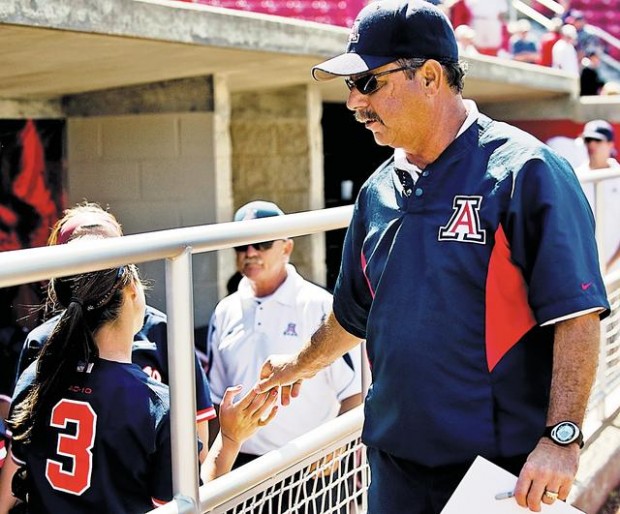
College softball's great motivator sits alone in the third base dugout 30 minutes before Monday's practice. Players go through warm-up drills. Assistant coaches scatter, chatting with player after player. There is activity all around, but Mike Candrea doesn't move.
His legs are crossed. His eyes are hidden behind sunglasses. His expression doesn't change. For 30 minutes, he sits as if the next game is against Louisiana-Lafayette and not against No. 1 Florida in the Women's College World Series.
"You can't get too high or too low," he says. "It's a game of relaxed skills and you've gotta make it relaxed and not life-threatening."
College softball's most successful coach is the Joe Torre of his sport: unflappable and impossible to read.
"A lot of times people say he is too stoic and that he doesn't show emotion," says UA outfielder Lauren Schutzler. "We killed a lot of teams this year and he just stood there."
People are also reading…
Friday night at Stanford, a five-hour ledge-walk during which his team teetered on the brink of elimination, the Wildcats followed their coach's lead. He would not give in to the pressure any more than he would publicly condemn the NCAA for its preposterous decision to send the Wildcats on the road for two weekends of tournament duress.
As former Arizona All-America shortstop Laura Espinoza memorably said after the Wildcats won the 1994 NCAA title, "He is one positive man."
With negative vibes and variables coming at Arizona from all directions, Candrea's never-let-'em-see-you-sweat demeanor made it possible for the Wildcats to embrace the pressure, survive and advance.
"Being on the road all the time has been a good thing," says senior home run slugger Sam Banister. "You can't do your best if you're mad at somebody."
Finally, late in Friday's super regional-clinching victory at Stanford — giving Candrea 20 WCWS berths in his last 20 seasons as Arizona's active head coach — he gave in to the moment. His frozen face momentarily thawed.
"He really knows how to motivate us," Schutzler says. "We're calm when we need to be calm. We're excited when we need to be excited. It really pumps us up when he gets excited. The words of wisdom he gives us is a whole edge that other teams don't have. We went crazy to see him clap his hands and jump up and down."
Says Banister: "It's a whole other world with him; he's has this mystique, something from the softball gods. … Whenever he's around, he's going to make things happen. He can fix your swing at just the right time or he can shift you a little to the left just in time to get a groundball. Like I said, Coach is an amazing man."
It would be fashionable to write that this is the finest coaching performance of Candrea's Arizona years. This much is true: He has never gone into a season with less pitching prowess or as little team speed.
In many of his previous 19 WCWS appearances, Candrea simply outmanned most opponents, but he admitted Monday that he actively worried about this team's ability and potential as much as any he has coached here.
And yet if Arizona wins his ninth NCAA title over the next 10 days, it will surprise no one. It's a lot like the old Bear Bryant qualifier: He can take yours and beat his. And he can take his and beat yours.
Arizona's team ERA is 2.80, worst in the Candrea years by more than a full run. In a low-scoring sport, it's like spotting the opposition a 1-0 lead.
In many years, the Wildcats have been the fastest team in softball. They've stolen as many as 136 bases a year. A bad season is 90. This year they've stolen 29, lowest in Candrea's career. And they still win.
For 20 years, Arizona has been a rally-killing machine because its lineage of All-America pitchers posted ridiculous strikeout totals of 684, 632 and 630. This year, opposing batters have struck out just 310 times. Opposing batters are putting the ball into play almost 50 percent more than ever before.
And yet they still can't keep Candrea out of the World Series.
In Arizona's stirring run to the 2007 national title, in which it stunned Tennessee All-America pitcher Monica Abbott in the championship round, Schutzler saw the other side of Candrea. Her sister, Lindsay, was an All-American at Tennessee.
When then-freshman Lauren arrived at her first World Series, May 2008, Candrea was on a sabbatical as coach of the USA Olympic team. He was at the tournament, but unable to help coach the Wildcats.
"We'd all look up to the area where coach Candrea was sitting, saying, 'talk to us; we want you down here on the field,' " Schutzler remembers.
This time, Candrea is back on the field. Talking is optional. Winning isn't.


