

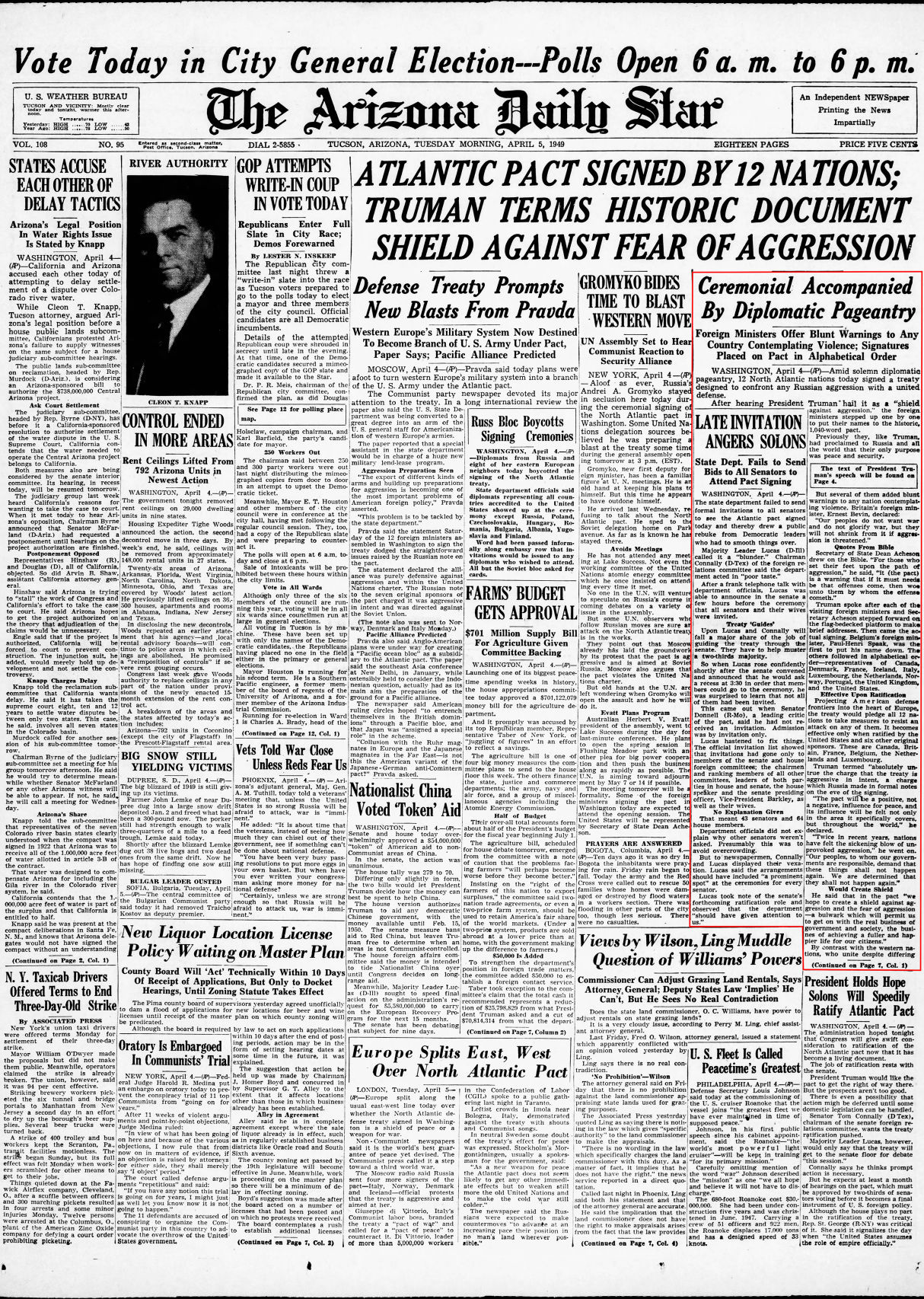
ATLANTIC PACT SIGNED BY 12 NATIONS
Ceremonial Accompanied By Diplomatic Pageantry
Foreign Ministers Offer Blunt Warnings to Any Country Contemplating Violence; Signatures Placed on Pact in Alphabetical Order
WASHINGTON, April 4 ─ (AP) ─ Amid solemn diplomatic pageantry, 12 North Atlantic nations today signed a treaty designed to confront any Russian aggression with a united defense.
After hearing President Truman hail it as a "shield against aggression," the foreign ministers stepped up one by one to put their names to the historic, 1,040-word pact.
People are also reading…
Previously they, like Truman, had proclaimed to Russia and all the world that their only purpose was peace and security.
But several of them added blunt warnings to any nation contemplating violence. Britain's foreign minister, Ernest Bevin, declared:
"Our peoples do not want war and do not glorify war, but they will not shrink from it if aggression is threatened."
Quotes From Bible
Secretary of State Dean Acheson drew on the Bible. "For those who set their feet upon the path of aggression," he said, "it (the pact) is a warning that if it must needs be that offenses come, then woe unto them by whom the offense cometh."
Truman spoke after each of the visiting foreign ministers and Secretary Acheson stepped forward on the flag-bedecked platform to make brief addresses. Then came the actual signing. Belgium's foreign minister, Paul-Henri Spaak, was the first to put his name down. The other followed in alphabetical order ─ representatives of Canada, Denmark, France, Iceland, Italy, Luxembourg, the Netherlands, Norway, Portugal, the united Kingdom, and the United States.
Effective Upon Ratification
Projecting American defense frontiers into the heart of Europe, the treaty would pledge all 12 nations to take measures to resist an attack on any of them. It becomes effective only when ratified by the United States and six other original sponsors. These are Canada, Britain, France, Belgium, the Netherlands and Luxembourg.
Truman termed "absolutely untrue the charge that the treaty is aggressive in intent, a charge which Russia made in formal notes on the eve of the signing.
"The pact will be a positive, not a negative, influence for peace, and its influence will be felt not only in the area it specifically covers, but throughout the world," he declared.
"Twice in recent years, nations have felt the sickening blow of unprovoked aggression," he went on. "Our peoples, to whom our governments are responsible, demand that these things shall not happen again. We are determined that they shall not happen again."
Johanna Eubank is a digital producer for the Arizona Daily Star and tucson.com. She has been with the Star in various capacities since 1991. Contact her at jeubank@tucson.com

Johanna Eubank
Online producer
