

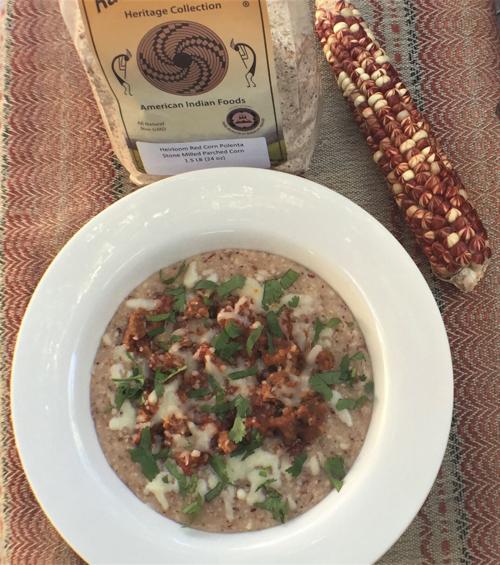
Lately I’ve been craving polenta, and I came across the legendary Ramona Farms’ stoneground red corn polenta in their online store. But it looked like none of Ramona Farms’ Tucson retailers carry it.
On an exquisite Arizona fall morning — brilliant blue skies, cool temperatures — my penchant for polenta inspired a road trip up to Sacaton, where the company is based, to pick up a bag or two. Imagine my delight when I encountered both Terry and Ramona Button, the farm’s founders, in the office.
For more than 40 years, the couple has farmed traditional varieties of wheat, corn and beans on their farm on Gila River Reservation lands. They are internationally known for their contribution to preserving Native American foods.
Terry shared some information about the beautiful red corn with its yellow “chin tattoos,” as he calls them — a variety he calls Supai, named to honor several Supai tribes in Arizona — used to make the red-flecked stoneground polenta.
People are also reading…
We talked about his Supai corn in comparison to other polenta corns I know about, including Floriani, an Italian heirloom. Both are quite high in protein, but Supai’s a bit higher – 28 grams of protein per cup of uncooked polenta, vs. Florian’s 21 grams.
“Supai is a flour corn, while Floriani is a flint corn,” he said. “Flour corns have a thin pericarp, the outer layer that contains the color, and a white endosperm — the interior that grinds into flour. There are many varieties of corn, from flint and dent and flour to various mixes of those. One hundred percent flint corn would be like popcorn.”
But flint corns don’t grow well in the Southwest, he said. “All the landrace corns grown here tend to be soft endosperm, flour-type corns. They variety in maturity, and in taste and sweetness.” Landrace grains have evolved to suit the environment where they’re grown and have been improved by traditional agriculture methods.
All of Ramona Farms’ corn is harvested by hand, Terry said, because the growth habit of the corn is quite different from current hybrids. “The plants are bushier than most modern corn, and the ears tend to form near the bottom or middle of the plant,” he said. “Modern harvesting machines are designed to harvest corn that all has its ears in the same place on the plant.”
Ramona Farms’ polenta has still one more virtue: it’s stoneground. The ancient method of milling grain between two heavy stone disks preserves the grain’s nutrients because the stones stay cool and heat-sensitive nutrients remain intact. By comparison, roller milling is used for mass-market flours and meals; in roller milling, the grain is heated before milling and many vitamins are lost in the process.
I could hardly wait to try this polenta, but it was such a beautiful day that I decided to take the Pinal Pioneer Parkway from Florence back to Oracle Junction, with pause to honor Tom Mix at his memorial on the site where the first Western film star was killed in a crash in 1940.
By the time I finished the scenic drive home, I knew what I wanted to do with the polenta. I would prepare it in a traditionally Italian way but would highlight its uniquely Arizonan provenance with a Southwestern style sauce instead of an Italian ragu or Bolognese sauce. The sauce I developed features Hatch chile bratwurst, cumin, lime juice and cilantro.
And while the oven method of preparing polenta isn’t strictly traditional, I switched to it long ago because I’d rather Netflix and chill while I wait for dinner to be done than stand over a sputtering pot of polenta to stir it constantly.
By the way, if you’d like your polenta to be firm enough to cut into shapes after cooling — so you can fry them or grill them — reduce the water to 3 cups. You can also stir in chopped fresh greens such as spinach or kale, when you add the cheese for even more nutrition.
Arizona’s Own Polenta
Makes 4 to 6 servings
Any kind of bratwurst would work in this dish, but I was going for a zingy sauce, so I used Villa Roma Hatch Chili brats. Hot Italian sausage would give a very different flavor profile but would be just as good. Vegetarians and vegans could substitute plant-based meat for the bratwursts to make this dish.
Ingredients
For the polenta:
1 cup red corn polenta
4 to 5 cups water
1 tablespoon olive oil or butter
1 teaspoon salt
1 cup grated cheese: Queso de Oaxaca or mozzarella
For the sauce:
1 pound bratwursts, removed from their casings
2 14.5-ounce cans diced tomatoes with chiles
1 tablespoon tomato paste
1 teaspoon salt
1/2 teaspoon cumin
Juice of two limes
Chopped cilantro, for garnish
Additional cheese, for garnish
Preparation
Preheat the oven to 350 degrees. Grease a large casserole dish with butter or cooking spray.
Tip the measured polenta into the casserole dish and add the water. Gently whisk in the olive oil or butter and salt, and place into the oven. Bake, uncovered, for 40 minutes.
While the polenta bakes, make the sauce. In a large skillet over medium heat, cook the bratwurst, breaking the links into pieces as they brown. When they’re just shy of being done, stir in the diced tomatoes, tomato paste, salt, cumin and lime juice. Reduce heat to low and simmer until the sauce is thick, 15 to 20 minutes. Keep sauce warm until polenta is finished.
After the polenta bakes for 40 minutes, remove from the oven and whisk in the cheese. Return the polenta to the oven so cheese can melt, about 10 to 15 minutes. It will thicken as it cools.
To serve, spoon the polenta into a bowl and spoon sauce over it. Garnish with cilantro and more cheese and serve hot.
Robin Mather is a longtime food journalist and the author of “The Feast Nearby.” Follow her blog as she writes her third book, “The Feast of the Dove,” at www.thefeastofthedove.com.

