ORANGE, Calif. — Carmen Basu, bundled in a red jacket and woolly scarf, stood outside the headquarters of her local health plan one morning after picking up free groceries. She had brought her husband, teenage son, and 79-year-old mother-in-law to help.
They grabbed canned food, fruit and vegetables, and a grocery store gift card. And then Basu spotted a row of tables in the parking lot staffed by county social service workers helping people apply for food assistance and health coverage. Her mother-in-law, also a Medicaid recipient, might qualify for food assistance, she was told.
“It would be less money for me that I would have to put aside,” said Basu, who has been the sole breadwinner for the family since her husband suffered a stroke. “Maybe I can use that extra money to cover other expenses.”

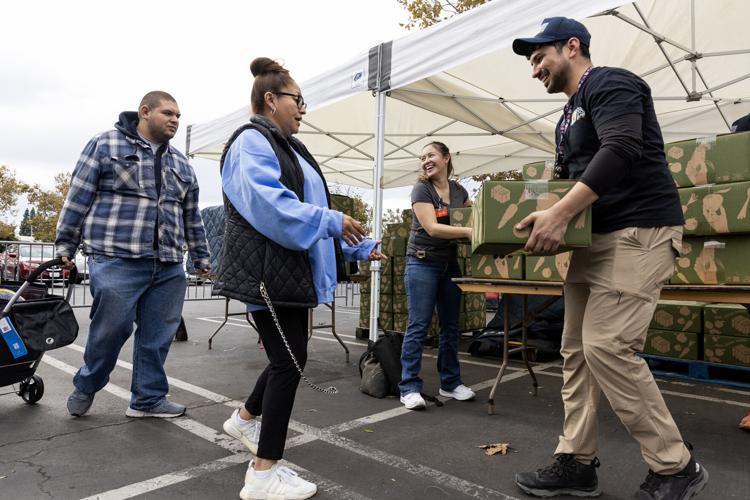
Nina Sicaeros with the County of Orange Social Services Agency, left, helps Carmen Basu apply for CalFresh for her mother-in-law during a Thanksgiving food distribution event on Nov. 22, organized by the Medi-Cal insurer CalOptima in Orange, Calif.
Basu was among the more than 3,000 people who turned up at a November CalOptima event. It marked the start of a $20 million campaign by the Medicaid health insurer to help low-income residents get and maintain health coverage and food benefits as federal restrictions under President Donald Trump’s One Big Beautiful Bill Act take effect.
People are also reading…
The law cuts more than $900 billion in federal funding for Medicaid, known in California as Medi-Cal. It also slashes around $187 billion from the Supplemental Nutrition Assistance Program, or SNAP, known as CalFresh in California. That’s about 20% of the program’s budget over the next 10 years. As a result, up to 3.4 million Medi-Cal recipients and almost 400,000 CalFresh beneficiaries could lose benefits. (Most CalFresh beneficiaries also receive Medi-Cal.)
Republican representatives say the changes, some of which have already taken effect, will prevent waste, fraud and abuse through expanded eligibility checks and work requirements. Yet Medicaid health plans across the nation are bolstering outreach to low-income households in a bid to not lose enrollees, many of whom are already struggling with high grocery and medical costs.
In Los Angeles County, L.A. Care Health Plan launched community information sessions this month to educate the public about upcoming changes to Medi-Cal. Hawaii’s AlohaCare is mobilizing a coalition to help mitigate the impact of Medicaid coverage losses. And Community Behavioral Health, a Medicaid managed-care plan for behavioral health in Philadelphia, plans to host a series of summits to get the word out about the changes.

Sam Flores, far left, and his mom Irene Flores, center left, pick up food from Second Harvest Food Bank team members Clarissa Green and Joey Fonseca-Islas during a Thanksgiving food distribution event on Nov. 22 in Orange, Calif., that also offered assistance with signing up for Medi-Cal and CalFresh.
“We know that these changes will affect a lot of our members,” said Michael Hunn, CEO of CalOptima, one of about two dozen Medi-Cal managed-care plans paid monthly based on their number of enrollees. “We have a great responsibility to make sure that they understand and can navigate these changes as they are implemented.”
CalOptima has allocated up to $2 million through the end of 2028 to pay for county eligibility workers to provide on-the-spot assistance. It’s funding that An Tran, head of Orange County’s Social Services Agency, said can help pay for critical outreach the county otherwise wouldn’t be able to afford.
“We are talking about families who desperately need help especially at a time when food costs and inflation is high and they’re barely able to make it,” Tran said.
U.S. Rep. Young Kim, a Republican who represents part of Orange County, did not respond to a request seeking comment but has said Trump’s signature budget law, which she voted for, “takes important steps to ensure federal dollars are used as effectively as possible and to strengthen Medicaid and SNAP for our most vulnerable citizens who truly need it.” She and other Republicans have said it will provide tax relief for working Americans.
After nearly an hour with an eligibility worker, Basu learned she earned too much for her mother-in-law, who lives with the family, to qualify for CalFresh. Now, Basu said, she’s worried about Medi-Cal eligibility changes for immigrants, which she fears could affect her mother-in-law, who obtained lawful permanent residency about a year and a half ago.
“Before having that, we were paying cash for cardiology, for labs, everything. It was very pricey,” Basu said. “I’m thinking I will have to, in a few months, pay again out of pocket. It’s a lot on me. It’s a burden.”
In most of the nation, people who’ve had a green card for less than five years generally don’t qualify for federally funded Medicaid. However, California has provided state-funded Medi-Cal coverage for them and low-income immigrants without legal status.

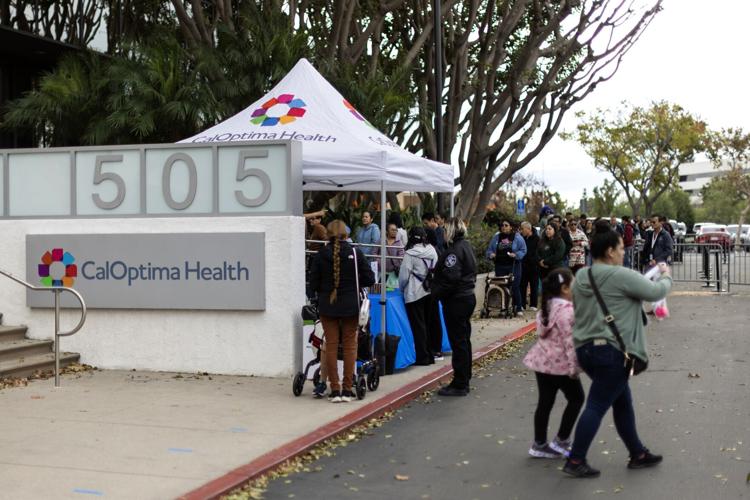
Over 3,000 people attended a food distribution and community resource event on Nov. 22 organized by CalOptima in Orange, Calif. Low-income people are being strained by high living costs, job losses, and worries about changes to food and health assistance programs, local officials say.
But even those benefits are being rolled back amid state budget pressures. In July, the state will eliminate full-scope dental benefits for some enrollees who have had a green card for less than five years, as well as certain other immigrant enrollees. A year later, this group will start being charged monthly premiums.
Starting in January, California will freeze enrollment for people 19 or over without legal status, as well as some lawfully present immigrants.
Meanwhile, the state is drafting guidance for counties on how to implement the federal Medicaid eligibility changes, said Tony Cava, a spokesperson for California’s Department of Health Care Services. The federal work rules and twice-yearly eligibility checks are slated to take effect by the start of 2027, applying to enrollees under the Affordable Care Act coverage expansion.
KFF Health News is a national newsroom that produces in-depth journalism about health issues and is one of the core operating programs of KFF, the independent source for health policy research, polling and journalism.