

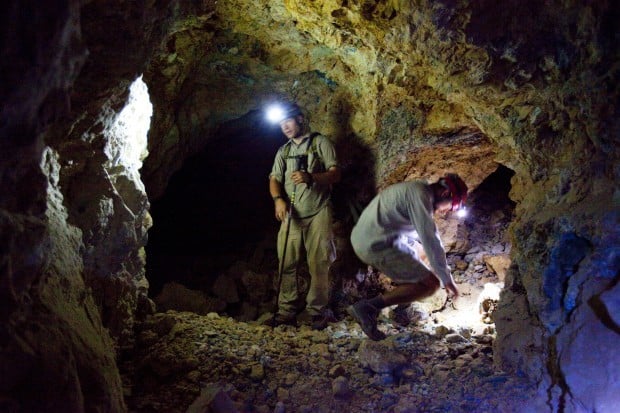
GRAND CANYON - More than 2,100 feet below the rim of the Grand Canyon and swallowed in the redwall limestone of an abandoned copper mine, Jason Corbett shines his single headlamp light around a black corner and then disappears.
With him is Steve Rice, a hydrologist with Grand Canyon National Park who softly calls his name, just to make sure he's still there.
Corbett reappears calmly, remarking how incredible the work ethic had to be among men who labored in these mines with pickaxes and mules more than 100 years ago. He goes on to wonder aloud about what the men's lives must have been like.
"Look here," Corbett says, tracing his finger along the black soot to a small hole covered in wax. "Here's where they had their candles. Can you imagine, working in here by candlelight alone?"
Walking along the rails built for ore carts, Corbett and Rice enter a large room, old timbers and piles of rock stacked high. Tints of green running in veins along the walls hint at the valuable copper still housed here at the Last Chance Mine, which gained international renown for its ore quality.
People are also reading…
"If this wasn't a national park, some company would have come in here and opened this back up for mining," Corbett says.
For all of the 29-year-old's interest in the anthropology of this place, he is not here for human interest alone.
Corbett is a bat man. That is, he is a man of bats. He is the Southwest subterranean program coordinator for Bat Conservation International. It is a mouthful of a title, but at least part of what it means is this: When old mines get shut down and sealed off to protect humans, Corbett makes sure that if bats live there, they get protected.
"Bats have just as much right to be here (on the planet) as humans do," he says. "But they are also an irreplaceable part of the global ecosystem."
Large colonies of bats like the Mexican free-tailed bat, which in summer months inhabit bridges around Tucson, consume hundreds, thousands and even, literally, tons of insects every night, Corbett says. That insect control helps fend off disease and crop damage that would lead to catastrophic events for humans.
Bats also have the most number of species worldwide, next to rodents, he says, with some 1,100 species of bats performing other life-sustaining duties as well. Bats are responsible for seed germination and plant pollination, including in rain forests and for Arizona's iconic saguaro cactus.
"Without bats, those ecosystems can't reproduce," Corbett says.
Corbett's job is to survey mines and assess the presence of bats and other wildlife and, based on his findings, recommend how to properly handle closure if bats are, indeed, present. Depending on his findings, closure methods can include backfilling them with earth, fencing and sealing them with polyurethane foam. When bats are present, Corbett prefers using a bat-gate method, which includes installing steel-barred gates that lock, keeping humans out, but have enough space between the bars for bats to move freely in and out of the mine.
In late September, Corbett and Rice were part of a team that descended onto the Grand Canyon's Horseshoe Mesa, where the Grandview and Last Chance Mines are located, to install steel gates to keep people out and safe. In addition, the gates are bat friendly, so the integrity of the site as an important maternal colony for the Townsend's big-eared bat, Corynorhinus townsendii, can stay intact.
The radon-gas detector strapped to Corbett's chest is a sobering reminder of the need to seal off the mines from humans. They contain high amounts of uranium, which produces the odorless, tasteless and highly radioactive radon that can reach dangerous levels within. Daughter particles of the decomposing uranium can be present in dust and, when breathed in, set up conditions for long-term heath problems, like cancer.
The aging timbers within produce an even more immediate threat - collapse and fall hazards. Corbett says that the mines are full of ladders and bridges that might invite a curious hiker to cross or climb them. Wood that is more than 100 years old might not hold up. The dangers extend to Corbett.
"You can die very easily," Carol Chambers, one of Corbett's former professors, said of the hazards of working in abandoned mines. "Jason will tell you that at times he gets scared, and he should." Despite the perils, Chambers says, that she is confident that Bat Conservation International chose the right person for the job when it created the post of subterranean program coordinator and filled it with Corbett.
And there's no shortage of abandoned mines. Corbett estimates the number in Arizona at between 50,000 and 100,000, many in Southern Arizona, including those in the Santa Rita and Huachuca mountains, where he has worked extensively.
Growing up in Tucson, Corbett became a wanderer early on, spending a lot of time outdoors with his grandfather, father and older brother, he says. "Grandpa liked going for walks, and they lived in the Tucson Mountains."
When he was about 8 years old, Corbett started discovering the hills with virtually no trails. Golden Gate Mountain and Cats Back are some he remembers. He grew up in the Scouts, making Eagle Scout with his Eagle Scout father, Richard, who was his Scout master for much of his youth.
"It's really quite encouraging," the elder Corbett says, "to see your son grow up and accomplish all that he has. I'm very proud."
By age 13, Jason Corbett already knew that he wanted to spend his life committed to working with wildlife.
Corbett served five years in the Arizona Army National Guard, mostly while attending Northern Arizona University in Flagstaff, where he pursued his bachelor's of science in biology with an emphasis in fish and wildlife management.
After graduating, Corbett took a year off from school to work at Grand Canyon National Park before returning to complete a master's degree. The park agreed to fund his master's project. He studied the roosting ecology and foraging patterns of the big free-tailed bat, under the tutelage of Chambers, NAU professor of wildlife ecology .
"He is exceptional in his ability to be prepared, work in field work alone or in teams. He is a very hard-working, intelligent person," Chambers said.
After stints in Maine and in the consulting world, Corbett returned to Tucson and landed at Bat Conservation International. His job includes working in the field doing surveys and making recommendations, and training folks in different government agencies and private citizens about bat awareness.
Of the 47 species of bats that inhabit the United States, roughly half depend on underground habitat at some point in their life cycle, so Corbett's work is of critical importance to the 28 species in Arizona, said Chambers. He is one of just a handful of biologists who survey subterranean habitat in an official capacity, she said.
His job requires doing a great deal of paperwork and, because Bat Conservation International is a nonprofit, he is always looking for funding for projects.
Early on at the organization, he found a way to get funding to return to the Grand Canyon. He dug up some old studies showing the mines in the Canyon needed to be protected and sealed, and he began looking for money. Corbett queried a public relations representative at Freeport McMoRan Copper and Gold, the worldwide mining company with extensive operations in Arizona, about financing a project to install bat gates in the mines.
"It's highly visited, and it's one of the crown-jewel national parks of the world," he says. "I figured, hey, we can get money for this. Someone is going to be interested in protecting this."
Corbett was right. Freeport McMoRan cut a check for $30,000 that "pretty much paid for everything" on this most recent project. The National Parks Service contributed staff time and helicopter transport.
It took the staff about a year to organize and process paperwork needed to do a project in the protected area. The whole point of the Wilderness Act is, according to Corbett, "to manage landscapes to be untrammeled, free and unaltered from human manipulation."
The project would require the use of gasoline generators, prefabricated steel gates, welding equipment, cutting torches, rock drills and grinders, not to mention flying a helicopter in restricted air space. That takes planning and a lot of regulatory paperwork."We have to justify the project," Corbett says.
Then they have to prove that they are using the absolute minimum of tools to reduce the impact.
"It takes a lot of careful planning because you have to list all of the alternatives. We know that we can't use 50 mules to pack everything in and out, but we still have to list it and give the reasons why it won't work".
After completion, the only trace of any work at the mine was the rust-colored gate blending with the red rock.
Back in Tucson where he lives with his wife, Trish, Corbett continues his work. When he is not backpacking and hiking for his job, he enjoys backpacking and hiking, technical canyoneering and military history.
Corbett says his interest in the lives of those who once roamed the mine tunnels has roots in a fascination with the American West.
"It doesn't get much more old West than an old mine in the Grand Canyon," he says.
His post as a conservation biologist is his "best job so far. It's exactly what I wanted to do as a kid." And it has an added bonus: It allows him to pursue what's most important to him. That's not money or prestige, he says, but the preservation of nature and wildlife .

