


PHOENIX — Arizona can't collect two new taxes on cigarettes totaling 82 cents a pack if the purchases are made at reservation stores, Attorney General Terry Goddard said Friday.
In a formal legal opinion, Goddard said Proposition 203, approved by voters last month, was worded in a way that means only off-reservation sales are subject to the new 80-cent tax designed to raise money for early childhood development programs.
Similarly, Goddard said a separate 2-cent tax, approved as part of Proposition 201 to police new restrictions on smoking in public places, also is written to apply solely to off-reservation sales.
He said there is a legal way to apply both levies to sales made at Indian smoke shops, just as was done in 1994 when the tax was hiked by 40 cents, and again in 2002 when an additional 60 cents was tacked on. But that wasn't done here in either case, he said.
People are also reading…
Friday's opinion does more than undermine the $150 million a year that backers of Proposition 203 hoped to raise each year for early childhood development programs and the $5 million for smoking enforcement.
It also creates an $8.20-a-carton disparity between on-reservation and off-reservation prices that may be enough to convince some smokers who now get their smokes locally to instead make the drive and stock up.
Goddard's decision surprised Nadine Mathis Basha, the Chandler resident who put Proposition 203 together. She said it was always assumed that the new tax, approved by voters last month, would apply to all sales throughout the state.
Basha, the former president of the state Board of Education, said she hopes tribes will "voluntarily add tax" and then turn the proceeds over to the state — and eventually over to a new board created to award grants for various programs around the state.
She said that makes sense because Proposition 203 is written so that tribal members can benefit from the health and education programs the tax is supposed to fund.
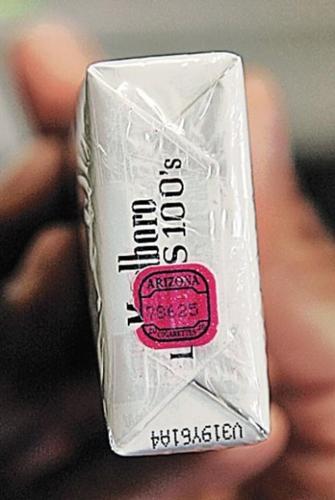
Tribes are free to impose their own sales taxes where state levies do not apply. They purchase special red-colored tax stamps through tobacco distributors to mark products sold on reservations to non-Indians.
But in the past they have earmarked the proceeds for their own programs rather than giving them to the state.
Goddard said there is no requirement for tribes to levy a new tax or, if they do, there's no restriction on how to spend the money.
At the heart of the issue is the language of the ballot measures.
Dan Zemke, spokesman for the state Department of Revenue, said the 1994 and 2002 tax hikes were written as "a tax on the consumer that was pre-collected through the purchase of the tax stamp by the distributor." And the distributors have to purchase those stamps when the cigarettes first come into the state.
But Goddard said both Proposition 203 and 201 impose what in essence is a transaction-privilege tax — one that is the obligation of the retailer to pay. And he said federal law generally precludes the state from taxing reservation transactions, even if the buyers are not Indians.
Most of the proceeds from the 1994 tax pay for health care programs for those who earned too much money to qualify for free health care but earned less than the federal poverty level.
The 2002 levy was designed to help fund emergency health services.
Both those tax increases, while written to apply to reservation sales, also included an opt-out provision: Tribes could impose their own taxes to offset the new state tax. Most tribes adopted that provision, keeping the revenues for themselves.
The Tohono O'odham Nation raised taxes to match the 82-cent increase imposed by Propositions 201 and 203.
Page D7
The Tohono O'odham Nation this week issued a decree that raised taxes to match the 82-cent increase imposed by Propositions 201 and 203, Adam Andrews, executive assistant to Chairwoman Vivian Juan-Saunders, said in an interview.
Pilar Thomas, the Pascua Yaquis' interim attorney general, said that if Arizona Attorney General Terry Goddard ruled that Proposition 203 applied to the tribe, the Pascua Yaqui would raise prices on tobacco products sold on the reservation to match other retailers.
Tribal officials could not be reached for comment on Goddard's Friday ruling.
Patrick Ignacio, owner of the Tobacco Barn at 7310 S. Nogales Highway, said he raised prices at his shop near the Desert Diamond Casino on the O'odham reservation to meet the tax guidelines.
Now, Ignacio hopes the tribe will drop the new levies.
"That would be a real big help for the Indian stores, and would give consumers a big advantage," he said.
Chico's Smoke Shop, 2161 W. Drexel Road, also on the O'odham reservation near South Mission Road, also raised prices for cigarettes to meet the tribal guidelines.
Informed of the attorney general's ruling late Friday, Chico's staff supervisor Donna Martinez also said she hopes the tribe acts to rescind the taxes.
"The people will be ecstatic," she said, adding that some customers complained about the price increases.
— Levi J. Long