

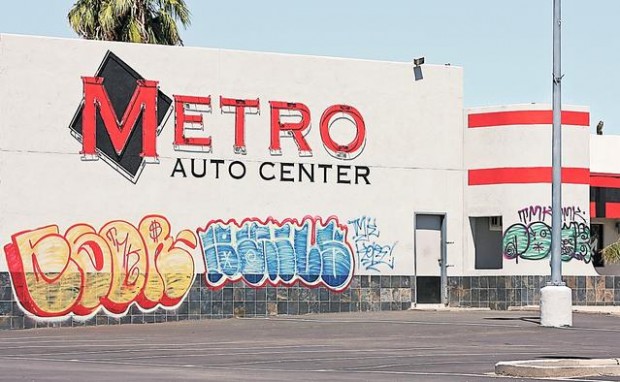

Frustration and uncertainty linger for many customers who purchased vehicles from Metro Auto Center in the used-car dealer's dying days.
Some buyers, or their financial institutions, still haven't received titles for vehicles purchased months ago.
If they bought an extended warranty or additional insurance from the dealer, the premium was never paid, rendering those purchases worthless. And it's unlikely the consumers will have much recourse, a consumer-advocacy attorney said, as the dealership has shut down and its owners filed for bankruptcy.
The Arizona Motor Vehicle Division has received about 50 title complaints against Metro Auto, said spokeswoman Cydney DeModica. The Transportation Department's Office of the Inspector General is investigating each complaint individually, DeModica said.
Limited details are available about the investigations because they are ongoing, she said.
People are also reading…
Metro Auto's owners, Tony-Khalid Salem and Amira Salem, individually filed for Chapter 7, or liquidation, bankruptcy protection on June 22.
Attempts to reach the Salems for comment at their Oro Valley residence were unsuccessful. A telephone number listed for them is temporarily disconnected — as is the number for Metro Auto Center itself.
Their bankruptcy attorney, Scott Gibson, was out of town last week and not available for comment. But in an earlier interview he said the Salems filed individually — as opposed to through their company Metro Auto Wholesalers LLC, which does business as Metro Auto Center — because they had personally guaranteed much of the company's debt.
Gibson has said Metro Auto, which had used-car lots at 4901 N. Oracle Road and 3901 E. Speedway, is working on getting vehicle titles into the right people's hands.
In some cases, the titles have been released, local credit union officials said.
At one point, Vantage West Credit Union had 11 members who had not received titles from Metro Auto, and six of those have been resolved, said Rene Almazan, the credit union's senior vice president of sales.
Hughes Federal Credit Union originally had eight titles that hadn't been delivered, and two of those titles have been released, said Andrew Britton, the lending and collections manager for Hughes.
Both credit-union officials said the situation that arose with Metro Auto is a rarity.
"These dealers dropping off the grid like this happens so infrequently, it's just a risk the buyers and lenders have to take," Britton said.
Consumers who haven't received the titles said they learned the company that finances inventory for Metro Auto never received payment for the vehicles.
Mickey Perry, 55, is one who's still waiting.
He and his wife, Barbara, bought a 2004 Chevrolet Impala late in May, but their lender never got the vehicle's title, and Perry was unable to get ahold of anyone from Metro.
"There's a lot of people who've been damaged," Perry said. "And it's one of those things where you can't even go after the people that harmed you because they've declared bankruptcy."
Perry filed a title complaint with the Motor Vehicle Division and received a letter back that indicated the lien holder, Manheim Tucson, had asserted an interest in the vehicle.
The letter said Perry could request an administrative hearing, file a civil action in Superior Court or file against the dealer's bond.
It also said he may wish to consult an attorney.
Under Arizona law, new- and used-car dealers must obtain a bond, which is used to pay consumer claims should the dealership go out of business. Perry filed a claim against Metro Auto's bond in hopes there might be some cash available so Manheim would release his title.
He got a letter, dated July 29, back from Wisconsin-based Capitol Insurance Company that said the total claims against the bond "far exceeded" its $25,000 sum.
DeModica, the MVD spokeswoman, said the Arizona Legislature increased the required bond amount for dealers to $100,000 a few years ago, but that only affected new dealerships that opened after the law went into effect.
Because Metro Auto was an older dealer, in business before the change in law, it was only required to have a $25,000 bond.
Art Weiss, a consumer advocacy attorney, said the possibility does exist that Manheim could repossess the vehicles if it doesn't get paid for them.
Manheim Financial Services, which provides financial services for used-car dealers and rental car companies, was a secured lender for Metro Auto, a company spokeswoman, Lois Rossi, said in an e-mail.
"By agreement and custom, Manheim retains titles for vehicles it finances until paid for those vehicles," Rossi said. "We have and will continue to deal with third-party claims for titles as appropriate under the law. Otherwise, it is our policy not to comment on pending collection matters."
Other than dealing with the headache of an undelivered title, Perry said he's been satisfied with the car — but that's not the case with everyone who bought from Metro Auto in the days before the business closed shop.
Keith Powell, who owns an agency with American Family Insurance, co-signed with his daughter for a used car early in June. His son had purchased a vehicle about 18 months earlier at Metro Auto and had a positive experience, so he figured it would be worth checking on what the dealer had available, Powell said.
His 22-year-old daughter chose a Chrysler PT Cruiser, the first car she bought for herself.
Powell said he was surprised when Metro Auto shut down quickly after his daughter had signed the documents to buy the car and an extended warranty.
"Closing a business is never something you wake up one day and decide to do," Powell said.
Then he learned from the financing company that it hadn't received the title. On top of that, the car started having mechanical problems, and Powell and his daughter learned that Metro Auto had never sent the premium to the company handling the warranty.
Things got worse, Powell said, when the car's right-front ball joint broke from the axle while his daughter was making a right turn in an intersection.
Powell said the financing company has been able to obtain the title, but there's still the matter of the unpaid premium on the warranty, which leaves him or his daughter holding the bill for the repairs.
Not wanting to pay the cost out of pocket, Powell said they've left his daughter's car sitting — unused — at a repair shop near Tucson International Airport.
It wouldn't have been a problem, he said, if Metro Auto had been upfront about closing its business and sold the car to his daughter "as is." But the company appeared to be a reputable dealer, and he figured it would honor the commitment to pay the premium on the extended warranty.
"All of this could have been rectified with a bit of honesty," Powell said.
As for the unpaid premiums on warranties and extra insurance, there's not much a consumer can do to get that money back, said Weiss, the consumer advocacy attorney. Even though those products cost thousands of dollars, filing a civil suit against Metro Auto and declaring those as damages wouldn't likely lead to much, Weiss said.
"Once an entity goes into bankruptcy, they have monstrous protection, number one," Weiss said. "And number two, they don't have money to give you anyway."
Also, state and federal laws don't do much to protect consumers, Weiss said.
"Caveat emptor — or buyer beware — is very much alive."