

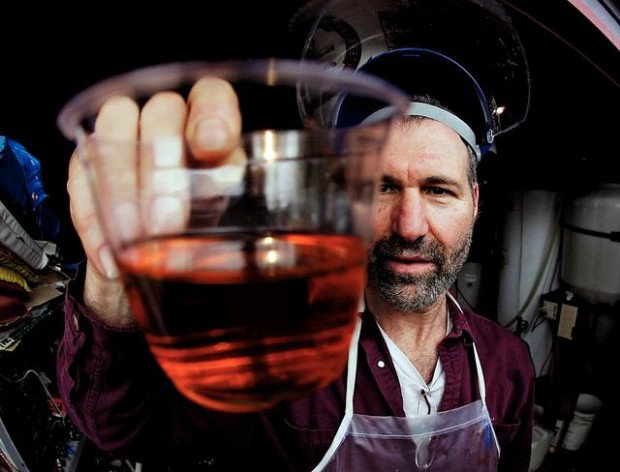
Trying to live green and beat high gasoline prices, some enterprising Americans are turning cooking oil into biodiesel in their garages. The problem is: Some of these do-it-yourselfers are burning down the house.
Fire officials around the country are warning of the dangers and considering new restrictions to make sure people don't torch the whole neighborhood.
Ferocious fires and explosions blamed on backyard refining operations have been reported in Arizona as well as in Washington state, Colorado, Massachusetts and Oregon. No deaths or serious injuries have resulted, but some fire officials say it's just a matter of time.
In the Phoenix suburb of Surprise, fumes from chemicals used to make biodiesel caused an explosion and fire at a home in August.
In Phoenix, officials may restrict residential biodiesel production to properties of 1 acre or more, Fire Chief Bob Kahn said.
People are also reading…
"We're trying not to discourage people from doing it," Kahn said. But "when you're rendering in it in a garage in a family or neighborhood setting, you're exposing an awful lot of people to this potential hazard."
In recent years, many Americans have discovered that diesel cars can run on fuel made primarily from vegetable oil, and about the only drawback is a french-fry smell. Some motorists are going so far as to brew their own fuel from used frying oil obtained from restaurants, which often are glad to get rid of the gunk for little or no charge.
With hundreds of how-to guides posted online and kits for sale, home-brew enthusiasts can get started with less than $500.
Biodiesel is typically made by combining the cooking oil with methanol, or wood alcohol, in a mixture heated to about 120 degrees. But methanol is highly flammable. And frying oil, as any cook knows, can catch fire if it gets too hot or comes into contact with a flame.
The results can be spectacular, particularly in cases where home refiners have stockpiled tanks and barrels of material.
When a barn caught fire in 2006 outside Canby, Ore., "it was a huge column of black smoke unlike anything I'd ever seen in a typical fire," Canby Fire Marshal Troy Buzalsky said. "We had flames that scorched nearby 70-foot trees. It was so hot that it burned aluminum and sagged metal."
The blaze was caused by an electrical short, and the flames eventually ignited a 275-gallon plastic container of fuel.
In Colorado in 2006, a homeowner who was processing a tank of homemade biodiesel forgot to turn off the heating element, and a fire burned the surrounding shed and equipment. Investigators found seven 55-gallon barrels of methanol and other hazardous materials.
In Monroe, near Seattle, chemical vapors caused an explosion last May in an attached garage where a homeowner was brewing biodiesel. Firefighters put out the fire before it caused serious damage.
Find key provisions of Tucson's biodiesel regulations in the online version of this story at www.azstarbiz.com
Local angle
Tucson Fire Department officials say they are concerned about the danger of home-brewed biodiesel.
But regulations for personal biodiesel production are covered under an updated fire code adopted in 2006, and no new regulations are being considered at this time, said Dan Uthe, the Fire Department's deputy chief and fire marshal. (See fire-code summary below)
Uthe said the department has responded to a few biodiesel fire calls in the last couple of years, but no injuries have been recorded.
"If they follow the fire code, there shouldn't be a problem," Uthe said.
The fire code limits the amount of methanol and other hazardous ingredients that may be stored and prescribes storage and handling procedures, among other requirements.
The Northwest Fire/Rescue District has similar fire-code requirements, spokesman Capt. Adam Goldberg said, adding that he's aware of only one non-injury fire involving a home biodiesel producer in the last few years.
Uthe said he and other Southern Arizona fire marshals met with the a local biodiesel group, the Arizona Biodiesel Board, last fall to discuss biodiesel safety issues.
Uthe said his department is reluctant to impose new rules that may be impossible to effectively enforce.
Typically, fire officials find out about a home-brew setups only from neighbors' complaints or from 911 calls, Uthe said, adding that he was unaware of any current move by other local fire districts to increase biodiesel regulations.
Northwest Fire's Goldberg also said the district has no current plans to add to existing regulations governing biodiesel.
— David Wichner